
James P. Johnson (4)
In Search of "Carolina Shout"
James P. Johnson Week
Part one: The new book Speakeasies to Symphonies: The Jazz Genius of James P. Johnson by Scott E. Brown, and a reprint of the substantial interview of James P. Johnson by Tom Davin
Part two: Mike Lipskin on stride piano; two tracks from “The Beetle” and a session from Willie Gant; favorite tracks from a few other more famous names
Part three: A basic guide to the first two decades of James P. Johnson solo recordings, plus a couple of historical photos
Part four: In Search of “Carolina Shout”
Coda: “Poet and Peasant Overture” and other light classics circa 1910
Part four
New upload: A score follower video of James P. Johnson’s “Carolina Shout” with my light transcription.
I have added this transcription to the collection I share with my students.
Ethan Iverson Teaching PDFs [dropbox link]
includes
Original Sheet Music of Two Dozen Jazz Standards
Theory of Harmony
Bird is the Word
Doodlin’
Core Repertoire
21 Cramer Studies Taught by Beethoven
Bud Powell Trifecta
Trane ’n Me (by Andrew White)
Dohnanyi first three pages (polyphony) + accents (bebop)
Carolina Shout (two versions)
(If you want to share the dropbox further that’s fine, just encourage the recipients to sign up for Transitional Technology.)
James P. Johnson recorded “Carolina Shout” several times, with four of the solo or duo performances being intended for commercial release. Two were piano rolls and two were records.
Artempo Piano Roll 12975 (1918)
QRS Piano Roll 100999 (1921)
1921 solo for OKeh
1944 duo with drummer Eddie Dougherty for Decca
There are also studio band recordings and live solo performances, including at Carnegie Hall in 1938 for the John Hammond evening of “Spirituals to Swing" and a rare 1944 aircheck with a spoken introduction by Eddie Condon. None are the same, and sometimes the differences are reasonably radical. There’s clearly no one way that Johnson played “Carolina Shout.”
In Black Bottom Stomp, David A. Jasen argues convincingly that the second piano roll (the one made in 1921 for the bigger company QRS) was the one that mattered the most, at least in terms of shaping jazz history. Duke Ellington explained how he learned this version in Music is My Mistress:
Percy Johnson was a drummer and a buddy of mine. His nickname was “Brushes.” One day he invited me over to his house just across from that sign shop on T Street.
“You’ve got to listen to this,” he said when we got there.
He had a player-piano and he put on a roll by James P. Johnson. This was, of course, an entirely new avenue of adventure for me, and I went back there every day and listened. Percy slowed the mechanism down so that I could see which keys on the piano were going down as I digested Johnson’s wonderful sounds. I played with it until I had his “Carolina Shout” down pat, and then Percy would go out on the town with me and show me off. I really had it perfect, so that when James P. Johnson himself came to Washington to play at Convention Hall my cheering section and pals waited until he played “Carolina Shout” and then insisted that I get up on the stand and cut him!
I was scared stiff, but James P. was not only a master, he was also a great man for encouraging youngsters. He went along with the whole scene, and when I finished “Carolina Shout” he applauded too. I didn’t play any more that night but just leaned over the piano and listened to the one and only. What I absorbed on that occasion might, I think, have constituted a whole semester in a conservatory.
The sheet music was published in 1926 by Clarence Williams in a folio that apparently included a few other Johnson pieces: “Keep Off the Grass,” “Jingles,” and “Scalin’ the Blues.” I have never seen the folio, it is very rare, but the individual pieces have been uploaded by an angel to IMSLP. “Carolina Shout” is the only one of the four described as a “Negro Classic,” the others are described as “Novelty Solos.”
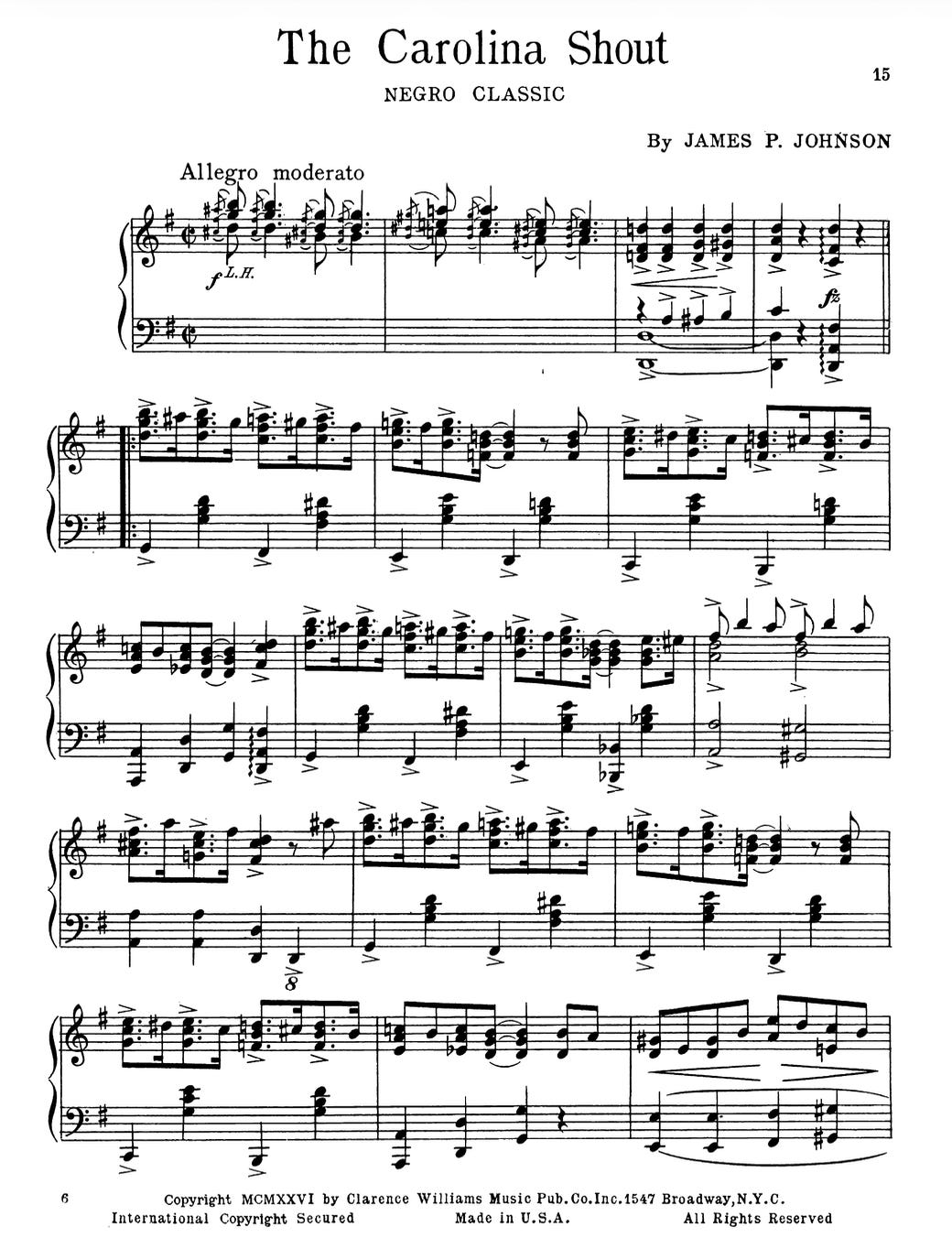
This official sheet to “Carolina Shout” is really but a vague simulacrum compared to a Johnson recording. Some believe Johnson’s scores were simplified for the amateur in the manner that Jelly Roll Morton’s published scores were also apparently simplified for the amateur. Perhaps writing out what they actually played was also simply too time consuming, especially when Johnson and Morton were going to change it a bit by next week anyway.
There’s also a parallel thought experiment: Would Chopin and Liszt have bothered notating so much nerdy filigree if they could have recorded their daily improvisations? Or to bring it a bit closer to home: Scott Joplin’s own piano roll of “Maple Leaf Rag” has additions not marked in his score. Indeed, for some professional ragtimers, a playing Joplin “straight” is the hallmark of an amateur.
This basic sheet of “Carolina Shout” has influenced my fresh edit of a transcription done some time ago, and I have added the score as an addendum to my transcription in the dropbox. However, as far as I know, this formerly rare piece of sheet music has never been that relevant to any jazz professional and those 100+ recordings mentioned in the previous post. The earlier jazzers worked with the 1921 piano roll and the 1921 record, although later players also may have consulted a transcription of the 1944 version of “Carolina Shout” (where Johnson duos with drummer Eddie Dougherty) by Dick Meares and David Le Winter.
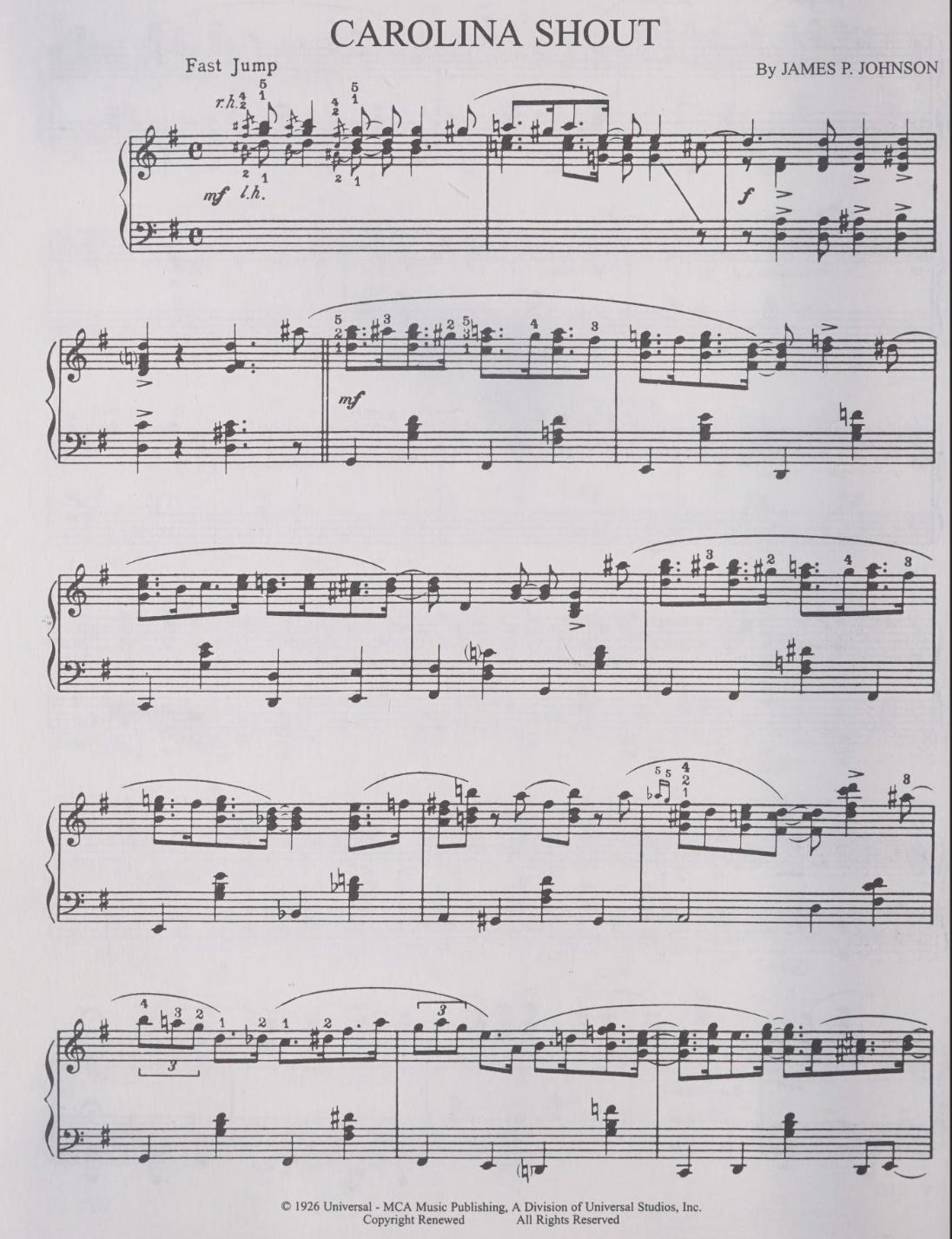
That ‘44 transcription was part of the folio Piano Solos by James P. Johnson, which also had ‘44 “Keep Off the Grass,” “Riffs,” “Snowy Morning Blues,” and “Over the Bars.” These transcriptions are not perfect: In addition to questionable note choices, usually Meares and Le Winter run out of steam before the record does. Later on, the Meares/Le Winter transcription was reprinted (without attribution) in the popular Hal Leonard anthology Jazz, Blues, Boogie, and Swing, and thus is somewhat common currency: When I heard the great Stanley Cowell play “Carolina Shout,” it was clear that Meares/Le Winter was his starting point. Since the score is not marked a transcription, it would be easy enough to assume that the page was Johnson’s own score, which it is not.
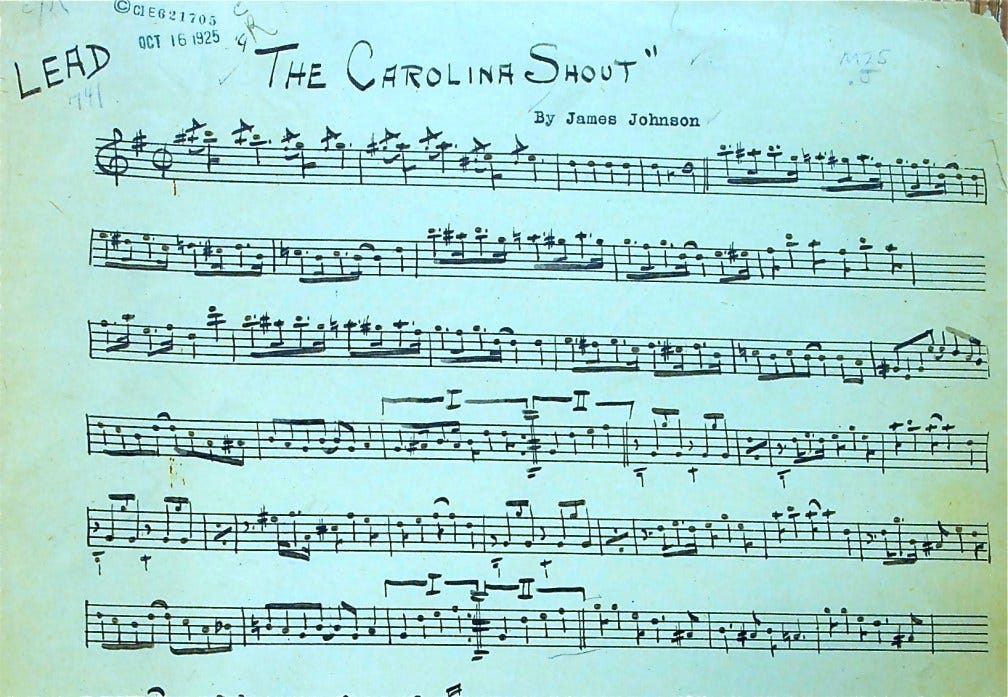
I would love to go back in time and grill James P. Johnson. What was his rationale for what he wrote out for publication? (I literally want to point to certain bars and ask why they aren’t syncopated like other similar bars.) How did he see his scores in relation to Joplin and Gershwin scores? What did he think of the Meares/Le Winter transcriptions? What did he like to sight-read at home? What kind of sheet music did he bring to a record session — for example, was there paper at hand for all those marvelous duos with Bessie Smith? What about his symphonic work? In my opinion, those large-scale pieces (such as Yamekraw and Harlem Symphony) will only be successful if the work is let off the leash, with a fearless music director willing to embrace the avant-garde and section leaders given room for improvisation and elaboration. (What would he say to that presumptuous declaration??)
Would he be surprised to learn I was handing out transcriptions and scores to “Carolina Shout” to students in 2026, over 130 years since his birth?
The only thing I know for sure is that notation was important, and important not just to James P. Johnson, but to a whole lost world of black entertainment that once thrived in New York.
I have been following and enjoying your writing (and playing!) for years. I am a pianist and teacher here in DC, and I was pleasantly surprised to see you give credit to Clarence Williams. I presented a research paper to the IAJE conference in the early 2000s on Clarence Williams; I was attempting to respond to what I felt was a lot of criticism and negativity directed at him in jazz literature of the time. I argued that he should be viewed as a player/entrepreneur who was composing, publishing, and producing jazz from the beginning.
As for the actor, funny story: I was on a funk gig at the time and told the bassist that I was researching Clarence Williams and he immediately responded “yeah, he was Prince’s father!” I wasn’t aware…must have been very early internet days.
Thanks for everything, best regards Jon Ozment
On my way into NYPL Library for the Performing Arts in Lincoln Center this morning I noticed three marble three-step stairs that have been placed next to the stone "seats" (ledges) on the north side wall of Metropolitan Opera House. One has the name James P. Johnson, with the names of Benny Carter & Herbie Nichols on the other two stairs. No clue why these have been placed there, nor how these musicians were chosen for the honor. Must be an omen, and worth a photo if you're in the area.