
James P. Johnson (3)
A basic guide to the first two decades of solo recordings + a couple of historical photos
Names frequently happen after the fact. In the extensive Tom Davin interview, James P. Johnson does not use the word “stride.” He refers to his piano music as “ragtime.”
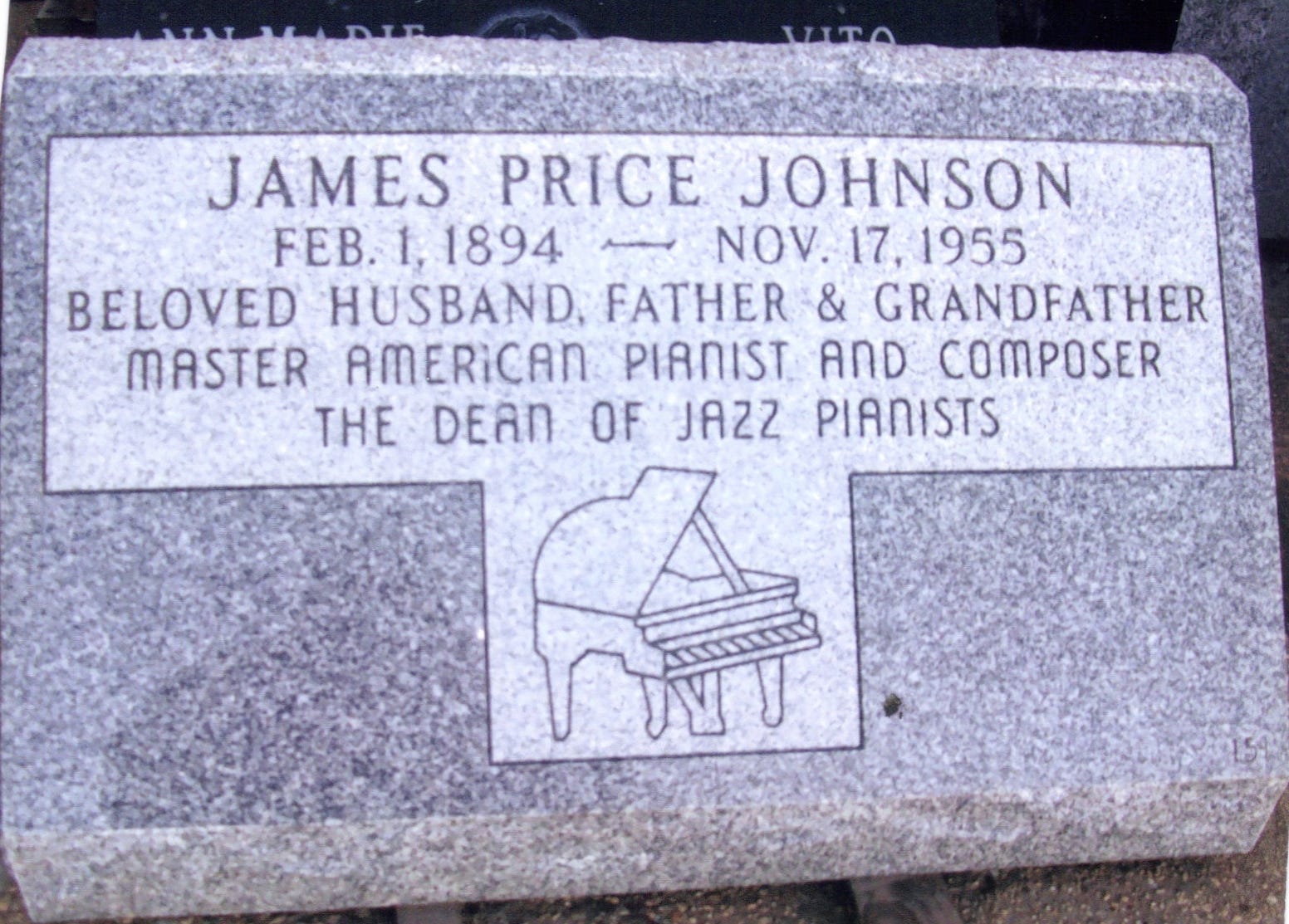
Scott Joplin’s music came out of Sedalia and St. Louis. Jelly Roll Morton’s music came out of New Orleans. James P. Johnson was third in the timeline, and he was the first New York pianist, the one from which we all descend from, whether we know it or not. Johnson liked to be known as the Dean of Jazz Pianists, and after Spike Wilner led the fundraiser “The Last Rent Party” in 2009, that’s what went on the tombstone. (Previously Johnson was buried in an unmarked grave.)
The early 1920s were when black musicians were first regularly documented on 78, and thus the James P. Johnson discography begins within a year or two of Eubie Blake and Jelly Roll Morton.
“Harlem Strut” (9/21) Most of James P. Johnson’s early piano music is now known as the apotheosis of Harlem Stride. Usually there is a sequence of themes in the Joplin manner, with a concluding “trio” that goes up a fourth. “Harlem Strut” is in cheerful C major, with a twisty F major section to take it home.
“Keep Off the Grass” (10/21) The first strain of “Keep Off the Grass” has a mysterious chromatic “thumb line” (the lower note of the dyads and chords) that, if isolated, would be just like Thelonious Monk. The last strain and its variants are made up of falling diminished chords. After nearly a century of increasingly advanced jazz harmony, it’s hard to hear parallel diminished chords as provocative today. In 1921, though, James P. would have meant those diminished sequences to mean uncertainty and perhaps even sadness, the tear beneath the smile.
“Carolina Shout” (10/21) Johnson’s finest recording of his most famous instrumental work. David A. Jasen makes the astute observation that the themes get funkier as they go along. Duke Ellington learned “Carolina Shout” from the earlier Johnson piano roll, and it would go on to be recorded by Fats Waller, Willie The Lion Smith, Art Hodes, Donald Lambert, Dick Wellstood, Dick Hyman, Terry Waldo, Judy Carmichael, Marcus Roberts, Helen Sung, Stephanie Trick, and over 100 others.
We don’t know who invented what or when in the 19th-century, but for the 20th-century piano players, the blues occurred after ragtime. Someone like Eubie Blake always considered the blues a modern fad.
For the next four pieces from 1923, James P. seems to be keeping up with the times by investigating the conceit of “piano roll blues,” for they are mostly 12-bar forms and have the kind of constant chattering repetition common to most piano rolls. (This would be right around the time that piano rolls were on their way out in terms of commercial viability as that medium started losing ground to recordings.)
“Weeping Blues” (6/23) Wide-ranging melodies and a fat beat. At a medium tempo like this, Johnson’s left hand suggests a full orchestra.
“Worried and Lonesome Blues” (6/23) This one especially sounds like a piano roll, with the verse constantly articulated in repeated triplets. There’s some fun two-handed “middle of the keyboard” interjections in the multiple blues variations. My favorite of this set.
“You Can’t Do What My Last Man Did” (7/23) A blues in feeling but not in form. Again, the “piano roll triplets.”
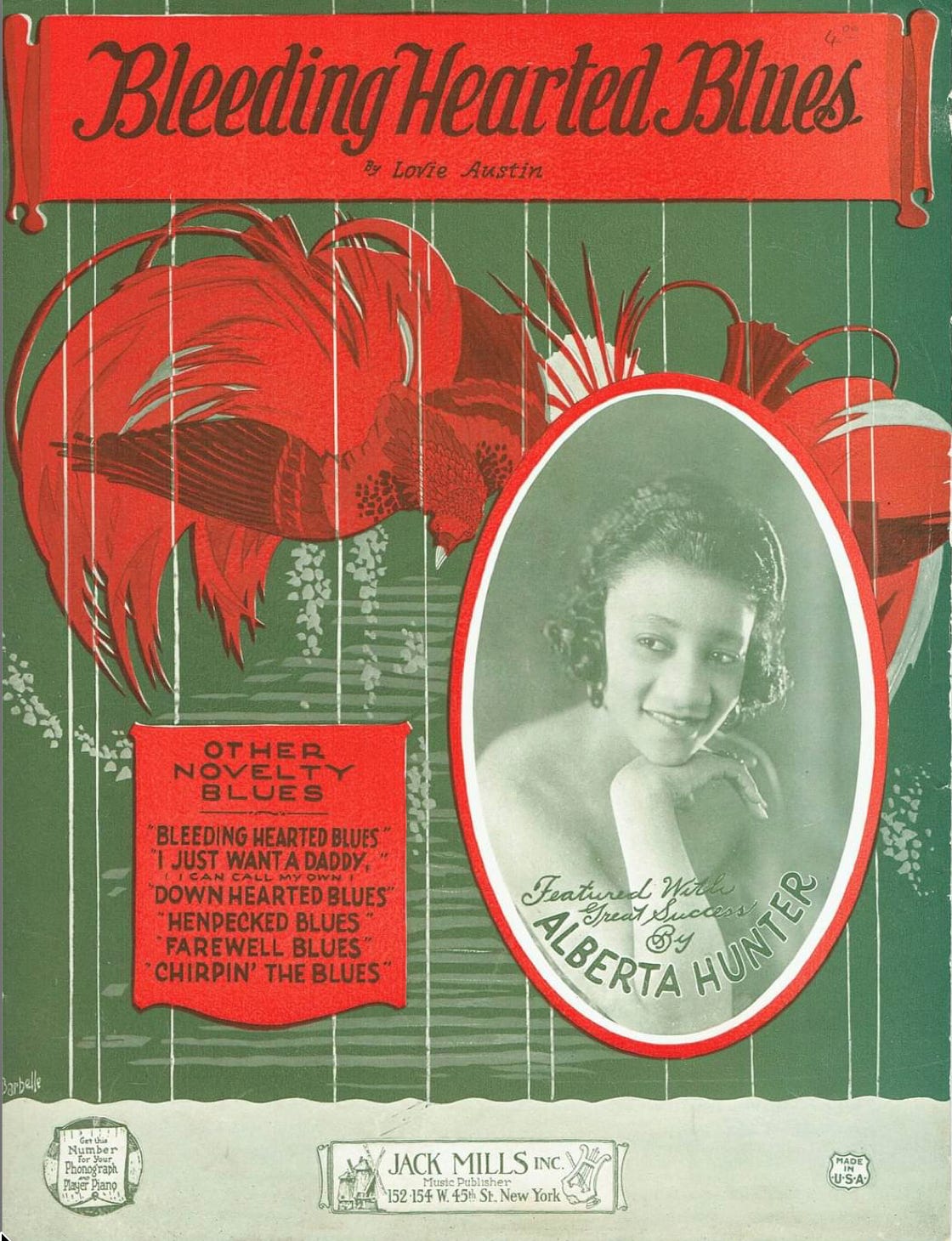
“Bleeding Hearted Blues” (7/23, comp. Austin) Bessie Smith recorded this Lovie Austin composition with Fletcher Henderson on piano, although the cover of the sheet music cites Alberta Hunter.
Johnson’s right hand owns this one with big chords and aggressive punches throughout.
“Scouting Around” (8/23) A “break” begins every blues chorus. Eventually Johnson modulates up a fourth and explores some harmonic subtleties.
“Toddlin’” (8/23) The loping right hand figures are probably connected to the “novelty piano” style of Zez Confrey. As the track goes along, Johnson breaks up the 4/4 stride into 3/4 and 5/4, a famous effect.
It’s great blues playing, although not everyone thinks so. In 1958, Dick Wellstood wrote in the Jazz Review:
James P.’s blues were not too successful, except for Backwater Blues and a few others. He certainly was not a blues pianist in the same way that someone like Jimmy Yancey was. He plays blues much in the same way that he plays a tune like Blue Turning Gray Over You, and his blues suffer for it.
This trope is explored further by Gunther Schuller in his influential 1968 book Early Jazz:
Johnson’s playing for Bessie Smith…also leaves the nagging impression that his interests in commercial music and a “classical” repertoire closer to semi- or light classics had left its imprint on his playing. One might say that he played his blues very much the way he would play a show or pop tune.
Art Hodes gave his take in the liner notes to an Edmond Hall reissue (the track is 1943’s “Blues at Blue Note”). Unlike Wellstood or (especially) Schuller, Hodes is inside the community, and his criticism has less authoritarian sting:
James P. takes a chorus. I regard Jimmy with reverence. He was Big Daddy (although this tempo blues wasn’t his bag) and if you listen there’s always something you can learn from his playing.
Schuller’s claim that Johnson doesn’t understand genre is particularly irritating. Johnson told Tom Davin:
We moved from Jersey City to New York in 1908 when I was 14. We had a piano in the house again. In Jersey City I heard good piano from all parts of the South and West, but I never heard real ragtime until we came to New York. Most East Coast playing was based on cotillion dance tunes, stomps, drags and set dances like my “Mule Walk Stomp,” “Gut Stomp,” and the “Carolina Shout” and “Balmoral.” They were all country tunes. In New York, a friend taught me real ragtime. His name was Charley Cherry. He played Joplin. First he played, then I copied him, and then he corrected me.
(…)
In New York I got a chance to hear a lot of good music for the first time. Victor Herbert and Rudolph Friml were popular.
(…)
From 1910 on, Handy’s blues were played in cabarets. Mannie Sharp, a singer and dancer, and Lola Lee, a blues singer, taught me Handy’s blues in 1911… Memphis Blues, St. Louis, and later Beale Street and Yellow Dog. Before that, there were “natural blues” sung on southern waterfronts, in turpentine camps, farms, chain gangs. Leadbelly and Ma Rainey were singing “natural” 12-bar blues that were developed from the spirituals.
It is all pretty obvious when glancing at the published scores to some of Johnson’s most famous themes. “The Charleston” is a dance from Carolina, “Old Fashioned Love” is a hymn-like pop song that is next door to Victor Herbert, and “Worried and Lonesome Blues” is blues that looks just like the pieces in a W. C. Handy folio. None of them are ragtime in the manner of the sheets to “Carolina Shout” or “Keep Off the Grass.”
Johnson studied the blues, he knew what the blues was, and he used it for specific reasons. This was true of most of the New York piano players. The legendary music mogul John Hammond heard James P.’s solo piano version of “Worried and Lonesome Blues” when it was first released in 1923 and said it “changed his life.”
It was five years before Johnson recorded solo again. The improvement in recording technology is noticeable, and the piano for the 1927 session is excellent.
“All That I Had Is Gone” (7/27, comp. Bradford) Perry Bradford was a mover and shaker for Johnson in those days, and Johnson recorded a fair amount of Bradford in band settings. “All That I Had Is Gone” is an attractive blues-based pop song in mid-tempo C major. When playing marching quarter notes, the left hand articulates not just octaves but the fifths the middle, emulating the overtones of a bass drum, making the keyboard that much more percussive. (Jelly Roll Morton did this also.)
“Snowy Morning Blues” (7/27) Perhaps James P. Johnson’s finest melody in his best recording, a perfect blend of black folklore and American pop song.
“Riffs” (1/29) A B-flat blues with breaks that also mixes with a non-blues E-flat theme. It seems to be an update on what he was working on with “Scouting Around,” now with truly outlandish displacement of the beat.
“Feelin’ Blue” (1/29) Begins with the folkloric B-flat changes that Sonny Rollins also took for “Doxy.” The right hand phrases with unusual freedom in the minor-key section.
The next session is from the dawn of the next decade.
“Crying for the the Carolines” (1/30, comp. Warren) Harry Warren’s E minor ditty is still known just because of this performance. Perhaps James P. played it because of its reference to his beloved Carolina. After the whole piece being in minor, Johnson cheekily ends with two bars of major.
“What Is This Thing Called Love?” (1/30, comp. Porter) Cole Porter’s famous tune was brand new at the time of this recording., and Johnson record demonstrates how jazz musicians in 1930 thought about pop songs. If you look at Cole Porter’s published sheet music you can see exactly where Johnson is coming from, which is also true of Warren’s “Crying for the the Carolines” and Austin’s “Bleeding Hearted Blues.” Johnson plays the verses, and eventually bases his improvisations closely on the melody.
In a related topic: There is a later James P. studio record of George Gershwin’s “Liza” that is just great, and apparently this song was a long-term Johnson cutting-contest speciality. Indeed, a lo-fi live document of Johnson goofing off to impress his peers at Fats Waller’s house is simply extraordinary. I think Art Tatum could take him, but not Fats or the Lion. No way.
“You’ve Got to Be Modernistic” (1/30) For Johnson, “Modernistic” seems to mean the whole tone scale and the corresponding augmented triad. This is in the Confrey “novelty” tradition until the third theme in D-flat, where James P. settles down to do some serious swinging. The beat does push, but this was normal for the era. The clanging minor seconds show just where Thelonious Monk comes from.
“Jingles” (1/30) An earlier ragtime piece in bright F major. It’s not just the speed, it’s the meaty touch that is so important. James P. Johnson will always be the gold standard for the stride “feel.”
The next solo session is from from nine years later.
“If Dreams Come True” (6/39, comp. Goodman/Sampson) Duke Ellington said that when James P. Johnson took over the keyboard at a rent party, “Then you got real invention – magic, sheer magic.” The tune is quickly discarded and the variations unroll. These variations seem like they could keep coming forever, like “magic.” Later on in the track we hear one of the most fabulous aspects of Johnson’s late style, “displaced bells” in the right hand, where big chords are splashed out at irregular intervals while the left keeps pumping away. It’s quite modern, really. Jason Moran uses this kind of thing without sounding old-fashioned in the slightest.
“Fascination” (6/39) Reminiscent of an earlier ragtime-style piece, although by this point James P.’s phrasing is more relaxed. Double thirds in the left hand are notably uncommon.
“A Flat Dream” (6/39) The first and best boogie-woogie record from Johnson. It’s a minor masterpiece: the first A-flat themes are memorable, then, presto! The 32-bar Db-flat tune has two incarnations, first as chimes over a cello, then as authentic Harlem stride.
The boogie bass Johnson uses is not a particularly hard one. Most pianists would consider the stride in the last chorus harder than the gently rocking boogie figure. But it doesn’t seem like Johnson had played boogie that much. Boogie-woogie was popular at the time, almost everyone made a boogie record or two whether they were boogie masters or not.
At any rate, it is of pianistic interest to note that Johnson muddles the boogie figure a little bit: not badly, but he probably could have used another take to work on getting the feel right. The stride in the last chorus is perfect.
“The Mule Walk” (6/39) This is a folkloric shout or “ring dance” from Carolina, and a great one, too.
“Lonesome Reverie” (6/39) Like “A Flat Dream,” this performance has an unusual form. After two choruses of lovely slow blues in G, Johnson shifts to C and gives us a beautiful 32-bar tune with a rich harmonization worthy of Ellington. Then up to E-flat for some variations and a hint of stomp.
“Blueberry Rhyme” (6/39) One of Johnson’s prettiest pieces, reminiscent of “Snowy Morning Blues” but slower and sadder. Wonderful ornamentation in the melody. There is also a great live version captured at the John Hammond “From Spirituals to Swing” concert the same year.
There is a lot of later James P. Johnson solo piano on record, but after his first stroke in 1940 his mechanism slowed down a bit. Beautiful tracks include a purely Harlem “Gut Stomp,” a richly-harmonized version of “Sweet Lorraine,” and a hard-charging rendition of “Caprice Rag” that sounds like it is 1920 again. By default, everything James P. recorded is important, especially unusual items like the extended composition “Yamekraw,” the Cuban-influenced “The Dream,” and the Harlem-ized Joplin of “Maple Leaf Rag” and “Euphonic Sounds.”
When I first worked on this essay in 2009 I simply owned what I could find in commercial issue. But things keep turning up in the streaming era. Johnson was in notably good form playing Bessie Smith’s “Backwater Blues” at Alumni Gymnasium at Hamilton College in Clinton, N.Y. The uploader says 1949, while Lord has May 3, 1947.
Duos with Bessie Smith
From early 1927 until mid-1930 Johnson recorded 14 duets with Bessie Smith: “Preachin’ the Blues,” “Backwater Blues,” “Sweet Mistreater” “Lock and Key,” “He’s Got Me Goin,’” “It Makes My Love Come Down,” “Wasted Life Blues,” “Dirty No-Gooders Blues,” “Blue Spirit Blues,” “Worn Out Papa Blues,” “You Don’t Understand,” “Don’t Cry Baby,” “On Revival Day,” and “Moan Mourners.” (On the last two selections Smith and Johnson are joined by a small male gospel choir, the Bessemer Singers.)
This is Johnson in prime condition playing with the most celebrated singer of the era. The visions-of-Katrina “Backwater Blues” is on every Smith compilation, but most of the other music is not well known, and rarely assessed as a discrete body of work.
The songs are mostly blues or blues-inflected pop ranging from the death and gloom “Blue Spirit Blues” to the erotically charged “It Makes My Love Come Down,” the tuneful “You Don’t Understand” and the sanctified numbers with the Bessemer Singers.
Naturally, the music is a showcase for Bessie’s astounding rhythmic flexibility and swing. She also makes any lyric at all seem like inevitable truths. (From “No Gooders Blues”: There are 19 men in my neighborhood/There are 19 men in my neighborhood/18 of them are fools and one ain’t no good.) Johnson doesn’t get much solo space but he plays out the whole time, swinging like crazy and sounding like a full band. Whatever the source material was, it was undoubtedly fairly basic. Johnson creates veritable rhapsodies out of nearly nothing. These tracks may actually showcase Johnson’s rollicking time feel better than many of his piano solos. He was veteran of countless shows and revues and knows just how to take care of the soloist. Those like Gunther Schuller who say that James P. Johnson couldn’t play the blues can go climb a tree.
James P. was a big man who played a lot of keyboard with those massive hands. Bessie’s voice could raise the roof. Their mission together is pride, rhythm, and love.
From the historical files
The original press blast of the event at Smalls 17 years ago:
James P. Johnson’s Last Rent Party!
Smalls Jazz Club
October 4th, 2009James P. Johnson, the father of stride piano, the composer of The Charleston and The Carolina Shout and one of the founders of modern jazz piano lies, shockingly, in an unmarked grave in Maspeth, Queens, Mt. Olivet Cemetery.
Please join the James P. Johnson Foundation, a not-for-profit organization dedicated to music education and to raise the awareness of James P. Johnson, the Johnson family and Smalls Jazz Club for an all day “rent party” to raise money to buy a monument to commemorate this great musician!
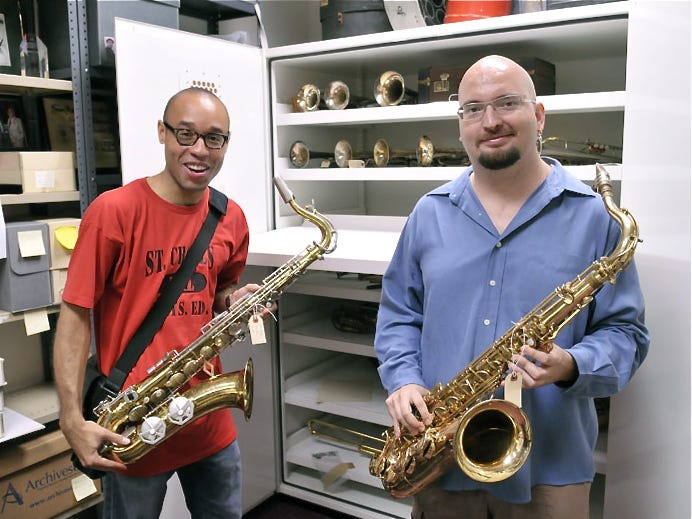
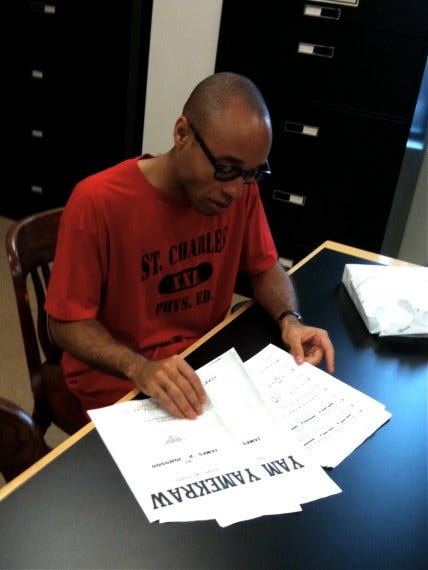
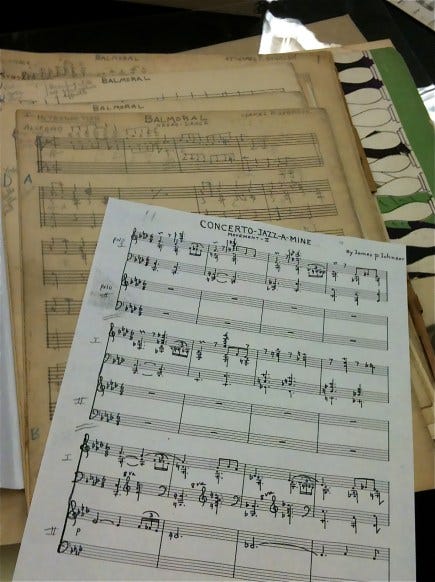
Join us on Sunday, October 4th beginning at 1:00 PM at Smalls Jazz Club located at 183 West 10th street at 7th Ave. The afternoon will begin with a symposium by musicologist and Johnson scholar Scott Brown on the life and work of James P. Johnson. This will include an exhibit from the James P. Johnson archive housed at the Rutgers Institute for Jazz Studies.
Around 3:00 will then be a steady stream of pianists to play solo piano in tribute to James P. Johnson.
Suggested tax-free donations are $20 with all the proceeds to go to the James P. Johnson Foundation. You may come and go as you please throughout the afternoon. Refreshments will be served.
Please come by and pay your respects to The Dean of Stride Pianists!
1:00 PM Doors Open
1:30 PM Opening Words – Barry Glover and The James P. Johnson Society
2:00 PM Symposium – James P. Johnson: The Man Who Made The Twenties Roar – Scott E. Brown
3:00 PM Symposium – James P. Johnson: Invisible Pianist of the Harlem Renaissance – Mark Borowsky
4:00 PM J Michael O’Neal and Natalie Wright
4:30 PM John Bunch
5:00 PM Tardo Hammer
5:30 PM Conal Fowkes
6:00 PM Terry Waldo
6:30 PM Spike Wilner
7:00 PM Ethan Iverson
7:30 PM Mike Lipskin
8:00 PM Aaron Diehl
8:30 PM Ted Rosenthal
9:00 PM Dick Hyman

Thank you for the series. Living history. Marvelous.
"Go climb a tree," indeed. I've always been obsessed with James P.'s playing on "He's Got Me Goin'." Some of the finest piano accompaniment there is.