
James P. Johnson (1)
Scott E. Brown's new book and the JPJ interview with Tom Davin
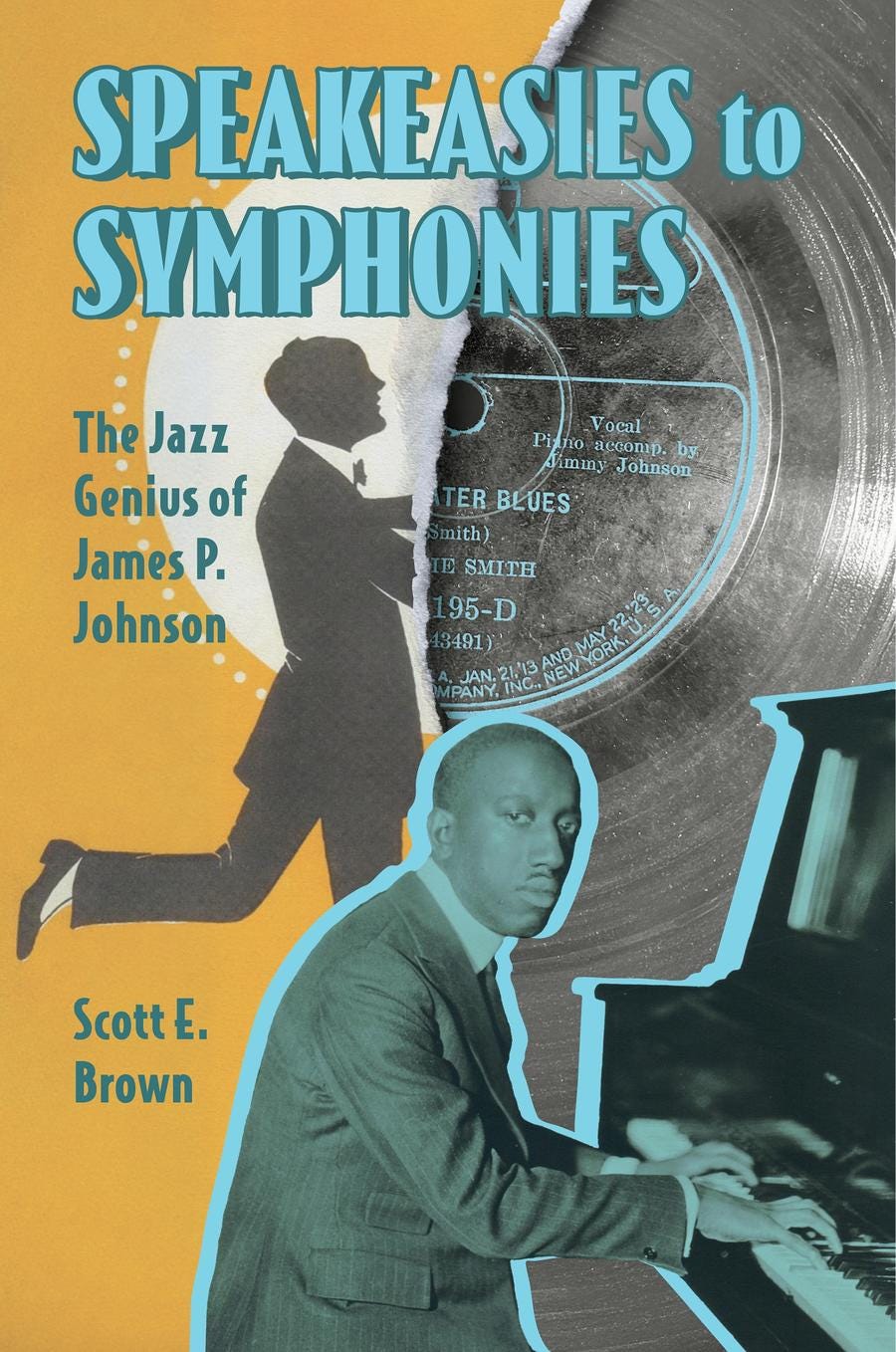
James P. Johnson has a worthy biographer, Scott E. Brown. Brown’s earlier book James P. Johnson: A Case Of Mistaken Identity from 1986 is now superseded by Speakeasies to Symphonies: The Jazz Genius of James P. Johnson.
Brown’s perspective and through-line is valid: “Rare jazz aficionados know him as the Father of Harlem Stride piano but his other monumental contributions to American music are seldom acknowledged.”
Indeed, James P. himself regarded his piano playing as just part of a larger career. A highlight of Speakeasies to Symphonies is a long look at Plantation Days, Johnson’s most successful revue. Plantation Days even traveled to England for controversial performances.
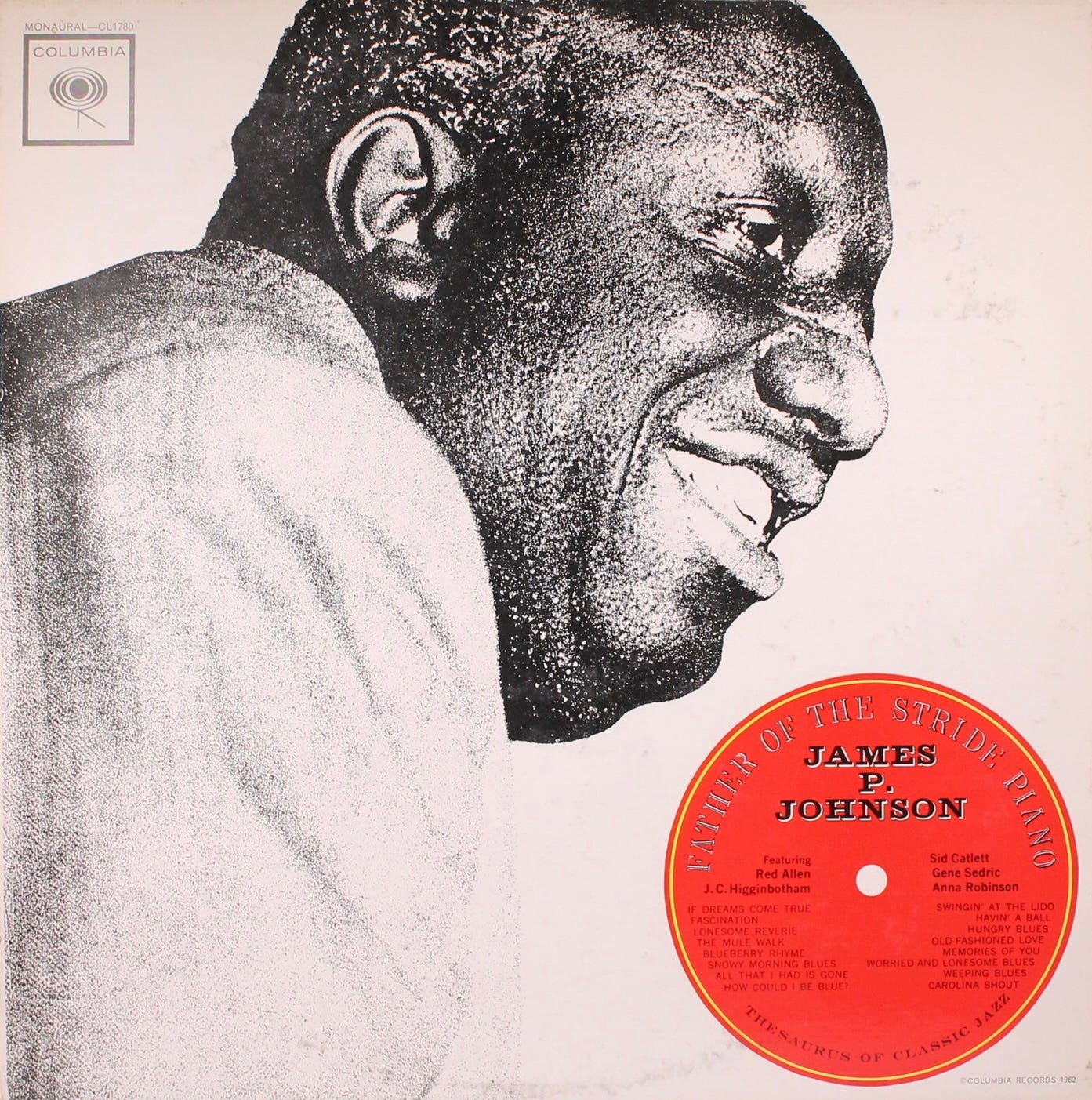
Brown also digs into where the word “stride” comes from, and decides that it begins picking up steam as a trope-namer in about 1944. The phrase “Father of Stride Piano” would eventually be synonymous with James P. Johnson, and that phrase seems to be the work of Stanley Dance, who was in charge of the Columbia anthology Father of the Stride Piano from 1962.
Kevin Whitehead reviews Speakeasies to Symphonies at NPR.
Jeff Sultanof gives a rave at An Eclectic’s Corner.
The Jazz Review published several priceless documents, including Tom Davin’s five-part interview with James P. Johnson. Davin writes that this conversation took place two years before Johnson died, which would mean circa 1953. Some dispute this date, for in 1951 Johnson had a major stroke that left his speech impaired — although in the last section, Johnson mentions the 1953 Riverside Records release of his early piano rolls. According to Scott E. Brown, Davin also took down the interview in shorthand, which obviously means mistakes could be made.
At one point, James P. is quoted:
Alberta Simmons was kind enough to teach me the full Joplin rags that she played so well: “Frog Legs,” “Maple Leaf Rag,” and “Sunflower Slow Drag.”
“Frog Legs Rag” from 1906 is not by Joplin, but by James Scott, and since Johnson is usually conscientious about composer credit, I speculate that this is Davin’s shorthand momentarily betraying the truth.
More importantly, Alberta Simmons also taught Thelonious Monk. According to Monk’s biographer Robin D.G. Kelley, Simmons frequently played Eubie Blake’s “Memories of You,” and this may be why Monk played “Memories of You” so often in later years. At any rate, the fact that James P. Johnson and Thelonious Monk actually shared a piano teacher is a wonderful detail. I believe Scott E. Brown is the first to bring this detail to light: one of many revelations from Speakeasies to Symphonies.
Here is my light edit of the substantial, informative, and entertaining Davin interview, with Davin’s questions and a certain amount of connective or lesser commentary removed. When I dispute Davin’s grasp of musical techniques, I take it out or make a note. Nonetheless, sincere gratitude to Tom Davin: If only we had one of these interviews from all the jazz greats!1
JAMES P. JOHNSON SPEAKS TO TOM DAVIN
Part one, from The Jazz Review Vol. 2, No. 5, June 1959, edited by yours truly
In New Brunswick, N. J., where I was born, my mother was a choir singer in the Methodist church. She worked out as a maid and one day she got the chance to buy a big, ebony, “flat top” square piano from the people she worked for.
When I was just a little baby I used to play on the floor with the piano pedals while she played hymns and simple tunes. Her favorite piece was “Little Brown Jug.” When I got big enough, I got up to the piano and picked out the tunes she played.
My sister, who was eight years older than me, was taking piano lessons, but she used to dodge them. She and my brothers used to bring sheet music home, so I learned to sing all the latest popular tunes. I had a high soprano voice until I was 14 and was a good enough singer for people to give me 10 or 15 cents to sing songs like “There’ll Be A Hot Time In The Old Town, Tonight!” and “I’m Looking For That Birdie.” This would be about 1900, when I was six.
In New Brunswick, the only music I heard outside of home was from bands that paraded in the town. Kids would yell: “There’s a band!” and we’d all run in the direction of the music.
My mother was from Virginia and somewhere in her blood was an instinct for doing country and set dances — what were called “real shoutings.” My “Carolina Shout” and “Carolina Balmoral” are real southern set or square dances. I heard them first at my mother’s social parties with her friends and my stepfather’s friends in New Brunswick. Of course, I was supposed to be in bed, but I’d creep to the head of the stairs and listen and watch.
One of the men would call the figures and they’d dance their own style of square dances. The calls were :“Join hands” — “Sashay” — “Turn around” — “Ladies right and gentlemen left” —“Grab your partner” — “Break away” — “Make a Strut” —“Cows to the front, bulls stay back.”
When he called “Do your stuff” or “Ladies to the front,” they did their personal dances. The catwalk, for instance, was developed from the cotillion, but it was also part of the set dances.
Sometimes, they would have a prize for the best dancing: a quart of wine, gin or whiskey or maybe $5. When the caller shouted “Ladies, show your underwear,” the girls got prizes for fancy ribbons on their pantalettes or petticoats. The man with the funniest patch on his pants or the funniest coat would get a prize. Sometimes the men would get drunk and go out in the road to fight.
These people were from South Carolina and Georgia where the cotillion was popular, and the “Charleston” was an offspring of that. A lot of my music is based on set, cotillion and other southern dance steps and rhythms.
In my mother’s church the hymns attracted me and they have ever since. Southern Negroes who came north carried their traditional music with them. You could hear real southern country church singing in New Brunswick around 1900.
In 1902, when I was eight, we moved to Jersey City .My older brother met some ragtime piano players, or ticklers as they were called, and since they were popular fellows, always in demand socially, I looked up to them.
I became friendly with one tickler, Claude Grew, who could play anything in all keys. That was the mark of a cabaret player, who had to accompany different singers in their favorite keys. He taught me everything he knew. So did an older boy, George Perry, who was another real tickler. I remember another player, Floyd Keppard, a Creole with French background, sharp features and thick, good hair.
What they played wasn’t ragtime as we know it now. It was mostly popular songs with a strong rhythm and with syncopated vamps, not a whole composition or arrange- ment. Scott Joplin’s pieces were popular. They got around the country, but the ticklers I knew just played sections of them that they heard someplace. I never knew that they were Joplin’s until later.
I guess at times there were more good ragtime players in Jersey City in those days than any other place in the United States. Most of the ragtime players were working in sporting houses and cabarets in the South: Baltimore, Norfolk, Charleston, Atlanta-and in the Middle West: Pittsburgh, St. Louis, Memphis and other places.
Now, most of these fellows were big-time pimps or at least did a little hustling on their own. The ladies liked their music, so these boys would play slow drags, rags or songs that would touch the ladies’ hearts, so they would get a woman or two or three to hustle for them. These ticklers didn’t make much money, playing sometimes 12 hours a day in the houses or cafés-maybe $10 a week, and as much more in tips. Some had to work on tips alone. So they managed a few girls on the side.
Now, a good girl was measured by how much money she could draw, and the best kind of sporting woman was a thieving woman who knew how to get into a man’s pocket and get his bankroll. Sometimes, a girl would roll a live one and get $500 or $1,000. This usually brought a complaint to the police, so the girl and her tickler friend would have to leave town. They’d head north and east to New York and the last stop on the railroad was Jersey City. These fellows brought all the latest styles of playing from the cabarets and sporting houses of the South and West to Jersey City and that’s where I heard them. They were popular fellows, real celebrities. They had lots of girl friends, led a sporting life and were invited everywhere there was a piano. I thought it was a fine way to live, just as later kids would think singers like Crosby or Sinatra were worth copying.
Like other kids, I used to work around saloons, doing a little buck dance, playing the guitar and singing songs like “Don’t Hit That Lady, She Got Good Booty, “Left Her On The Railroad Track,” “Baby, Let Your Drawers Hang Low.” Poor people drank beer, whiskey cost 10 to 12 cents a half-pint or less at the barrelhouses where you brought your own bottle. We came from a religious family, my mother still sang in the church choir, but we lived out near the Dixon pencil factory on Monmouth Street, a tough Jersey City neighborhood with sporting houses all around.
We moved from Jersey City to New York in 1908 when I was 14. In Jersey City I heard good piano from all parts of the South and West, but I never heard real ragtime until we came to New York. Most East Coast playing was based on cotillion dance tunes, stomps, drags and set dances like my “Mule Walk Stomp,” “Gut Stomp,” and the “Carolina Shout” and “Balmoral.” They were all country tunes.
In New York, a friend taught me real ragtime. His name was Charley Cherry. He played Joplin. First he played, then I copied him, and then he corrected me.
When I went to Public School 69, I was allowed to play for the Assembly and for the minstrel shows we put on there. I had a high soprano voice yet, so I was put into the school chorus. Once, Frank Damrosch (Walter Damrosch’s brother) auditioned us for his production of Haydn’s Creation. He used 100 boys in sections. I remember that he personally complimented me because I was singing so strong. We all got a bronze medal for taking part.
In New York I got a chance to hear a lot of good music for the first time. Victor Herbert and Rudolph Friml were popular. I used to go to the old New York Symphony concerts; a friend of my brother’s who was a waiter used to get tickets from its conductor, Josef Stransky, who came to the restaurant where he worked. The full symphonic sounds made a great impression on me. That was when I first heard Mozart, Wagner, von Weber, Meyerbeer, Beethoven and Puccini.
There weren’t any jazz bands like they had in New Orleans or on the Mississippi river boats, but ragtime piano was played all over in bars, cabarets and sporting houses. From what I have heard from older men who played in New York in 1890 and 1900, there was a kind of ragtime played then. W. C. Handy told me the same. A lot of early New Orleans tunes were played by bands and piano players around New York.
The other sections of the country never developed the piano as far as the New York boys did. Only lately have they caught up. The reason the New York boys became such high-class musicians was because the New York piano was developed by the European method, system and style. The people in New York were used to hearing good piano played in concerts and cafés. The ragtime player had to live up to that standard. They had to get orchestral effects, sound harmonies, chords and all the techniques of European concert pianists who were playing their music all over the city.
New York developed the orchestral piano: full, round, big, widespread chords and tenths, a heavy bass moving against the right hand. The other boys from the South and West at that time played in smaller dimensions.
We didn’t have any instruments then except maybe a drummer, so we had to use a solid bass and a solid swing to get the most colorful effects. In the rags, that full piano was played as early as 1910. Even Scott Joplin had octaves and chords, but he didn’t attempt the big hand stretches. Abba Labba, Luckey Roberts and later ticklers did that.
When you heard the biggest ragtime specialists play, you would hear fine harmony, exciting touch and tone and all the themes developed.
From 1910 on, Handy’s blues were played in cabarets. Mannie Sharp, a singer and dancer, and Lola Lee, a blues singer, taught me Handy’s blues in 1911: “Memphis Blues,” “St. Louis,” and later “Beale Street” and “Yellow Dog.” Before that, there were natural blues sung on southern waterfronts, in turpentine camps, farms, chain gangs. Leadbelly and Ma Rainey were singing natural 12-bar blues that were developed from the spirituals.
In 1911, when I was still going to school in short pants, we lived on 99th Street, Manhattan, and I used to go to a cellar on 100th Street and 3rd Avenue, called The 100th Street Hall, run by a fellow nicknamed “Souser.” I never knew his name; he was a juice hound. They had a four or five-piece band there (piano, drums, violin, flute or clarinet). It was called the New Amsterdam Orchestra or Hallie Anderson’s Orchestra. They played verses and choruses, in simple arrangements until 2 A.M. every night. But after two, they pulled the piano out into the middle of the floor and “Souser” would play terrific rags. Then he’d let me play and I’d hit the piano until 4 A.M. I kept my schoolbooks in the coal bin there and went on to school after a little sleep.
In the same year, I was taken uptown to Barron Wilkins’ place in Harlem. Another boy and I let our short pants down to look grown up and sneaked in. Who was playing there but Jelly Roll Morton! He had just arrived from the West and he was red hot. The place was on fire! We heard him play his “Jelly Roll Blues.” I remember that he was dressed in full-back clothes. and wore a light brown melton overcoat, with a three-hole hat to match. He had two girls with him.
Then I was just a short-pants kid in the back of the crowd and I never saw him again until 10 years later in Chicago. I was able to appreciate him then, but I couldn’t steal his stuff. I wasn’t good enough yet. In 1943, though, they picked me to impersonate his style at the New Orleans Jazz Carnival.
That same year, 1911, I heard Thad “Snowball” Wilkerson who played only by ear and in one key, B natural. He had taught Alberta Simmons to play rags. She was a fine instrumental pianist who played with Clef Club Bands. She lived at 8th Avenue and 41st Street. Alberta Simmons was kind enough to teach me the full Joplin rags that she played so well: “Frog Legs,” “Maple Leaf Rag,” and “Sunflower Slow Drag.” (ed: see comment above.)
Part two, from The Jazz Review Vol. 2, No. 6, July 1959, edited by yours truly
In the years before World War I, there was a piano in almost every home, colored or white. The piano makers had a slogan: “What Is Home Without A Piano?” It was like having a radio or a TV today.
If you could play piano good, you went from one party to another and everybody made a fuss about you and fed you ice cream, cake, food and drinks. In fact, some of the biggest men in the profession were known as the biggest eaters we had. At an all-night party, you started at 1:00 A.M., had another meal at 4:00 A.M. and sat down again at 6:00 A.M. Many of us suffered later because of eating and drinking habits started in our younger socializing days. But that was the life for me when I was seventeen.
In the summer of 1912, during high-school vacation, I went out to Far Rockaway, a beach resort near Coney Island, and got a chance to play at a place run by a fellow named Charlie Ett. It was just a couple of rooms knocked together to make a cabaret. They had beer and liquor, and out in the back yard there was a crib house for fast turnover.
It was a rough place, but I got nine dollars and tips, or about eighteen dollars a week. That was so much money that I didn’t want to go back to high school. That fall, instead of going back to school, I went to Jersey City and got a job in a cabaret run by Freddie Doyle. He gave me a two-dollar raise.
In a couple of months, Doyle’s folded up, and I came back to Manhattan and played in a sporting house on 27th Street between 8th and 9th Avenues, which was the Tenderloin then. It was run by a fellow named Dan Williams, and he had two girl entertainers that I used to accompany. I played “That Barbershop Chord,” “Lazy Moon,” Berlin’s “Alexander’s Ragtime Band.” Some rags, too, my own and others: Joplin’s “Maple Leaf Rag” (everybody knew that by then), his “Sunflower Slow Drag.” “Maori” by Will Thiers. “The Peculiar Rag” and “The Dream” by Jack the Bear. Then there were piano arrangements of medleys of Herbert and Friml, popular novelties and music-hall hits — many by Negro composers. Indian songs were also popular then, and the girls at Dan Williams’ used to sing “Hiawatha,” “Red Wing,” “Big Chief Battleaxe,” and “Come With Me To My Big Teepee.”
Blues had not come into popularity at that time. They weren’t known or sung by New York entertainers.
I was working out a number of rags of my own that they wanted to publish at Gotham & Attucks, a Negro music publishing firm whose offices were at 37th Street off Broadway. I couldn’t write them down and I didn’t know anybody who would do them for me. Cecil Mack was president of Gotham & Attucks. All the great colored musicians had gathered around the firm: Bert Williams, George Walker, Scott Joplin, Will Marion Cook, Joe Jordan, Tim Brymm. They had a lot of hit songs. Gussie L. Davis, who wrote white-style ballads for them, was the composer of “The Baggage Coach Ahead,” the greatest tear-jerker of the time.
I had a number of jobs in the winter of 1912-13. One was playing movie piano at the Nickelette at 8th Avenue and 37th Street. In the spring of 1913, I really got started up in The Jungles: the Negro section of Hell’s Kitchen. It ran from 60th to 63rd Street, west of 9th Avenue. It was the toughest part of New York. There were two to three killings a night. Fights broke out over love affairs, gambling, or arguments in general. There were race fights with the white gangs on 66th and 67th Street. It was just as tough in the white section of Hell’s Kitchen.
In 1910 and 1911, I used to drop in at Jim Allan’s place at 61st Street and 10th Avenue, where I’d wear my knickers long so they wouldn’t notice that I was a short-pants punk. After they heard me play, they would let me come when I wanted.
So, in the spring of 1913, got a job playing at Jim Allan’s. It was a remodeled cellar, and since it operated after hours, it had an iron-plated door like the speakeasies had later. There was a bar upstairs, but downstairs there was a rathskeller, and in the back of the cellar there was a gambling joint. When the cops raided us now and then, they always. had to go back to the station house for axes and sledge hammers, so we usually made a clean getaway.
My New York Jazz album on Asch tried to show some types of music played in The Jungles at that time: Joplin’s “Euphonic Sounds,” “The Dream,” and Handy’s “Hesitation Blues.”
One night a week, I played piano for Drake’s Dancing Class on 62nd Street, which we called “The Jungles Casino.” It was officially a dancing school, since it was very hard for Negroes to get a dance-hall license. But you could get a license to open a dancing school very cheap. The Jungles Casino was just a cellar, too, without fixings. The furnace, coal, and ashes were still there behind a partition. The coal bin was handy for guests to stash their liquor in case the cops dropped in. There were dancing classes all right, but there were no teachers. The “pupils” danced sets, two-steps, waltzes, schottisches, and “The Metropolitan Glide,” a new step. I played for these regulation dances, but instead of playing straight, I’d break into a rag in certain places. The older ones didn’t care too much for this, but the younger ones would scream when I got good to them with a bit of rag in the dance music now and then.
The floor of the dancing class was plain cement like any cellar, and it was hard on the dancers’ shoes. I saw many actually wear right through a pair of shoes in one night. They danced hard. When it rained, the water would run down the walls from the street so we all had to stop and mop up the floor.
The people who came to The Jungles Casino were mostly from around Charleston, South Carolina, and other places in the South. Most of them worked for the Ward Line as longshoremen or on ships that called at southern coast ports. There were even some Gullahs among them. They picked their partners with care to show off their best steps and put sets, cotillions and cakewalks that would give them a chance to get off.
The Charleston, which became a popular dance step on its own, was just a regulation cotillion step without a name. It had many variations, all danced to the rhythm that everybody knows now. One regular at the Casino, named Dan White, was the best dancer in the crowd and he introduced the Charleston step as we know it.
It was while playing for these southern dancers that I composed a number of Charlestons, eight in all, all with the same rhythm. One of these later became my famous “Charleston” when it hit Broadway.
My “Carolina Shout” was another type of ragtime arrangement of a set dance of this period. In fact, a lot of famous jazz compositions grew out of cotillion music such as “The Wildcat Blues.” Jelly Roll Morton told me that his “King Porter Stomp” and “High Society” were taken from cotillion music.
The dances they did at The Jungles Casino were wild and comical: the more pose and the more breaks, the better. These Charleston people and the other southerners had just come to New York. They were country people and they felt homesick. When they got tired of two-steps and schottisches, they’d yell: “Let’s go back home!” or “Now, put us in the alley!” I did my “Mule Walk” or “Gut Stomp” for these country dances.
Breakdown music was the best for such sets, the more solid and groovy the better. They’d dance, hollering and screaming until they were cooked. The dances ran from fifteen to thirty minutes, but they kept up all night long, or until their shoes wore out.
About this time, I played my first “Pigfoot Hop” at Phil Watkin’s place on 61st Street. He was a very clever entertainer and he paid me $1.50 for a night’s playing with all the gin and chitterlings that I could get down. This was my first “Chitterlin’ Strut” or parlor social, but later in the depression I became famous at “Gumbo Suppers,” “Fish Fries,” “Egg Nog Parties,” and “Rent Parties.” I loved them all.
Luckey Roberts was the outstanding pianist in New York in 1913 — and for years before and after. He had composed “The Elks March,” “Spanish Venus,” “Palm Beach Rag,” and “The Junkman’s Rag.”
Luckey had massive hands that could stretch a fourteenth on the keyboard, and he played tenths as easy as others played octaves. His tremolo was terrific, and he could drum on one note with two or three fingers in either hand. His style in making breaks was like a drummer’s: he’d flail his hands in and out, lifting them high. A very spectacular pianist.
He was playing at Barron Wilkins’ place in Harlem then, and when I could get away I went uptown and studied him (I was usually working at Allan’s from 9:00 P.M. to 7:00 A.M.). Later we became good friends, and he invited me to his home. Afterwards, I played at Barron Wilkins’, too, as did my friend Ernest Green, who first introduced me to Luckey. Ernest was a good classical pianist. Luckey used to ask him to play the William Tell Overture and the Light Cavalry Overture. These were considered tops in classical music amongst us.
Ernest Green’s mother was studying then with a piano and singing teacher named Bruto Gianinni. She did house cleaning in return for lessons, and several Negro singers got their training that way. Mrs. Green told me: “James, you have too much talent to remain ignorant of musical principles.” She inspired me to study seriously. So I began to take lessons from Gianinni, but I got tired of the dull exercises. However, he taught me a lot of concert effects.
I was starting to develop a good technique. I was born with absolute pitch and could catch a key that a player was using and copy it, even Luckey’s. I played rags very accurately and brilliantly. These would run other ticklers out of the place at cutting sessions. They wouldn’t play after me. I was playing a lot of piano then, traveling around and listening to every good player I could. I’d steal their breaks and style and practice them until I had them perfect.
From listening to classical piano records and concerts, from friends of Ernest Green such as Mme. Garret, who was a fine classical pianist, I would learn concert effects and build them into blues and rags.
Sometimes I would play basses a little lighter than the melody and change harmonies. When playing a heavy stomp, I’d soften it right down then, I’d make an abrupt change like I heard Beethoven do in a sonata.
Some people thought it was cheap, but it was effective and dramatic. With a solid bass like a metronome, I’d use chords with half and quarter changes. [This might be chords moving in half notes and quarter notes — ed.] Once I used Liszt’s Rigoletto Concert Paraphrase as an introduction to a stomp. Another time, I’d use pianissimo effects in the groove and let the dancers’ feet be heard scraping on the floor. It was used by dance bands later.
In practicing technique, I would play in the dark to get completely familiar with the keyboard. To develop clear touch and the feel of the piano, I’d put a bed sheet over the keyboard and play difficult pieces through it.
I had gotten power and was building a serious orches tral piano. I did rag variations on William Tell Overture, Grieg’s Peer Gynt Suite and even a “Russian Rag” based on Rachmaninoff’s “Prelude in C Sharp Minor,” which was just getting popular then.
In my “Imitators’ Rag” the last strain had “Dixie” in the right hand and “The Star Spangled Banner” in the left. (It wasn’t the national anthem then.) Another version had “Home, Sweet Home” in the left hand and “Dixie” in the right.
When President Wilson’s “Preparedness” campaign came on, I wrote a march fantasia called Liberty.
From 1914 to 1916, I played at Allan’s, Lee’s, The Jungles Casino, occasionally uptown at Barron Wilkins’, Leroy’s and Wood’s (run then by Edmund Johnson). I went around copping piano prize contests and I was considered one of the best in New York—if not the best. I was slim and dapper, and they called me “Jimmie” then.
Entertainers used to sing blues to me, homemade blues, and I’d arrange them for piano, either to accompany them or play as solos. One of these homemade blues, “All Night Long,” was made into a song by Shelton Brooks, who also wrote “The Darktown Strutters’ Ball.”
Then I met Will Farrell, a Negro song writer, and he showed me how to set my pieces down in writing. He also wrote lyrics for them. With him, I set down my first composition to be published, “Mamma’s and Pappa’s Blues.”
There had been a piece around at the time called “Left Her On The Railroad Track” or “Baby, Get That Towel Wet.” All pianists knew it and could play variations on it. It was a sporting-house favorite. I took one opening strain and did a paraphrase from this and used it in “Mamma’s and Pappa’s Blues.” It was also developed later into “Crazy Blues,” by Perry Bradford.
I had composed “Carolina Shout” before that. It wasn’t written down, but was picked up by other pianists. My “Steeplechase Rag” and “Daintiness Rag” had spread all over the country, too, although they hadn’t been published.
With Farrell, I also wrote “Stop It, Joe!” I sold it, along with “Mamma’s and Pappa’s Blues,” for twenty-five dollars apiece to get enough money for a deposit on a grand piano.
In the summer of 1914, I went for a visit to Atlantic City and heard Eubie Blake (who composed Shuffle Along later), one of the foremost pianists of all time. He was playing at The Belmont, and Charles Johnson was playing at The Boat House, both all-night joints. Eubie was a marvelous song player. He also had a couple of rags. One, “Troublesome Ivories,” was very good. I caught it.
I saw how Eubie, like Willie Smith and Luckey Roberts, could play songs in all keys, so as to be ready for any singer or if one of them started on a wrong note. So I practiced that, too. I also prepared symphonic vamps — gutty, but not very full.
While in New Jersey that summer, I won a piano contest in Egg Harbor, playing my “Twilight Rag” (which had a chimes effect in syncopation), “Steeplechase Rag,” and “Nighttime in Dixieland.”
There was a pianist there who played quadrilles, sets, rags, etc. From him, I first heard the “Walking Texas” or “boogie woogie” bass. The boogie woogie was a cotillion step for which a lot of music was composed. I never got his name, but he played the “Kitchen Tom Rag” which was the signal for a “Jazz” dance.
When I came back to New York, I met the famous Abba Labba in the Chelsea district, he was a friend and pupil of Luckey Roberts. Abba Labba was the working girls’ Jelly Roll. His specialty was to play a lot of piano for girls who were laundresses and cooks. They would supply him with stylish clothes from their customers’ laundry and make him elaborate rosettes for his sleeve guards. The cooks furnished him with wonderful meals, since they had fine cold kina (keena) then. Cold kina was leftover food from a white family’s dinner that the cook was entitled to. This was an old southern cooks’ custom: they fed their own family with these leftovers and they were sure to see that there was plenty of good food left. That’s why old southern home cooking was so famous--the cook shared it.
Most of the full-time hustlers used to cultivate a working girl like that, so they could have good meals and fancy laundry.
Abba Labba had a beautiful left hand and did wonderful bass work. He played with chromatic changes that were new ideas then. He would run octaves with chords, and one of his tricks was to play “Good Night, Beloved, Good Night” in schottische, waltz, and ragtime. I fell on his style and copied a lot of it. I was getting around town and hearing everybody. If they had anything I didn’t have, I listened and stole it.
Sam Gordon played at The Elks Café at 137th and 138th Streets and Lenox Avenue. He was a great technician who played an arabesque style that Art Tatum made famous later. He played swift runs in sixths and thirds, broken chords, one-note tremolandos and had a good left hand. He had been a classical pianist and had studied in Germany. He picked up syncopation here.
Fred Bryant from Brooklyn was a good all-around pianist. He played classical music and had a velvet touch. The piano keys seemed to be extensions of his fingers. Incidentally, as far as I know, he invented the backward tenth. I used it and passed it on to Fats Waller later. It was a keynote of our style.
Down in Chelsea, there was a player named Fats Harris, who looked like Waller did later. He had a rag in D called “Fats Harris’s Rag,” a great stomp tune.
Then in the fall of 1914, I went over to Newark, New Jersey, and first met Willie (The Lion) Smith and Dickie Huff who were playing on The Coast, a tough section around Arlington and Augusta Streets. Both were great players. I don’t have to tell you about Willie, he’s still playing great. He’s the last of the real old-time ticklers along with Luckey.
Part three, from The Jazz Review Vol. 2, No. 7, August 1959, edited by yours truly
Willie Smith was one of the sharpest ticklers I ever met and I met most of them. When we first met in Newark, he wasn’t called Willie The Lion, he got that nickname after his terrific fighting record overseas during World War I. He was a fine dresser, very careful about the cut of his clothes and a fine dancer, too, in addition to his great playing. All of us used to be proud of our dancing. Louis Armstrong, for instance, was considered the finest dancer among the musicians. It made for attitude and stance when you walked into a place, and made you strong with the gals.
When Willie Smith walked into a place, his every move was a picture. Yes, every move we made was studied, practiced, and developed just like it was a complicated piano piece.
When a real smart tickler would enter a place, say in winter, he’d leave his overcoat on and keep his hat on, too. We used to wear military overcoats or what was called a Peddock Coat, like a coachman’s: a blue double-breasted, fitted to the waist and with long skirts. We’d wear a light pearl-gray Fulton or Homburg hat with three buttons or eyelets on the side, set at a rakish angle over on the side of the head. Then a white silk muffler and a white silk handkerchief in the overcoat’s breast pocket. Some carried a gold-headed cane, or if they were wearing a cutaway, a silver-headed cane. A couple of fellows used to wear Inverness capes, which were in style in white society then.
Many fellows had their overcoats lined with the same material as the outside—they even had their suits made that way. Pawnbrokers, special ones, would give you twenty or twenty-five dollars on such a suit or overcoat. They knew what it was made of. A fellow belittling another would be able to say: “G’wan, the inside of my coat would make you a suit.”
When you came into a place you had a three-way play. You never took your overcoat or hat off until you were at the piano. First you laid your cane on the music rack. Then you took off your overcoat, folded it, and put it on the piano, with the lining showing. You then took off your hat before the audience. Each tickler had his own gesture for removing his hat with a little flourish: that was part of his attitude, too. You took out your silk handkerchief, shook it out and dusted off the piano stool. Now, with your coat off, the audience could admire your full-back — or box-back — suit, cut with very square shoulders. The pants had about fourteen-inch cuffs and broidered clocks. Full-back coats were always single-breasted to show your gold watch fob and chain. Some ticklers wore a horseshoe tiepin in a strong single colored tie and a gray shirt with black pencil stripes.
We all wore French Shriner & Urner or Haman straight or French last shoes with very pointed toes, or patent-leather turn-up toes, in very narrow sizes. For instance, if you had a size 7 foot, you’d wear an 8 1/2 shoe on a very narrow last. They cost from twelve to eighteen dollars a pair.
If you had an expensive suit made, you’d have the tailor take a piece of cloth and give it to you so that you could have either spats or button cloth-tops for your shoes to match the suit. Some sharp men would have a suit and overcoat made of the same bolt of cloth. Then they’d take another piece of the same goods and have a three-button Homburg made out of it. This was only done with solid-color cloth, tweeds or plaids were not in good taste for formal hats.
There was a tailor named Bromberger down on Carmine Street, near Sheridan Square in the old 15th Ward, who made all the hustlers’ clothes. That was a Negro section around 1912. He charged twenty-five to forty dollars a suit.
Another tailoring firm, Clemens & Ostreicher, at 40th Street, and 6th Avenue, would make you a sharp custom suit for $11.75—with broadlap seams (34 in.), a fingertip coal, shirred in at the waist with flared skirts, patch pockets, five-button cuffs and broad lapels.
Up on 153rd Street there was a former barber named Hart who had invented a hair preparation named Kink- No-More, called “Conk” for short. His preparation was used by all musicians, the whole Clef Club used him. You’d get your hair washed, dyed and straightened; then trimmed. It would last about a month.
Of course each tickler had his own style of appearance. I used to study them carefully and copy those attitudes that appealed to me.
There was a fellow name Fred Tunstall, whom I mentioned before. He was a real dandy. I remember he had a Norfolk coat with eighty-two pleats in the back. When he sat down to the piano, he’d slump a little in a half hunch, and those pleats would fan out real pretty. That coat was long and flared at the waist. It had a very short belt sewn on the back. His pants were very tight.
He had a long neck, so he wore a high, stiff collar that came up under his chin with a purple tie. A silk handkerchief was always draped very carefully in his breast pocket. His side view was very striking.
Tunstall was very careful about his hair, which was ordinary, but he used lots of pomade. His favorite shoes were patent-leather turnups. His playing was fair, but he had the reputation of being one of our most elegant dressers. He had thirty-five suits of clothes: blacks, grays, brown pin stripes, Oxfords, pepper and salts.
Some men would wear a big diamond ring on their pinky, the right-hand one, which would flash in the treble passages. Gold teeth were in style, and a real sharp effect was to have a diamond set on one tooth. One fellow went further and had diamonds set in the teeth of his toy Boston bulldog. There was a gal named Diamond Floss, a big sporting-house woman, a hot clipper and a high-powered broad, who had diamonds in all her front teeth. She had a place in Chelsea, the west thirties, in the Tenderloin days.
[Q. Where did these styles come from, the South?]
No, we saw them right here in New York City. They were all copied from the styles of the rich whites. Most of the society folks had colored valets and some of them would give their old clothes to their valets and household help.
Then we’d see rich people at society gigs in the big hotels where they had Clef Club bands for their dances. So we wanted to dress good, copied them and made im- provements.
In the sporting world of gamblers, hustlers and ticklers, the lowest rank is called a punk. He’s nothing. He doesn’t have any sense; he doesn’t know anything about life or the school of the smart world. He doesn’t even know how to act in public. You had to have an attitude, a style of behaving that was your personal, professional trade-mark.
The older Clef Club musicians were artists at this kind of acting. The club was a place to go to study these glamorous characters. I got a lot of my style from ticklers like Floyd Keppard, who I know in Jersey City, Dan Avery, Bob Hawkins, Lester Wilson, Freddie Tunstall, Kid Sneeze, Abba Labba, Willie Smith and many others.
I’ve seen Jelly Roll Morton, who had a great attitude, approach a piano. He would take his overcoat off. It had a special lining that would catch everybody’s eye. So he would turn it inside out and, instead of folding it, he would lay it lengthwise along the top of the upright piano. He would do this very slowly, very carefully and very solemnly as if that coat was worth a fortune and had to be handled very tenderly.
Then he’d take a big silk handkerchief, shake it out to show it off properly, and dust off the stool. He’d sit down then, hit his special chord (every tickler had his special trade-mark chord, like a signal) and he’d be gone! The first rag he’d play was always a spirited one to astound the audience.
Other players would start off by sitting down, wait for the audience to quiet down and then strike their chord, holding it with the pedal to make it ring.
Then they’d do a run up and down the piano a scale or arpeggios or if they were real good they might play a set of modulations, very offhand, as if there was nothing to it. They’d look around idly to see if they knew any chicks near the piano. If they saw somebody, they’d start a light conversation about the theater, the races or social doings light chat. At this time, they’d drift into a rag, any kind of pretty stuff, but without tempo, particularly without tempo. Some ticklers would sit sideways to the piano, cross their legs and go on chatting with friends near by. It took a lot of practice to play this way, while talking and with your head and body turned.
Then, without stopping the smart talk or turning back to the piano, he’d attack without any warning, smashing right into the regular beat of the piece. That would knock them dead.
A big-timer would, of course, have a diamond ring he would want to show off to some gal near by that he wanted to make. So he would adjust his hand so that the diamond would catch her eye and blind her. She’d know he was a big shot right off.
A lot of this was taught to me by old-timers, when they would be sitting around when I was a kid and only playing social dance music. I wasn’t a very good-looking fellow. but I dressed nice and natty. I learned all their stuff and practiced it carefully.
In the old days, these effects were studied to attract the young gals who hung around such places. Ed Avery, whose style I copied, was a great actor and a hell of a ladies’ man. He used to run big harems of all kinds of women.
After your opening piece to astound the audience, it would depend on the gal you were playing for or the mood of the place for what you would play next. It might be sentimental, moody, stompy or funky. The good player had to know just what the mood of the audience was. At the end of his set. he’d always finish up with a hot rag and then stand up quickly, so that everybody in the place would be able to see who knocked it out.
Every tickler kept these attitudes even when he was socializing at parties or just visiting. They were his professional personality and prepared the audience for the artistic performance to come. I’ve watched high-powered actors today, and they all have that professional approach. In the old days they really worked at it. It was designed to show a personality that women would admire. With the music he played, the tickler’s manners would put the question in the ladies’ minds: “Can he do it like he can play it?”
Full-back clothes became almost a trade-mark for pimps and sharps. Church socials and dancing classes discriminated against all who wore full-back clothes. They would have a man at the door to keep them out. So, in self-defense, the hustlers had to change to English drape styles, which were rumored to be worn only by pansies and punks. Oh, yes. Some of the toughest guys would even attend Sunday school classes regularly, just to get next to the younger and better-class gals there. They wore the square style of pinch-back coats and peg-top pants and would even learn hymns to impress a chick they had their eye on. They were very versatile cats.
Part four, from The Jazz Review Vol. 2, No. 8, September 1959, edited by yours truly
I told you about writing songs with Will Farrell. Well, right after publishing “Mama’s and Papa’s Blues,” “Stop it, Joe,” and “The Monkey Hunch,” the two of us opened an office together. We wanted to meet artists, write special material and generally contact the entertainment field. I wanted to learn how to write for the theater.
Nothing happened at first, but when things go low, somebody would walk in. We’d get jobs like social club shows, special music for industrial shows, conventions, topical songs…We’d put on one-night shows and dances to attract actors and looking get a week at the Lincoln or Crescent in Harlem.
Producers in those days would round up a couple of clever girls, work up an act with scenery and costumes, promote the music and then try to sell the whole unit to a circuit. We’d get paid for performing (not for composing). It would get our songs heard and maybe published. All composers and lyric writers started out that way then, even those who became the biggest in their field.
We learned a lot in those shoe-string days. We’d get the Negro reaction in the South and the opera house, white reaction in upper Pennsylvania, Connecticut and New York State. I was learning how to do show music, and it was all a new experience.
I played with the Clef Club on some gigs and fast calls. That organization was well run by Jim Europe. They used to have concerts with a 110 piece orchestra and 10 pianos on the stage. They made a fine sound.
I also worked in a song and dance act with Ben Harney, who was one of the greatest piano players and who was supposed to be “the inventor of ragtime.” He used to play two pianos together — one with each hand. Ben was also a great entertainer on the TOBA time, a southern vaudeville circuit. His big songs were: “I’m a Natural Born Cannon Ball Catcher,” and “Mr. Johnson, Turn Me Loose!”
One day I got a message to go see Mr. Fay at the Aeolian Company. He wanted someone to cut ragtime piano rolls.
Now, I had never cut a roll before. In fact, no Negro had ever cut his own compositions before. Mr. Fay at Aeolian set me down at a piano and I played a rag. Until he played it back at me, I didn’t know I had cut a roll. Later, Russell Robinson, a white pianist, taught me how to run the piano roll cutter. From 1916 on, I cut one or two rolls a month of my own pieces at Aeolian. I wrote rags in every key in the scale. Every one of them had to be written out perfectly because the manuscript of each piece was used for correcting the rolls, if any note wasn’t punched right.
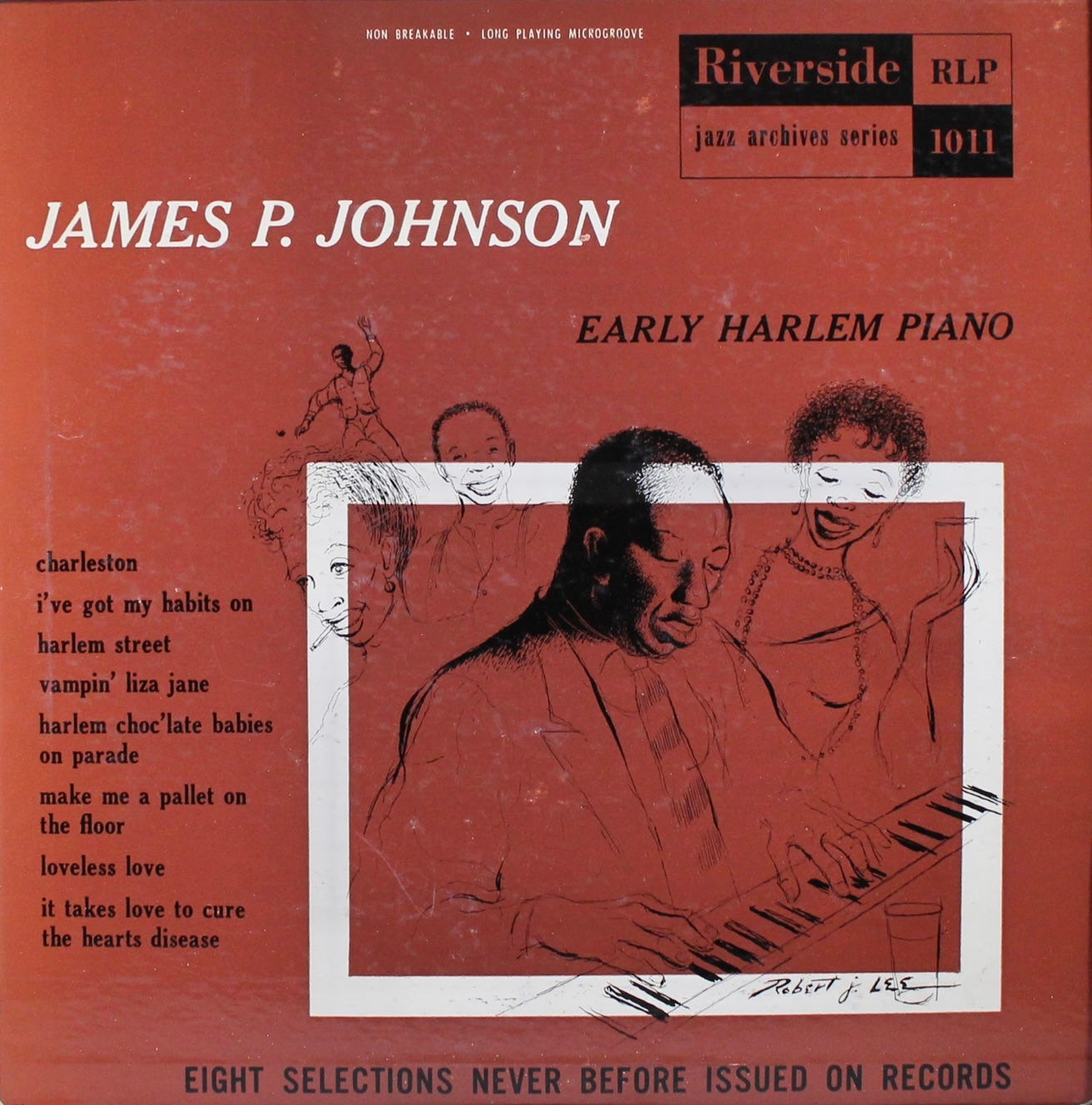
Being the first Negro composer to cut his own rags, I saw them become famous and studied all over the country by young ticklers who couldn’t read much music. Later did the same type of rolls for QRS, which had a bigger circulation and really spread my rags around. These were all terrific rags. They have been recut and recorded on LP by Riverside Records.
It was at Aeolian later, in 1920, that I met George Gershwin who was cutting “Oriental” numbers there when I was making blues rolls which were popular then. He had written “Swanee” and was interested in rhythm and blues. Like myself, he wanted to write them on a higher level. We had lots of talks about our ambitions to do great music on American themes.
At this time, I was rehearsing 3, 5, 7, and 14 piece combos and trying to introduce small chamber orchestras in symphonic style. I wanted to be a bandleader, and not just a leader, but an arranger too. I liked to work out ideas and experiments and I tried out what were known as “skulls” or “head arrangements”— full of counterpoint and contrasting melodies.
Those 1916-1918 years were “The Giggin’ Years” for me. Happy Rowan, a drummer, had various jobs to offer working in Clef Club gigs and on his own promotions. They were all fast calls; sometimes I’d work three jobs a day, and get eighteen to twenty- five dollars a night for a job.
So, I formed the Jimmie Johnson Trio and took on Happy’s gigs with them. My musicians, all virtuosos, were Nelson Kinkaid, sax/clarinet, who could reach E-flat above altissimo and could transpose from trumpet parts on sight. The violin was Shrimp Jones and we had a relief man, Clarence Tisdale, alto sax, from the Wright Quintet who were playing at Reisenweber’s.
All of them were well schooled and could play with the best people today. We had bags of music as big as trunks; all the parts were written out. There were no special arrangements in those days, but I had written some variations on pieces like “The Crocodile,” “The Sheik,” “The Vamp,” and “La Vida.” But we had learned all our repertoire by heart and never had to crack the music bags once.
Among other jobs, I played and accompanied Reece Dupree, a blues singer, at the Crescent, a little hole- in-the-wall vaudeville house on 135th Street. That was the cradle of colored entertainment in New York, Then I got a call to form a five-piece band for the play What’s Your Husband Doing? which played on Broadway. It was my first five-piece band, and we had a five-minute scene onstage. We went on the road with it to Boston, I met Fleurnoy Miller and Aubrey Lyles (who were later to write Shuffle Along) at Lucas’ place on Tremont Street, which was a hangout for professionals. After the show, I used to play the piano there with Louis Mitchell, a classical violinist then at Boston Music Conservatory.
When we got back to New York, there was great excitement: the Original Dixieland Band had hit the town and had made a big impression playing “Barnyard Blues” and “The Dixieland One-Step.” It was a white band, you know, imitating the New Orleans jazz style that had never been heard in New York before.
I saw that it was going to be popular and tried to get a similar band organized at the Clef Club, but the older men there vetoed it. They thought that kind of playing was vulgar compared to what they were trying to do. This experience, and others, was an example of their not encouraging the younger musicians. As a result, their membership fell off. There was another band that played in New York and other northern cities in the years between 1910-1916 that could really swing. That was the Jenkins Orphan Asylum Band from Charleston, S. C. It was a boys’ band, Negro orphan boys from 8 to 16 or 18 years old that made the rounds of northern cities. They played in the streets and in backyards in the Negro neighborhoods and passed the hat. They had white caps with red jackets and their drum-major was a great poser and strutter who knew all the tricks. Every boy who saw him wanted to be a drum-major. They played marches and minstrel and cotillion tunes with real syncopation and swing.
Many jazz musicians came from this boys’ school. The Aiken brothers, trumpeters in Joe Oliver’s band that was playing at Leroy’s in 1920, were from the Jenkins Orphan Asylum Band. “Traps” McIntosh, in my opinion the greatest drummer of all time, was trained there, as was Herbert Wright (Jim Europe’s drummer) and Gene Anderson whose specialty was drumming on the wall. Other drummers at that time included Bob Gordon, who was known as “The March King,” also played the piano regularly at Allan’s before I went there. He wrote “Oh You Drummer!” — a piece that made him popular because it had breaks for drums. A lot of drummers came to see him and I met them and heard them later. Some of the famous ones were Si Moore; Buddy Gillmore, (who was The Prince of Wales’ teacher when he took to the traps); a fellow known as “Battleaxe” who could do a perpetual bass drum roll with his right foot and had a comedy style.
But the greatest drummer of all time was “Traps” McIntosh, who was from the Jenkins Orphan Asylum Band. He used to play with different bands and when he was out of work he would hock his traps. If any leader wanted him, the leader had to get them out.
McIntosh used a small drum, bass drum and cymbal. His drumsticks were two chair rungs, whittled down. He played the cymbal with a stick. He had a roll that was like tearing toilet paper and he was a sensational exhibitionist, flying sticks and all. He’d hit the gong, toss his sticks into the air and go right into the groove. I worked with “Traps,” Herbert Wright and Gene Anderson and used to try and develop them and their effects. When the drums were tuned to a low G or A flat, it gave them a dull thud that was fine for jazz. A square, open box was used to set off the effects such as the rackazoo, chinese gong, blocks, cymbals, and triangle.
In the old days, the drummer was the salesman of the band, usually with his comedy effects. Later in the 1920’s, his place was taken by the dancers and the acrobatic specialties. Still later, the band salesman became the girl singers who just looked good. The movies came in and killed novelty drummers by making them sound effects men. So now they play rhythm all through. Some day they’ll come back.
Oh, I mustn’t forget something important in 1917. That year I married Lillie Mae Wright, whom I met at Allan’s in 1913. We’ve trouped together for years and have seen lots of things change.
Part five, from The Jazz Review Vol. 3, No. 3, March/April 1960, edited by yours truly
Ford Dabney had the best Negro band in New York at that time [1917]. It played at the Ziegfeld Roof and was made up of sixteen musicians who played straight Broadway music, pops and show tunes. Dabney got the job there through Jim Europe.
One of Dabney’s men, Allie Ross, a pianist and violinist, was one of our early ambitious musicians. He wanted to be a leader of ability and studied theory and harmony with E. Aldema Jackson, a juilliard graduate, organist and music theory teacher.
Allie later became a conductor for Lew Leslie; he rehearsed the orchestra for W. C. Handy’s “The Blues” and later trained Fletcher Henderson’s first orchestra that opened at Club Alabam on Broadway.
Allie was a very serious musician and was a good friend of mine. He was one of the first to recognize my talent, and one of his ambitions was to transcribe some of my piano pieces for chamber orchestra; but he never got around to it.
Harlem was starting to grow then. One of the great hangouts for musicians was a place called The Rock; some people called it The Garden of Joy. Anyway, it was located on top of a big shelf of rock in a vacant lot at 140th Street and Seventh Avenue, where Adam Powell’s church and the Mt. Zion apartments stand now. On the top of this rock, a man built a summer house with a dance floor and a kitchen. It was all hung with Japanese lanterns and looked like a summer resort in the middle of the city. There was always a breeze from the Heights or from the Harlem River below. Some of the best musicians in Harlem used to relax there. On weekends, the dictys would hold their socials, but on weekdays us musicians had it to ourselves. Piano players would come up there to improvise and show off their latest riffs afternoons and evenings; lots of small bands worked out their arrangements on The Rock, or sat in with us piano players developing new music. It was a lively little musical mountain, visited by all the talent in Harlem. Willie “the Lion” Smith, Fats Waller, Willie Gant and myself hung out there regularly, knocking each other out with rags, stomps, shouts and every wild chorus and freakish break we could think of. It was an odd place for an academy of music, but very relaxing, and there was always an intelligent and appreciative audience to follow us.
A short time later, on the 139th Street side of this vacant lot, a little cabaret called The Livia was built. All the rising girl singers visited it: Ethel Waters, Bessie Smith, Florence Mills, Gertrude Saunders, Adelaide Hall and Martha Copeland, among dozens of others. It was a favorite place to catch the latest blues and ballads, for the artists passing through would give out without too much coaxing.
I remember that Johnnie Dunn, a disciple of Joe Oliver, played his trumpet there. In Memphis or Chicago he had heard the King and copied all his effects. Seven years later, Joe Oliver himself came to New York but his style of playing had already been established here and had been widely imitated from its early introduction by Johnnie Dunn.
On 139th Street, right below The Rock was another jazz joint, The 101 Ranch, where wild little bands sounded off, defying all musical convention. They played without written music, never bothered with arrangements, orthodox modulations or harmonies, but just let go with natural blues, hot stomps and all sorts of wild rhythms and sounds that popped into their heads and right out through their instruments without the benefit of formalities. These original bands reminded me of the music we used to hear in The Hole In The Wall on 135th Street, which was another early and original well of unrestricted hot music.
We used to drop into The 101 Ranch with a small bottle, order a bottle of soda or a pitcher of ice water and sop up some of this primitive sound. It would rest our ears after working on complicated head arrangements. For fancy piano, we would drop into some place where Willie “the Lion” Smith was playing “The Sheik of Araby” or “Moonlight” with elaborate concert-style introductions based on Schubert’s “Marche Militaire.” That was considered very sophisticated in those days as we liked people to know that we could play the classics, too. I used to like to rip off a ringing concert-style opening using Liszt’s Rigoletto Paraphrase that was full of fireworks in the classical manner and then abruptly slide into a solid, groovy stomp to wake up the audience and get a laugh. Donald Lambert, who plays out in Jersey now, still does those classical bits on Grieg, Massenet and Beethoven’s Moonlight Sonata. They used to be in every tickler’s repertory in the early days, but few do them now. Lambert made some great records for Bluebird using these classical concert themes. He used to study me a lot.
Another tickler, Mike Jackson, now dead, came to play at Barron Wilkins’ from St. Louis and Louisville. His “Chinese Blues” was very popular. It was in D Minor and he used a muffled bass drum with it for Oriental effect. When vamping, he did an imitation Chinese monologue, and then he’d go into a natural blues (like “All Night Long”) with words that compared the troubles of the Chinese and the Negroes. Pace & Handy published it. Then we got into the war, and all the open cabarets turned into dance halls when prohibition came along.
I wasn’t a fighter like Willie Smith. He got in the army and made one of the fightingest records of any soldier in that war; he was decorated and everything. That’s when he got the nickname “The Lion.” He was always a fighter; and he fought a lot of my battles over the years. I remember the first thing he ever said to me when I met him and played after him on The Coast over in Newark. He said: “Well, you may be able to play better than I can, but I’ll bet I can beat you fightin’.” And he’s still got his pep and attitude to the present day. Nobody ever put anything over on Willie and got away with it.
In that war, you had to carry a draft card with you all the time. They used to have raids, and if you didn’t have your card, it was the end. One night, when I didn’t have my card on me, I was in a place when the MPs raided. I knew what it meant, so I just jumped out a window; it was only on the second floor.
I knew I had to get a war job or be drafted, so I got one in the Quartermaster Corps warehouse at 6th Avenue and 38th Street. The officers and soldiers uniforms were kept there. I pushed a 1/8 ton hand truck that really needed two men.
After work, I would go out to the cabarets and play late and then get up early to scuffle with the hand truck. I used to go into the toilet and get a little rest when I could. After awhile, I was moved to an easier job on the second floor of the warehouse, but I quit a few weeks after that. The war was over.
A funny thing happened during that year. Before I got that job, I was expecting to be drafted any minute, but nothing happened. Later I found out that the three Army doctors who had examined me had died in the big influenza epidemic that broke out — one after the other. By the time they got my records straightened out, the whole war was over.
In those days the Clef Club used to give big concerts in which all the good musicians played. I was ambitious to conduct one of these concerts and worked hard at it. But I didn’t get it, and it broke my heart. I quit the Clef Club and returned to rehearsing my own group.
We began to use new effects, like having a xylophone solo for the fast breaks, and copied the Dixieland style to get attention. During this time, I wrote “After Hours,” a good instrumental that had a blues in the last strain with a slow, sobbing end that was muffled. It used to break up dance hall audiences.
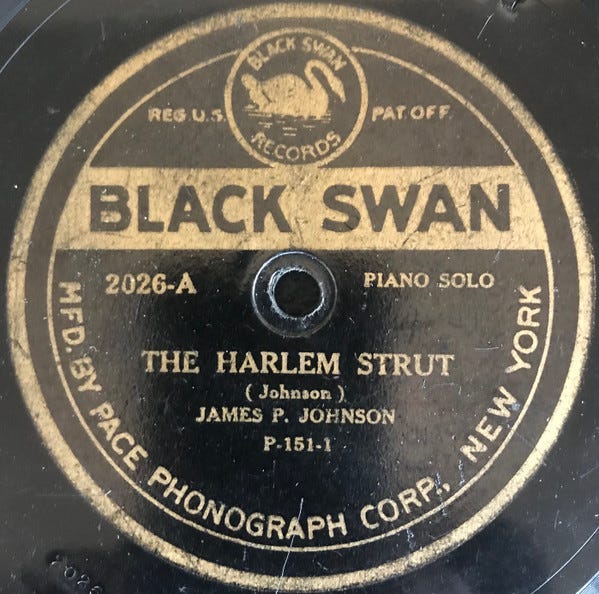
I took it to Columbia Records, but it didn’t go. Victor Records also turned it down. Harry Pace had formed the Black Swan Record Company that made the first successful colored record with Ethel Waters’ “Go Back Where You Stayed Last Night” and “Georgia Blues.” He gave me a chance to back singers with my combos. I made a solo, “Harlem Strut,” for Black Swan and some commercial songs, too.
We’d play anywhere for small dough to keep busy, and go around to dancing classes in the afternoon. Then I got a break and was offered a road job playing with a Smart Set show on the road-one week in Philly, one and a half weeks in Wilmington, Baltimore. Norfolk and Atlanta.
We played first in the Standard Theatre in Philadelphia, which was a haven for colored performers. It was run by a Negro, John T. Gibson. The director of the orchestra there at the time was Benton Overstreet, a fine musician and arranger. He was the composer of “There’ll Be Some Changes Made.” He never lived to hear it become famous. In the Philadelphia Dancing Class, a lively girl named Ethel Waters from Chester, Pa. had made quite a hit. She wasn’t pretty, but she had a lively, funny personality and was a great comic dancer.
After Philadelphia, we played Wilmington and Baltimore. The next stop was Norfolk, sa we took the Chesapeake Bay boat and relaxed... a little bit too much. I had a few drinks and dozed off. When I woke up, I found that somebody had taken all my money and my collar buttons, which were gold. Others had been robbed, too, by the lush-rollers. We wouldn’t have a cent when we got to Norfolk.
There was a piano on the boat, so I sat down and started to play, and my wife, who was with me, began to sing and dance. Pretty soon money started dropping. When the boat tied up, we had enough to eat in Norfolk. In Atlanta with the same Smart Set show, we played at the 81 Theatre on Carter St. At 91 the Bessie Smith Trio was singing. Since there was still a wartime atmosphere, they were singing “Liberty Bells” and when they came to the end of the chorus about the Liberty Bells ringing out victory, they used to turn around and waggle their plump butts in time to the bell ringing. It was a knockout effect.
Later I went to a party in Atlanta where Bessie was, and I played behind her in her “Alcoholic Blues,” improvising the accompaniment. This wasn’t so hard because all true blues are the same form. Every natural blues has: 4 bars opening in tonic/2 bars to subdominant/2 bars back to tonic/2 bars to dominant/2 bars ending in tonic. To be a real blues it must follow that plan.
At 91 Carter St., Eddie Heywood Sr. played regularly, although he was laying off when I was there. He was a great blues player and was known as “The Ragtime King of the South.” I wish I had been able to hear him. His son is a fine player and arranger now: Eddie Heywood, Jr.
During the same trip, I got out to Toledo, Ohio where I heard Johnny Waters who played “Western” piano. He taught his tricks to Roy Bargy, who was later pianist in Paul Whiteman’s orchestra. Waters was a fine, natural piano player who had a pint of whisky every morning for breakfast. He did slow blues with tenths: “When The Cold, Cold Winds,” “Easy Rider,” “All That I Had Is Gone,” “Walkin’ The Dog,” etc. Handy was becoming popular then.
When I was in Toledo, I studied composition with Jan Chiapuse who was at the Toledo Conservatory. He was a Paris Conservatory graduate. All the time, I was playing in a club called The Lion’s Jaw. Art Tatum later told me that he caught me there and studied my style. He was about 14 then.
At the end of 1919, when we got back, I picked up some short money playing gigs and Clef Club fast calls. I dropped into Edmund Johnson’s place at 132nd Street and Fifth Avenue. It was a black-and-tan place with singing waiters and that lively girl from the Philadelphia Dancing Class, Ethel Waters. Ethel was making her first big hit in New York singing songs like: “If You Go Away and Come Back and Somebody Has Taken Your Place-Don’t Get Mad,” “All Night Long,” a blues based on a current riff that was going around, and “The Blues,” with no special tune and with words she made up herself. She also used to sing my “Stop It, Joe!” and I would play behind her. She was a great comic singer — the greatest, in fact. I made records with her later.
Also at Johnson’s were Mattie Hite, one of the greatest cabaret singers of all time and Josephine Stevens, a coloratura, who was able to hold a note while the rhythm strode through and then pick up the rhythm without a break, a terrific effect.
Another interesting place in 1920 was Small’s Sugar Cane Club, a cellar club located on the southwest corner of 135th Street, and Fifth Avenue. It was the first Harlem night club to become popular with whites from downtown; the first of the big black-and-tan clubs, like The Cotton Club and Connie’s were to become later.
It was Charlie Small’s first place and the room where he made all his money. Charlie came from South Carolina, and most of his help were from that state, too. Many of them came from the Jungles, where I first played at Allen’s and Georgie Lee’s, since that neighborhood was full of South Carolinians. It was near the Ward Line docks whose boats ran to Charleston and other southern ports. Most of them were dock workers for the line. One of the attractions at The Sugar Cane was the jive of the waiters, who sang, danced and carried on a separate sideshow of their own while they took care of the customers between the regular floor shows. Each waiter served drinks or set-ups to his tables with an original strut, shuffle or tap, and then they’d cut away with a heel pivot and dip, spinning their empty trays over their heads like jugglers.
Those Small’s waiters sang, too! Solos and quartets, or if a shout refrain was indicated, they all joined in to make the room ring.
One of them was called “Whistling Seath” because he could whistle beautiful blues through his teeth with a fine mellow tone, giving as fine an effect as any voice or instrument. He was a very popular and attractive character and had a solid following, not only at The Sugar Cane, but all over Harlem.
At that time all good colored performers played at the Lincoln Theatre, which was to Harlem what The Palace was to Broadway or The Standard to Philadelphia. The Lincoln Theatre was the big, handsome successor to The Crescent, that little hole in the wall on 135th Street, where Harlem stage entertainment was born. As in all popular theatres, the gallery gods decided the fate of the performers. Some entertainers called The Lincoln “The Temple of Ignorance” because of the audi- ence’s preference for old-fashioned natural blues rather than the more artificial songs and ballads of Tin Pan Alley.
“Whistling Seath” from Small’s was a regular attendant at The Lincoln, and when a performer sang or played a blues, “Whistling Seath” would join in with his mellow whistle. The audience liked it, and most performers did, or seemed to. If he whistled behind you, it was a mark of acceptance, of success. You were in and had the house with you. He was part of a group known as Pimp’s Gang who acted like the permanent rulers of the Lincoln’s balcony and led the applause like the claques they have at the Opera downtown. Some artists used to entertain these fellows with liquor and food on the outside because they were influential, and their reaction in the audience could make you or break you.
When this gallery gang yelled: “Put us in the alley!” that was the signal for the entertainer on the stage to go into a low-down blues. Every piano player knew what to do. First, he hit the classical “blues announcement” with its familiar figure, and the audience squealed with anticipation. Then the musicians went into the groove with “Whistling Seath’ singing like a bird in the gallery. Everybody had a fine time. When you went “down the alley” at The Lincoln, you could be sure of a week and a return engagement.
Later on, Fats Waller got the same effect there playing the organ behind “Whistling Seath” during movies.
[Sadly, the interview abruptly ends there with the promise of more to come. However The Jazz Review folded and Tom Davin did not place further installments with any other publication. ]
Who was Tom Davin? According to my noted associate Matthew Guerrieri, who wrote the essay “James P. Johnson Gets Dressed”: “As an editor, Davin had worked for New York’s Museum of Natural History and Sheridan House, a publisher specializing in yachting and maritime volumes. In those roles, Davin mixed with American aristocracy and gentry—he turns up a few times, for example, in Charles H. Baker, Jr.’s legendary cocktail book The Gentleman’s Companion, that thorough compendium of the eating and drinking habits of the well-heeled American abroad. But Davin was also involved in radical and Communist movements of the 1930s and 40s, “marching with quaint and disordered fellows in May Day parades in Union Square,” as Baker put it, and occasionally writing for left-wing organs like New Masses. For a time prior to his Johnson interview, Davin had been effectively blacklisted from the publishing industry after pleading the Fifth in front of the House Un-American Activities Committee.”
I’m still working my way through the interview, but this is a fascinating glimpse into that era, at a street level that you normally don’t see. It’s compulsive reading.
I was going to send you a link to when I captured on my cell phone Aaron Diehl performing a James P. Johnson piece as an encore at his appearance with the Cleveland Orchestra earlier this year only to find it doesn't exist. Knowing I was going to record the broadcast the following night I didn't bother with my cell phone and the following night Diehl chose to play a Phillip Glass piece instead. Cue the sad trombone.