
James P. Johnson (2)
Mike Lipskin on stride piano + two tracks from "The Beetle" and a session from Willie Gant + listening guide to a few other more famous names
Mike Lipskin has held it down for decades as one of the few truly qualified stride pianists in America. He was there in the late 1950s and studied with Willie “The Lion” Smith, Eubie Blake, and Luckey Roberts; Lipskin even accompanied The Lion to the Great Day in Harlem photo shoot.
At 20:44 during this 1987 archival tape, Lipskin plays James P. Johnson’s “Mule Walk.” It’s the real deal.
Maurice Waller wrote a valuable biography of his father with an assist from Anthony Calabrese simply called Fats Waller. It was published in 1977 with a substantial foreword by Mike Lipskin.
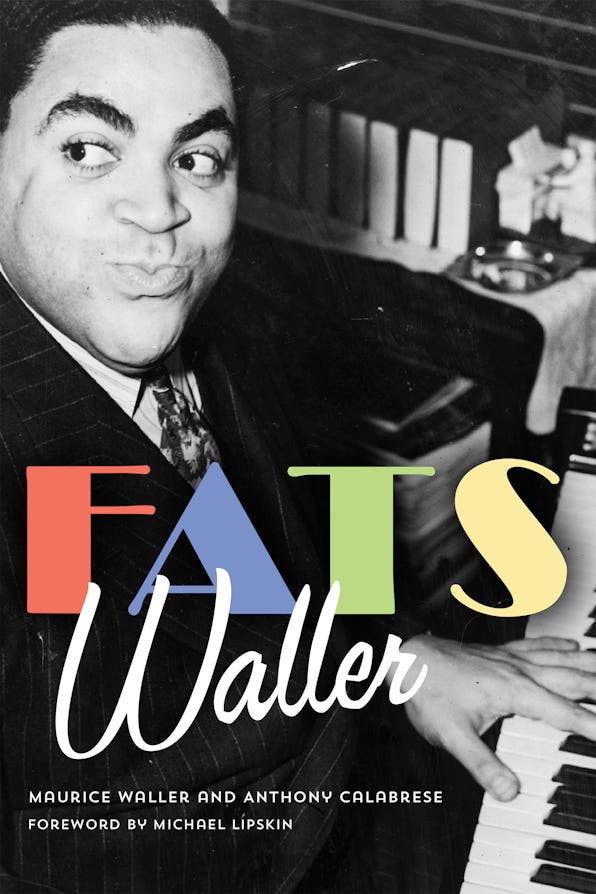
I don’t always trust the jazz histories from a certain vintage. Once-famous reference works like Rudi Blesh’s They All Played Ragtime and Gunther Schuller’s Early Jazz were written by egotistical critics who try too hard to prove they have the measure of the music. However, Lipskin is a player and he knew the creators, and his pocket history of stride piano (which is part of the foreword to Fats Waller) rings true. This excerpt goes through the start of the blues recording industry, and naturally includes a fair amount about James P. Johnson:
…“Stride” is a word coined in the early fifties…This musical language developed and was identified with the maturation of Harlem as a cultural center for black America before World War II.
In 1923, when a young Duke Ellington first arrived in New York, he called Harlem “the world’s most glamorous atmosphere. Why, it’s just like the Arabian Nights.” Ellington was more than correct, as this small northern section of New York’s Manhattan Island was the hub where musicians ended up after leaving New Orleans, Chicago, or St. Louis. The area fostered not only stride piano, but the first big band jazz units that eventually led to the swing era, and finally bebop.
As Harlem developed, at first middle-class Negro society moved there, and a proper music followed. By 1910 there were enough musicians uptown to form the Clef Club, a booking agency that provided the prejazz orchestras for high society, the show functions of the Castles, and the Ziegfeld Follies. The piano was then the main source of home and saloon entertainment in the United States, and every bar had one. Correspondingly, there appeared a growing number of keyboard “professors,” ragtime kids or ticklers as they were called, traveling from city to city and bar to bar. Often they were accompanied by a retinue of “ladies of the evening” who supplemented the musicians’ limited income.
From Baltimore to the Jungles, one could hear such colorful characters as Willie “Egghead” Sewell, “One Leg” Willie Joseph, Walter Gould, Jack “The Bear” Wilson (immortalized by Duke Ellington in a big-band piece of the same name), Richard “Abba Labba” McLean, Freddy “Harmony King” Bryant, William Turk, Fats Harris, and Jess “Old Man” Pickett. As Harlem grew, these pre-World War I musicians slowly migrated to New York, playing a version of ragtime that differed from the slower Midwest sound of Scott Joplin and Tom Turpin. Their music reflected a cosmopolitan exposure, and rather than play specific pieces they used a variety of material that included popular songs of the day and classical themes. Theirs was a faster ragtime that also combined the rhythms of the Southern Baptist church dance known as the ring shout (referred to in James P. Johnson’s “Carolina Shout”).
When they reached the Northeast, a group of younger pianists that included Eubie Blake, Luckey Roberts, Stephen “Beetle” Henderson, Leroy Tibbs, Willie “The Lion” Smith, and James P. Johnson followed the “professors” around. At the same time, an influx of Southerners and West Indians into Harlem slowly changed the atmosphere of the area from staid middle class to a vibrancy exploding within a set of city blocks featuring a variety of cabarets and nightclubs.
This then became the center of performance and music development where the younger men could expand their ideas and professionalism. Unlike the older pianists, they were very much interested in their music, and did not engage in pimping. They worked more steadily at jobs that gradually demanded reading sheet music and the ability to transpose songs on sight to accompany singers.
After hours the young men would meet, and try to outplay each other. These “cutting contests,” in which musicians tried to prove technical superiority over one another, happened throughout jazz history. Sometimes whole bands battled all night. With stride, though, the sound literally went nonstop for hours as one pianist took over from another. Beetle, for instance, would begin a pop tune and play as long as his creative juices would flow. Luckey Roberts, standing by, would then slide in alongside him and, at the end of a chorus, relieve Beetle’s hands, one at a time. Luckey would play for as long as he cared, and then Willie The Lion would replace him in the same fashion. Finally the dean, James P. Johnson, would sit in, and in this manner a single tune would last for perhaps a hundred choruses, with seemingly infinite variations. During the 1920s Cliff Jackson, Donald Lambert, Duke Ellington, Willie Gant, and other younger pianists like Fats Waller entered the cutting contests. As testimony to James P.’s superiority, they often used one of his compositions as the basis of a contest, each performer trying to equal the master on “Harlem Strut” or “Carolina Shout.” The nightclub job requirements, and the fine honing of cutting contests, helped evolve Harlem stride into an anachronistically mature idiom unequaled in either variety or subtlety of technique until decades later.
By 1919 it was evident that James P. Johnson was the master and leader of the uptown piano. He could play faster than the others, transpose with a singular facility, and improvise with an inventiveness that didn’t stop. Born in New Brunswick, New Jersey, in 1894, Jimmy moved to San Juan Hill while in his teens. As the young Fats would a decade later, James P. played piano day and night as a child. First learning by ear, he sharpened his technique by “woodshedding” (playing in all keys) the rags of the older men. Later he taught himself Bach and Chopin. By the time he was twenty-five he had commercial player-piano rolls on the market, and his “Caprice Rag,” “Carolina Shout,” “Harlem Strut,” and “Mama and Papa Blues” were a part of the repertoire of many other pianists.
James P. remained a musician’s musician even though he had pop success on Broadway, recorded beautiful sides with Bessie Smith, and wrote the hit theme of the 1920s, “Charleston.” During the Depression he spent most of his time at home in St. Albans, New York, writing serious symphonic works, some of which were performed at the Brooklyn Academy and Carnegie Hall.
The story of Fats and James P. would make a book in itself. No student and teacher in jazz were ever closer. Shortly after the death of Fats’ mother, James P. took Fats under his wing and painstakingly taught him basic technique, the concept of composition and improvisation, and, of course, the language of stride. Here was a generosity and devotion to music that left a strong, lifelong mark on Fats. Without Johnson, jazz piano’s course would have been altered; further, Waller’s sound would have been totally different.
While James P. was teaching Fats, Harlem was witnessing the birth of “race” records discs recorded by black talent for the black audience. Although the first supposed jazz record, “Livery Stable Blues” by the Original Dixieland Jass Band, had been released by the Victor Talking Machine Company in 1917, it was a white version of the poetic New Orleans music that was being created in the ghettos throughout the South and Midwest.
Then there were almost no black records, and the only significant ethnic outlet then was through piano player rolls. Eubie Blake, Luckey Roberts, and James P. had all cut rolls by 1916, but the final sound was mechanical, not conducive to displaying the subtle rhythmic and technical differences. For this reason their piano-roll product was distributed in the same manner as that of George Gershwin, Jimmy Durante, Felix Arndt, and Max Kortlander. Young Ellington and Waller studied their masters’s styles and techniques by slowing the rolls down and placing their fingers in the depressed keys as the piano played.
In any case, Harlem was host to an ever-increasing number of blues singers, dancers, and instrumentalists, all making the new “hot” music in the uptown nightspots. One songwriter from Georgia, Perry Bradford, had some blues songs, and vainly attempted to get the downtown record companies interested in his material. Ralph Peer, the recording director for Okeh, was finally interested after hearing Mamie Smith, a singer then working in Harlem, sing Bradford’s “Crazy Blues.” In 1920 an Okeh recording session was arranged, with Willie The Lion conducting the house band from the Club Orient. They cut “That Thing Called Love,” “You Can’t Keep a Good Man Down,” “Crazy Blues” and “It’s Right Here for You,” all with Mamie Smith as featured vocalist. Okeh released the first two sides without much reaction, probably because they contained more of a novelty than a blues feeling. But when they issued “Crazy Blues” someone had the idea of making sure the Harlem record stores would play the disc.
As uptown people went to work one morning they were astounded to hear, coming out of stores, the sound of one of their own, singing the blues with a band that was definitely from the neighborhood. The response was fantastic, and Okeh, happily surprised, sold hundreds of thousands of this first blues record in black areas throughout the United States. This episode was important because it proved to the music businessmen that there was money to be made in black music. — Mike Lipskin, from the foreword to Fats Waller
In the Tom Davin interview reprinted yesterday, James P. Johnson lists all sorts of New York area players active in the first quarter of the 20th century. The most famous are known to aficionados thanks to some imperishable recordings, especially Eubie Blake, Luckey Roberts, Willie “The Lion” Smith, and Donald Lambert. The younger generation included Fats Waller, Duke Ellington, and even Count Basie. Cliff Jackson, Hank Duncan, and Joe Turner also made worthy records.
But what of Abba Labba, “Snowball” Wilkerson, Alberta Simmons, Ernest Green, Sam Gordon, Fred Bryant, Fats Harris, Dickie Huff, Floyd Keppard, Dan Avery, Bob Hawkins, Lester Wilson, Freddie Tunstall, Kid Sneeze, and Mike Jackson…?
Above, Mike Lipskin cites Leroy Tibbs, Willie “Egghead” Sewell, “One Leg” Willie Joseph, Walter Gould, Jack “The Bear” Wilson, Freddy “Harmony King” Bryant, William Turk, and Jess “Old Man” Pickett…?
Were all these many players really that good?
Maybe so. Just recently I discovered two tracks from Stephen “The Beetle” Henderson, a mysterious figure who usually turns up in these lists of top Harlem pianists. Ellington thought highly of the Beetle. I thought the Beetle didn’t record, but it turns out there are two James P. Johnson pieces caught live on Art Hodes’s radio show in 1945.
The composer played “Keep Off the Grass” in F and “Carolina Shout” in G, and the Beetle plays both in B-flat. Odd! Perhaps he played everything in B-flat? At any rate these are truly outstanding stride piano performances that sound like nobody else.
James P. Johnson talks quite a bit about Willie Gant, and all of sudden five minutes of Gant exist on YouTube. These are not in the Lord discography, and a bit more documentation would be helpful (just says private session in 1959). It does sound like an old-time player, someone who is an all-round party pianist rather someone overly concerned with new-fangled “jazz,” although the uptempo left hand on “After You’ve Gone” and “Twilight in Turkey” is marvelously accurate and swinging.
It is worth mentioning that the Harlem Piano heyday was around 1920 and a bit later, so we are hearing these pianists somewhat after the fact. It doesn't sound like it! The Beetle and Gant seem to be at full power. But only James P. Johnson recorded many sides in the 1920s, although there is a tiny bit of Eubie Blake, especially a wonderful “Sounds of Africa” from 1921. Even Willie The Lion, Donald Lambert, and Luckey Roberts only got into the studios in the later ‘30s and then the ‘40s.
Gimme one track from each? Ok, you got it.
Eubie Blake, “Sounds of Africa,” 1921.
James P. Johnson, “Keep Off the Grass,” 1921. (Interesting to compare with the Beetle’s later version.)
Willie The Lion Smith, “Echoes of Spring,” 1939.
Luckey Roberts, “Railroad Blues,” 1946.
For Eubie, JPJ, the Lion, and Luckey, I choose terrific original compositions. Lambert will be represented by a wonderfully outrageous transfiguration of Richard Wagner.
Wonderful piece in every way. Thank you, Ethan!
Great stuff as always -- curious where you would place Herbie Nichols in this lineage?