
"I Like the Quiet"
RIP Nicholas Brendon
It is hard to process that the actors who portrayed Dawn (Michelle Trachtenberg) and Xander (Nicholas Brendon) on Buffy the Vampire Slayer are now both dead.
While Dawn was a later addition to the cast, goofy Xander was there from the beginning, part of the essential chemistry of the Scoobies. To some extent he was the most disposable character, and—thanks to the unique properties of the show—thus got a feature episode written by Dan Vebber and directed by James Whitmore Jr., “The Zeppo.”1
In the penultimate scene, Xander gets a rare chance to be conventionally tough during a standoff over a ticking bomb.
XANDER: I know what you’re thinking. Can I get by him? Get up the stairs, out of the building? Seconds ticking away...I don’t love your chances.
JACK: Then you’ll die, too!
XANDER: Yeah, looks like. So I guess the question really is, who has less fear?
JACK: I’m not afraid to die! I’m already dead.
XANDER: Yeah, but this is different. Being blowed up isn’t walking around and drinking with your buddies dead. It’s little bits being swept up by a janitor dead, and I don’t think you’re ready for that.
JACK: Are you?
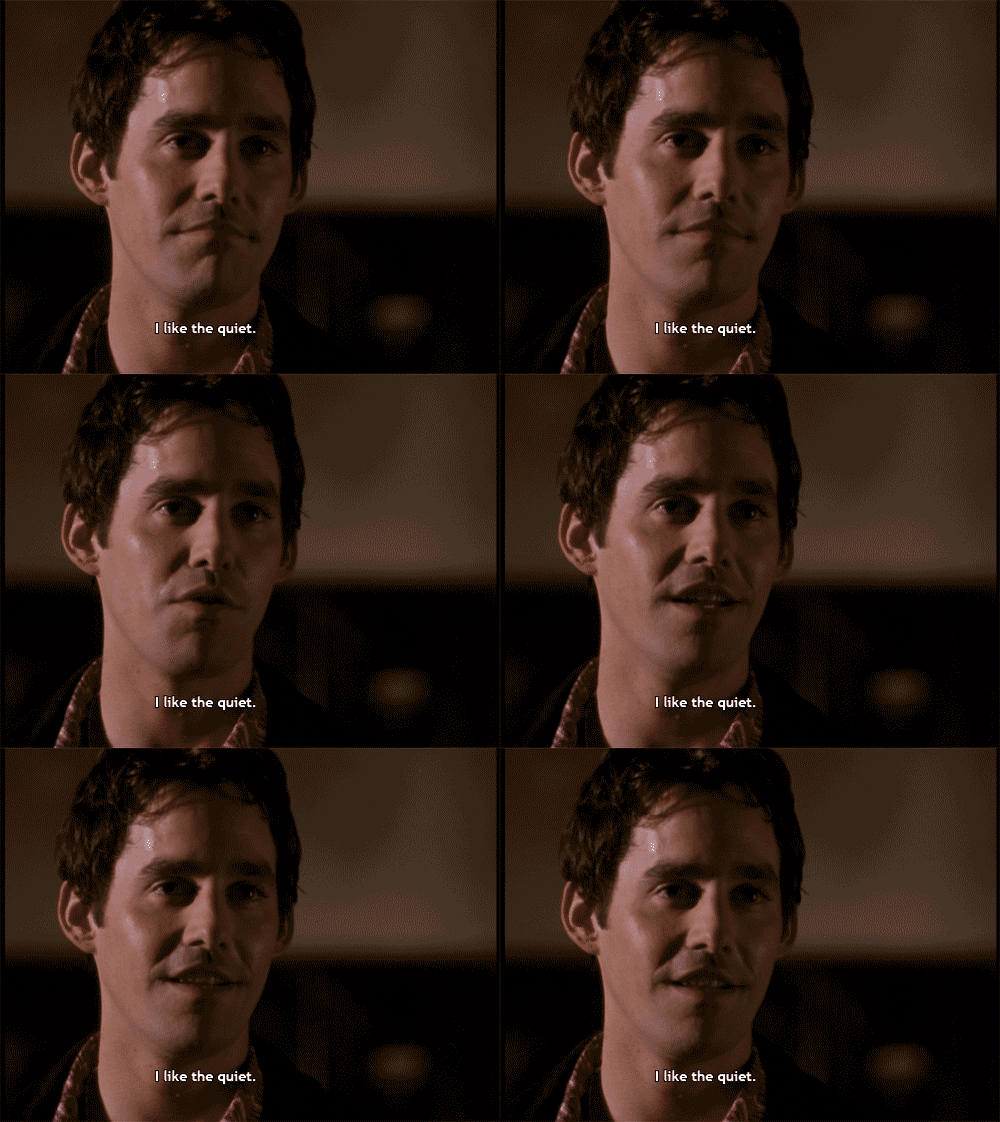
XANDER: I like the quiet.
I confess “The Zeppo” is one of my favorite things of all time. Part of the perfect unity on display is Nicholas Brendon’s delivery of a line that turns out to be the episode’s summation, “I like the quiet.” He’s still smiling a little bit, essentially goofy as always, even at this tense moment bemused to be suddenly in a starring role.
“The Zeppo” is not recommended as a Buffy entry point only because it works against an established formula. If you are new to the show, my suggestion is simply to start with season one, episode one, “Welcome to the Hellmouth.”
Season three is generally considered the best, and part of what makes season three so great is “The Zeppo.” Below is what I wrote in 2023:
A television show requires a lot of product made in a short time on a restricted budget. The team is on deadline, doing it as well as they can, by any means necessary.
Creator Joss Whedon described season one of Buffy the Vampire Slayer:
We shot the show in a big warehouse in Santa Monica. We don’t have a real studio to shoot in…we were very much on a tight budget. [For the first twelve episodes set in Sunnydale High School] we only had the one hall. So, we use it over and over again.
With certain exceptions, I don’t go so much for grand opera or the great American novel or meditative arty European cinema. I like jazz in the club, crime fiction, and Buffy.
Being creative in a tight space is exciting.
A long-term soap opera can be partially defined as, “a story where everyone eventually sleeps with everyone else.” Soap opera or not, the plot possibilities of any TV show get used up over time. Eventually the reversals get more and more elaborate and ludicrous. The smart money quits before “jumping the shark,”2 but it turns out that little of the money is smart.
There were seven seasons and 145 episodes of Buffy the Vampire Slayer broadcast between 1997 and 2003.
Sarah and I have seen all of Buffy at least once. The show went on too long, a lot of sharks were swimming in the water by the end, so we’ve never felt compelled to re-watch season seven.
Some of the very best Buffy episodes are in seasons four, five, and six. We’ve watched most of those a few times. Indeed, I’d argue that the fantastic musical episode “Once More With Feeling” early on in season six is the appropriate conclusion for the run.
But the heart of the matter is the first three seasons. We’ve watched these 56 episodes many times. The slayer and her team are still in high school, and the obvious yet juicy subtext is simply the trials of adolescence. Anyone can relate to the innocent themes.
Seasons one and two are excellent, but the show builds into something strangely profound in season three. Season three is the apex.
It’s still TV, though. The team had to blast out 22 episodes, so how could they all be equally strong? On this last run we skipped “Revelations” and “Helpless.”
Four of the best episodes land partially thanks to the longer context of previous seasons: “The Zeppo” (written by Dan Vebber), “The Wish” (Marti Noxon), “Doppelgangland,” (Josh Whedon), and “The Prom” (Marti Noxon).
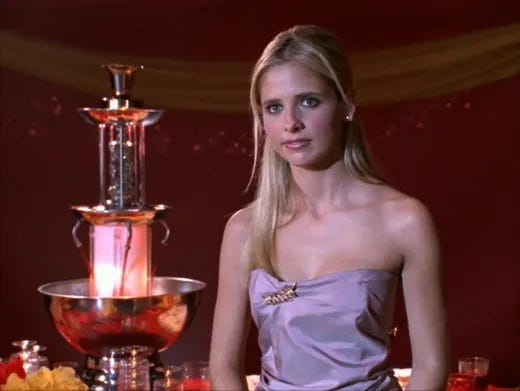
Most TV finales are a bit disappointing, but season three’s conclusion “Graduation Day” (by Whedon) is pretty darn perfect.
OZ: Guys, take a moment to deal with this. We survived.
BUFFY: It was a hell of a battle.
OZ: Not the battle. High school.
Roll call, season three:
Sarah Michelle Gellar as Buffy Summers
Nicholas Brendon as Xander Harris
Alyson Hannigan as Willow Rosenberg
Charisma Carpenter as Cordelia Chase
David Boreanaz as Angel
Seth Green as Daniel “Oz” Osbourne
Anthony Stewart Head as Rupert Giles
Kristine Sutherland as Joyce Summers
Eliza Dushku as Faith
Harry Groener as Mayor Richard Wilkins III
Alexis Denisof as Wesley Wyndam-Pryce
Creator, executive producer, and showrunner: Joss Whedon (also wrote five episodes)
Executive producer: David Greenwalt (wrote two episodes)
Co-producer: Marti Noxon (wrote five episodes)
Executive story editor: Jane Espenson (wrote three episodes)
Story editor: Douglas Petrie (wrote two episodes)
Staff writer: Dan Vebber (wrote two episodes)
Additional writing: Dan Fury and Thania St. John
Directors: Joss Whedon, James Whitmore, Jr., James A. Contner, David Greenwalt, Michael Lange, David Semel, Michael Gershman, David Grossman, Regis Kimble, David Solomon
Cordelia calls Xander “The Zeppo” in reference to Zeppo Marx, who—when compared to Groucho, Harpo, and Chico—was the most boring brother of the exceptionally talented Marx brothers.
The phrase “jumping the shark” comes from an episode of Happy Days where the Fonz literally gets in the water and completes this action.
Perfect.
Congratulations, you've made me curious about this series.