
Veronica Geng, "Tribute"
a timely satire for a snow day
After Vince Keenan made me laugh with a Substack Note…

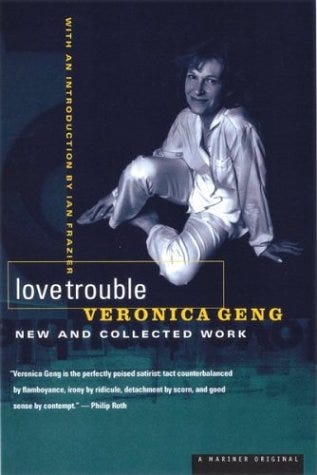
…I suggested that Sarah read me “Tribute” out of the magnificent Veronica Geng collection Love Trouble. (It was a snow day, after all.)
“Tribute” is hard to understand if you don’t command the context. Geng was a genius at satirizing voice, and in this case, she is attacking the relentless positivity of a banal awards show.
TRIBUTE by Veronica Geng
I’m not blaming the news media for this, because if their coverage of the XXIII Olympiad featured the athletes, the athletic events, and the Olympics per se, that’s probably as it should be. It’s right, yet in another way it’s perhaps also wrong, to have overlooked certain small, unofficial things that people all over the country did to sustain the national and even international mood of Olympic pride and pain. One of these things was a thing Ed did right in our apartment. It was Sunday, August 12, 1984, about 10 p.m. New York time, during the closing ceremonies of the Olympics. Ed and I were half watching them on TV while we tried to cover our refrigerator with Con-Tact paper. It’s the refrigerator Ed had for years when the apartment was his bachelor pad, and a cat he used to have had a habit of jumping on top of it and walking around and then clawing her way down the sides trying to get off, so the enamel finish had gotten all scratched and then the scratches had rusted; when I moved in a few months ago, we decided to cover the whole thing with black Con-Tact paper. Well, we were going nuts trying to cut the paper to fit around the handle and around the screws on the corners. There were scraps of Con-Tact paper all over the floor.
It must have been close to 11 p.m. New York time—at the Olympic ceremonies they were reprising all the national anthems—when I noticed that Ed, barefoot, was walking across the kitchen with one of the scraps of Con-Tact paper stuck to the bottom of his right foot. The paper was somewhat bigger than his foot—roughly the size of a piece of typing paper—and I want to emphasize this: the backing had not been removed to expose the sticky surface. (I know this, because that’s the way I apply Con-Tact paper—cutting it to shape and only removing the backing when I get a perfect fit.) It was pretty hot in the apartment—we’re way up on the twenty-third floor and we had the windows open, but it was August, remember, and we don’t have air-conditioning—so I guess the perspiration on his foot helped it adhere to the rather glossy surface of the paper.
I didn’t think too much about it, but I kept noticing it out of the corner of my eye, like a visual irritant, and finally—just for something to say, because it was getting a little tense in there, what with the heat and the frustration of this refrigerator project—I said jokingly, “When are you planning to take that piece of paper off your foot?”
Quietly, Ed replied, “I think I’ll keep it on until the official closing of the Olympic Games, as one man’s tribute to the Olympic spirit.”
I let out an audible gasp. Quite simply, the man is a genius. In that improvisational, or seemingly improvisational, moment, he proceeded to unveil a technique as powerfully controlled as if he’d trained for years. Altering his gait slightly, so as to press his foot firmly on the surface of the paper with each step, for several hours he walked a fragile tightrope between tragedy and comedy. I detected no signs of cramping.
I’m aware that in some quarters “technique” is a dirty word, and I realize that Ed might come under some criticism if I harp too much on the skillfulness of his performance. Suffice it to say that it was not despite but because of his skill that he was able to celebrate so lovingly not only the greatness but, more important, the defects of human beings. The perfection—one might say even the imperfection—of his performance was that although it caused him to suffer minor discomfort in the last hour, it was completely pointless, aspiring neither to goal nor to glory. But is it truly pointless when, say, a scientist who could be discovering a cure for cancer discovers, instead, an infinitesimally tiny molecule with no conceivable medical or athletic implications? Isn’t what really counts that the task was done just for the sheer joy of the doing? What Ed did, he did with total love and commitment. By the end of his performance, as the ABC-TV closing credits rolled down the screen and a voice on the P.A. system at the Olympic stadium intoned the concluding words “Will the choir please leave the stage,” I thought less of Ed as an athlete but a great deal more of him as a person.
Surprisingly, or maybe not so surprisingly, people want to applaud the accomplishment of something they know is “difficult.” But what if a man is, God help us, an original, who does something completely new and makes it look easy? In this dog-eat-dog world, I find a man like that not just an inspiration but an antidote to post-Olympic letdown. Ed’s achievement by no means devalues the medals won by the official Olympic athletes in competition, but when we threw all the scraps of Con-Tact paper out the window and watched them flutter down on the ticker-tape parade, we both felt on top of the world. — Veronica Geng
The world desperately needs a reissue of Veronica Geng’s Love Trouble.
This was a perfect antidote to the letdown of the end of the Olympic's three week diversion from "the world according to Trump"!