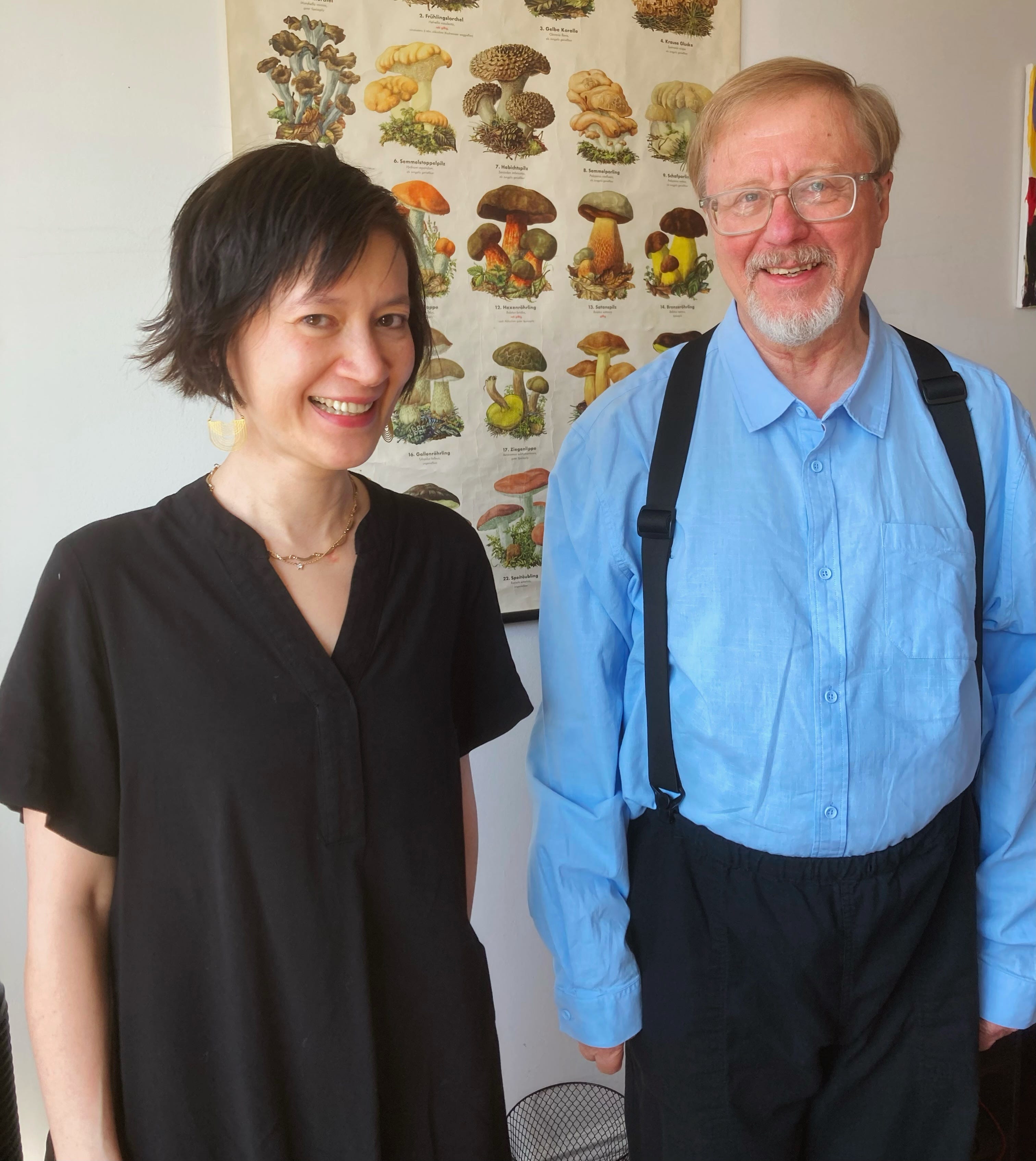
TT 571: Interview with Georg Friedrich Haas
on the occasion of a tremendous new violin concerto
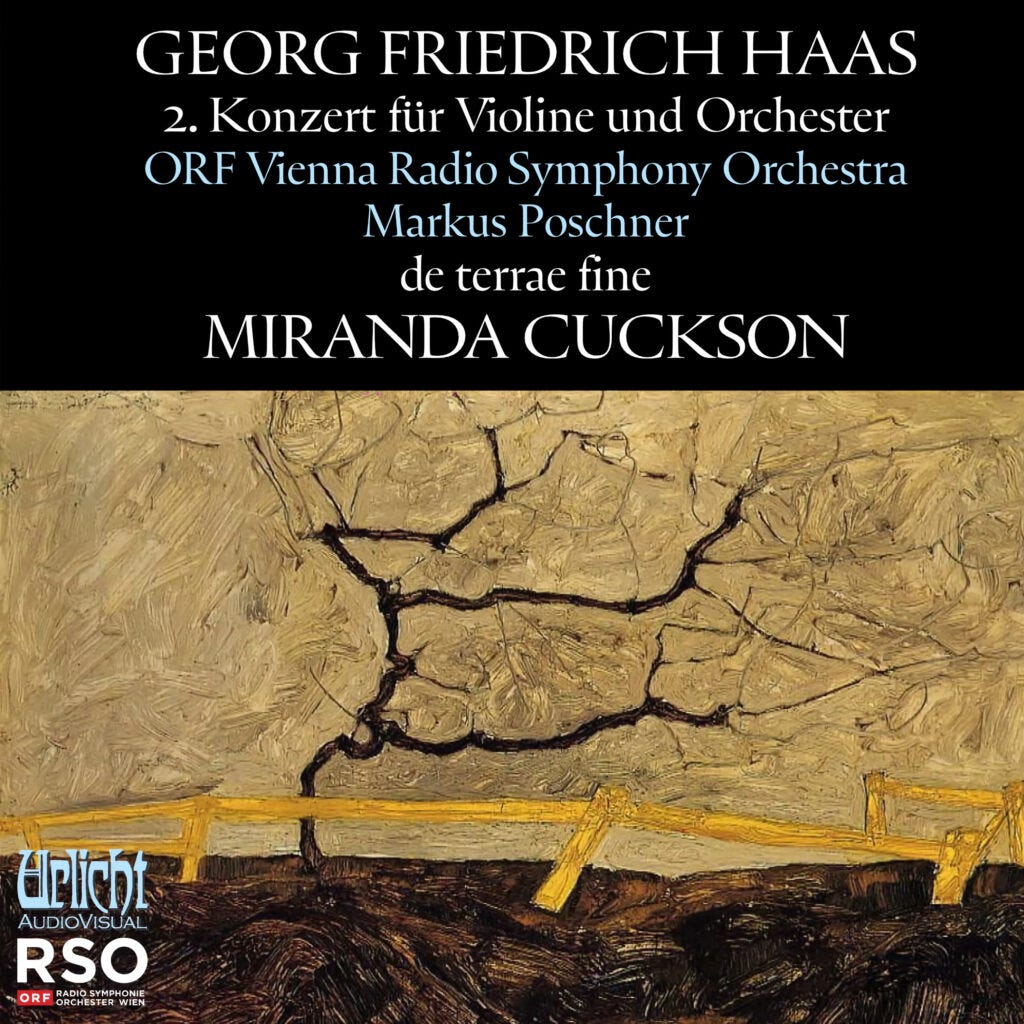
The Violin Concerto No. 2 of Georg Friedrich Haas is released in digital and CD formats on the Urlicht label. Miranda Cuckson is the soloist with the ORF Vienna Radio Symphony conducted by Markus Poschner.
The concerto is paired with Haas’s solo violin work de terrae fine, previously released on Cuckson’s spectacular recital Melting the darkness.
Talking with Georg Friedrich Haas over Zoom gave me a decidedly odd feeling. I know many fantastic musicians but have rarely met a “great European composer.” Haas is that: A truly great composer, one of those that headlines a chapter in the history books, someone who shapes the elite musical direction of a continent. The intellect and charisma was palpable, and I was considerably more shy than usual.
Miranda is my friend, she made the introduction. (Gene Gaudette is also our mutual producer.)
Related gig announcement! Miranda joins Parker Ramsay and Jay Campbell for a must-see concert featuring “alternate tunings from modern to baroque” this Thursday, February 26 at Kaufmann Center. On the program is a Haas premiere, Annäherung.
This morning, before posting, I listened carefully again to Violin Concerto No. 2. It is easy on the ears, in nine distinct sections, and a fabulous showcase for the soloist. At the top, the orchestra finds its footing (“prelude”) before the violinist throws down the gauntlet (“cadenza”). The two elements combine and multiply (“resonance and feedback”) and eventually generate a brief bitter agreement (“three part invention”). At midpoint, the orchestra threatens to overwhelm the soloist (“sgraffito”) before reversing direction. A magical offering (“in a quiet voice”) encourages the orchestra to reset (“interlude”). A complicated peace (“just intonation”) is the longest movement, but the troubles are not over; a farewell (“aria”) speeds up and marches the argument offstage. Further valuable notes on the work can be read at Miranda’s own site.
Ethan Iverson: Do you use a computer notation program?
Georg Friedrich Hass: I have used Sibelius since 2000. It’s a tool. Sometimes I compare it to musique concrète, in terms of how the composers worked with the possibility of electronic reality.
For example, the score to my violin concerto for Miranda has a complexity that would not be there if I had been forced to write it by hand.
My first full orchestra piece was from 1993. I was writing by hand, but after two months, I realized if that I kept going in this level of complexity, I would need 20 further years to finish one piece. So, I changed my language, because I wanted to do other things.
Today, with the computer program, I am able to continue in that former complex manner—although, to be clear, my imagination is really the source for the sounds. Recently I was quite angry when judging the scores at the Takemitsu competition, for the young composers were using so much copy and paste. This means they are not masters of the program. Instead they just say, “Oh, look at the lovely gifts the computer gives me!”
All sorts of complex progressions and rhythms cannot be done automatically. Especially with triplets and quintuplets, you have to rewrite everything as you go.
EI: Witold Lutosławski got fairly complex sounds with aleatoric notation, but as far as I know, this is not part of your style.
GFH: You are right, and this is the reason: In 1991 I was working on my first string orchestra piece. It started complex, and became even more complex as I worked on it. At some point I went to aleatoric, for this seemed like the logical next step. However when the aleatoric section started in performance, the tension abruptly decreased.
At that moment, I understood how notation is not just a kind of a document of the sound, it is an instruction for the performance. It is a communication. If I ask the musicians, “Please practice this crazy rhythm,” the result is very different than if say, “Play whatever you want.”
EI: When I looked at the score for Violin Concerto No. 2, I was impressed by how practical it was. Of course it is complex, but it is also playable. Not the solo violin part, of course, that is in a different category! However, the orchestral parts seem manageable, despite everything.
GFH: I always have to be conscious of this basic fact: I work with human beings. And these persons give me the gift of their time. It is a kind of moral necessity to find a way to get what is needed with the least effort.
Sometimes—I’m sorry—there is no way around doing the work. If you want something to speak in perfect just intonation, you need to practice until you get it. But! when you get it, you are happy. One time I asked the conductor, “Could I have just ten minutes for this one chord?” It was wind ensemble of the Berlin Philharmonic, a traditional and conservative orchestra, and, after ten minutes, they not just got it, they applauded.
In this case, it makes sense to ask for this effort. But if it not something so audible, if I just want some crazy structure, then…no. This is not what I want to ask musicians to do.
EI: In the Violin Concerto No. 2 score, there is a moment in just intonation when you ask the strings to listen to the soloist, and then even for the soloist to help the orchestra. It is a kind of “this is how you tune in a practical way” written into the score.
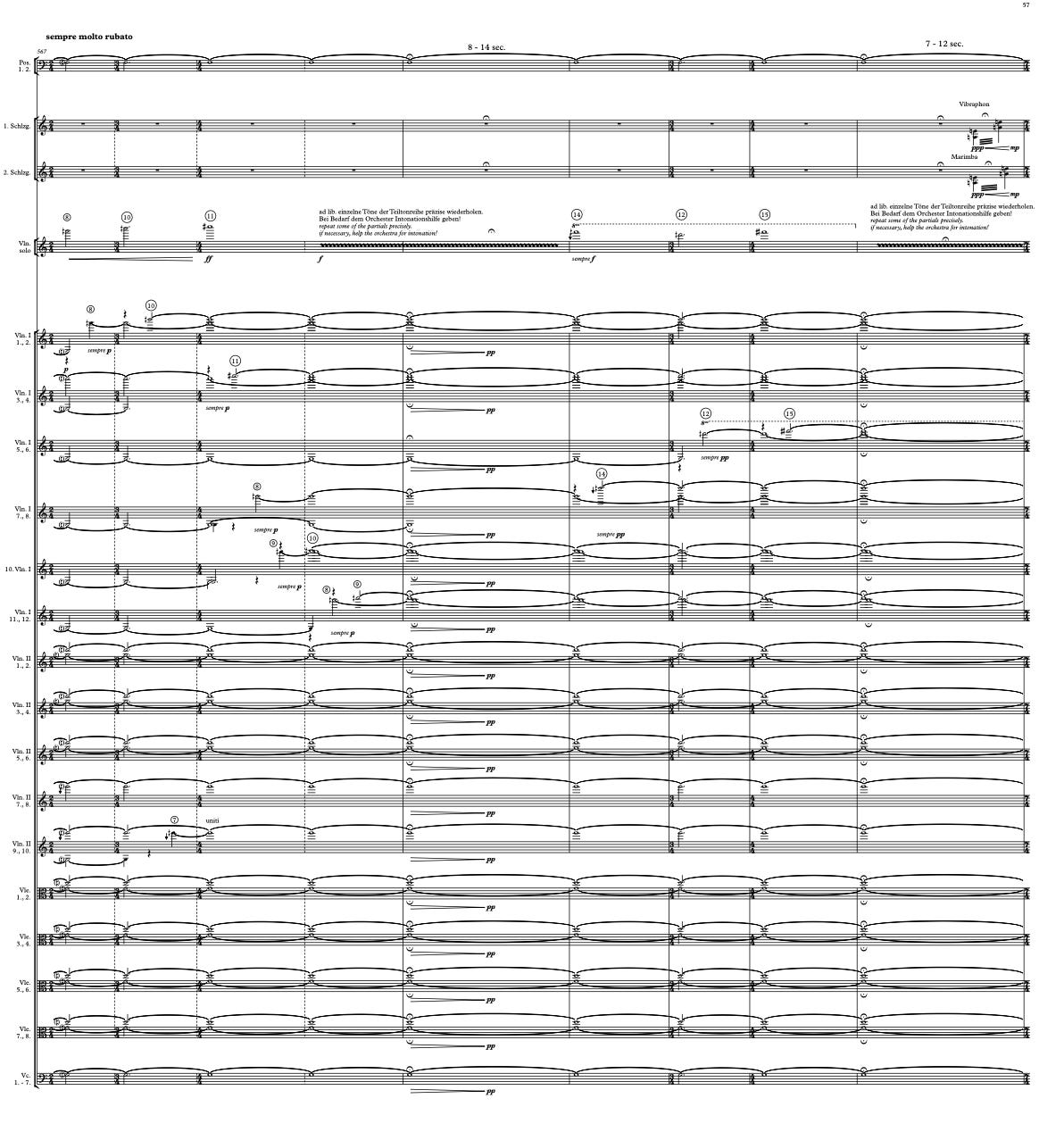
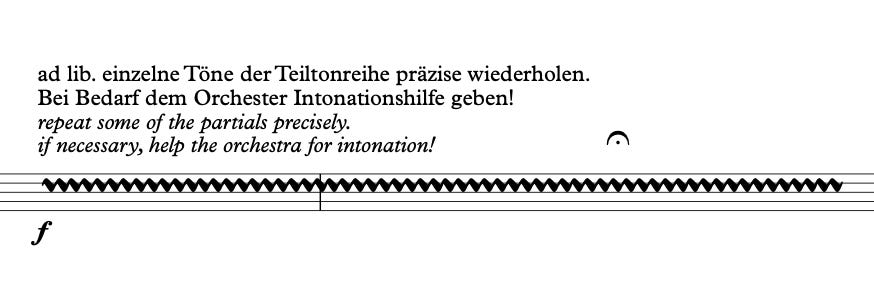
GFH: I always compose with connections. It is important that the musicians hear. Nothing is more problematic in new music than the performers: Many players don’t like it, they don’t want to do it, they don’t understand what it is for…and they settle for an approximation of what is written.
An orchestra is comprised of amazing and highly specialized musicians. And if you give them a friendly challenge, and say, “Please listen to this! Enjoy!”—then the result is beautiful.
EI: Sorry for a banal question, but how did you get interested in microtones?
GFH: In high school had a wonderful teacher named Gerold Amann, who sadly passed away just a few days ago. He made recordings of birdsong and squeaking doors. He transcribed this with an old Revox machine—a tape recorder that could adjust speed and pitch—-and wrote it out for piano. However, Amann explained to us: “Notice how the pitches of the piano does not have richness of the original birdsong. The piano has a C and a C-sharp, but the birds sing between!”
This was the start.
Later, I learned that all of music is microtonal. A fast passage of violin and flute in unison can never be perfectly in tune.
EI: There are a lot of famous piano quintets, but piano placed next to a string quartet can actually be a hard match in terms of intonation.
GFH: Absolutely, but it also has such potential. A good string player can meet the piano—softly, and with tiny changes of pitch—and achieve a blend where we all sit back and exclaim, “Ah! That’s so beautiful.”
Opera singers know how to sing out of tune in a way that is beautiful. The difference between a good opera singer and a bad opera singer is often simply that the good singer knows how to sing out of tune and the bad singer doesn’t know how to sing out of tune.
When I use microtones for composing, I am using something that has always existed. Performers have had freedom to use intonation as an expressive tool…but now, as a composer, I have to say to them, “No, now this is my job.”
EI: Miranda Cuckson seems to understand your sensibility and your tuning.
GFH: She’s fantastic; such an amazing musician, and also such an open-minded person who really wants to understand—and is able to understand—what is happening. Working with her is a gift.
Also on this CD is de terrae fine for violin solo, where the musicians has to change from quarter tones to 1/6th of tones to just intonation to 1/8th of tones. This is extremely difficult, and only very few people could do this as well as Miranda.
By the way, I hate the phrase “just intonation!” It is so ideologic. But I usually don’t know what else to say, that is the term we use. Perhaps I could lobby for “music using the frequency of overtones.” At any rate, more and more composers are using just intonation and microtonality, and more and musicians are coming to terms with the tuning.
EI: Miranda told me that sometimes you mark the tuning very clearly, and on other occasions is more general.
GFH: Again, notation is not an exact document, but a communication. For example: in a case where the music has overtone relationships based on the traditional chromatic system, resulting in slower melodies with 1/12ths of tones, then, of course, this must be perfect.
However, if I have a fast element, there is room for imprecision, for the ear needs time on each interval to perceive the tuning. Nonetheless, I still get a completely different result if I mark it with basic quarter tones instead of with tempered tuning.
Perfection is not always the ideal, and this is true also in rhythm. For a recent work I wanted a gradual accelerando, so I had quintuplets, sextuplet, septuplets, and so forth. But I also wrote on the score, “Please don’t play this perfectly,” because it would be wrong if it was perfect!
Notation has many limitations. If you played Beethoven in perfectly even tempo with his exact markings, it would be horrible. All music only becomes alive in hands of sensitive musicians.
EI: You have a large orchestra but much of the time everyone is playing very quietly.
GFH: Yes, this is just beautiful. Sometimes I don’t get it as quiet as I want, because the orchestra musicians want to hear what they play. “What is it?” They have to get louder, trying to find the meaning and the pitch, and then everything increases in volume.
In fact, I can prefer everyone playing a perfect pianissimo with the pitches a bit out of tune rather than mezzoforte with the pitches as I have composed. The struggle of the player to not control their instrument at the softest dynamic can be part of the effect.
Of course, if I want pitches to be heard clearly as part of sound structures, then I write that instead.
EI: I was surprised when the accordion appeared in the Violin Concerto No. 2.
GFH: The accordion is a wonderful instrument. Historically, the accordion is related to traditional Japanese and Chinese music and the wind instruments the shō and the sheng; when those reeds could be played by hand and with bellows, the accordion became a popular instrument in Europe. Still, for me, the accordion conjures a sacred or ceremonial atmosphere.
Also, the accordion was the instrument of Gérard Grisey, a composer very important to me. When you listen to Grisey, you hear the influence of the accordion! The accordion can do something that no other instrument can do, in terms of just handling the sound.
EI: Thanks for mentioning Grisey. Dare I ask you to name some other composers who have inspired you?
GFH: Well, this would change every day, but three names are always there: Franz Schubert, Ivan Wyschnegradsky, and Alois Hába.
I am friends with Helmut Lachenmann. His music is far away from than mine but I admire him very much, and he was important to my development. In fact, I just published an article in VAN: “The Last Romantic: Georg Friedrich Haas on Helmut Lachenmann at 90.”
The experimental American composers are also important to me! John Cage, James Tenney, La Monte Young, Harry Partch. Charles Ives…Julián Carrillo. They are mind-opening!
In the European tradition, Webern and Berg…oh, and György Ligeti, I should have named him much earlier, for Ligeti is absolutely one of my gods!
Closing comment from Miranda Cuckson:
At the dress rehearsal for a previous performance of this violin concerto, Georg came to the stage after listening to the run-through and told us “Great, thank you! So beautiful. I’m very happy.” Then as he and I stood there together quietly, while the conductor gathered his things, Georg turned his head and looked at me. He said, “The 10th partial is too low.”
I replied, “In the just intonation section?”
He nodded. Dang it! The work always continues…