
TT 565: Structural Features of Early Bad Plus
What’s in a Rock Cover?
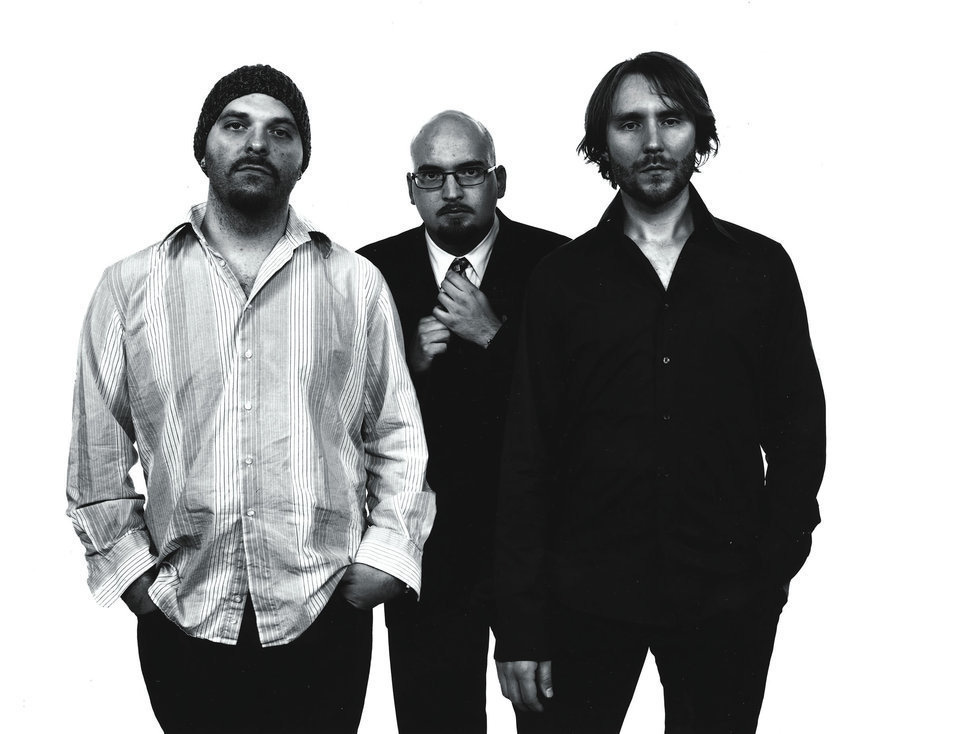
According to an Instagram post, The Bad Plus is calling it quits. It is rather a shame the farewell text doesn’t mention Ben Monder or Chris Speed, for reportedly the ensemble had settled into a secure sound that the fans liked. Instead, Reid Anderson and David King will tour this year with Chris Potter and Craig Taborn playing the music of the Keith Jarrett American Quartet. This final iteration seems more like Broken Shadows (the band with Tim Berne and Chris Speed) then the Bad Plus, but this new ensemble will undoubtedly offer good concerts, and of course a “project” is attractive to promoters—especially with Potter aboard, one of the most beloved tenor saxists of the age. Taborn has played with Anderson and King since they were all teenagers in Golden Valley, and, indeed, there is a strong argument that Taborn should have been the pianist in Bad Plus from the beginning.
I’m a Keith Jarrett fan, but I never thought Jarrett’s original themes were much more than serviceable/appropriate for the innovative group languages of his marvelous bands. Certainly Jarrett is not Ornette Coleman or Thelonious Monk in terms of creating instantly memorable melodies. It says something about something that Branford Marsalis made his recent Blue Note debut playing the music of the Jarrett European quartet, and that the Bad Plus will end their tenure playing the music of the Jarrett American Quartet.
Tribute projects may obscure contemporary composition. In the Bad Plus, there was at least one great composer, Reid Anderson. Dave King also had brilliant ideas, and something like his “Anthem for the Earnest” was key to the band’s sound, but King was more like a punk rock craftsman, someone who could create something fresh out of thin air with very little traditional training. Anderson was the one who understood European harmony and counterpoint, and past that, Anderson really understood pop song on a cellular level. Certainly Reid Anderson is a better tune-writer than Keith Jarrett! It is one of the curiosities of relatively recent jazz history: When the Bad Plus had their surprise breakout in 2003, Anderson’s visible career as a jazz composer in the community was sidelined. Previously, Anderson’s albums on Fresh Sound suggested he was on track to be a major composer of a generation—around the turn of the century, both Mark Turner and Kurt Rosenwinkel played a couple Anderson tunes even when a different bassist was on the gig—and to this day, some insiders think Anderson’s solo album The Vastness of Space (2000) is superior to anything that the Bad Plus ever did.
The blessing and the curse of early Bad Plus was the focus on rock covers. Indeed, the brief mention Bad Plus gets in the jazz history books is frequently confined to the covers. (I have rarely seen a statement from a critic to the effect that Anderson’s original melodies were of unusually high quality.) Of course, the covers gave the band a significant career, and a significant career is hard to come by. And, to be fair, the band’s approach to rock covers was innovative. While there was ostensibly nothing new about playing pop tunes in a jazz context, they still sounded fresh and different when we got our hands on ‘em.
Some critics thought we were hopelessly ironic in our appropriations, others dismissed the covers as nothing more than a cash grab. The fans generally couldn’t get enough: More than once, I was under the impression that the audience patiently waited out our original music before exploding when we finally played “Smells Like Teen Spirit” or “Flim.”
We were genuinely interested in trying to find a new way to infuse something of an avant perspective into familiar themes; at the same time, we also were trying to position our original music as just as worthy as the covers, an impossible task. When we were offered some pretty big opportunities, like being featured on television under the auspices of Jools Holland and Conan O’Brien, we played original music. In retrospect, perhaps we should have doubled down on the covers: Our reach with the general public might have gone a bit further.
On the occasion of the band’s demise, I thought I might be of moderate historical interest to go back and listen to the covers from the first three albums, trying to remember what I was thinking about a quarter of a century ago.
The idea of “deconstructing” a piece of music has always been part of my aesthetic: Indeed, some of my first albums grouped originals and standards as Construction Zone and Deconstruction Zone. Reid and Dave had already explored using rock music as a vehicle for improvisation, with themes from Led Zeppelin etc. being featured in early bands.
The first gigs were as the Ethan Iverson trio in Minneapolis. There might have been a few originals but mostly we played jazz standards. Certainly there was “Body and Soul,” “Just In Time,” and so forth on the set list. However, Reid and Dave were interested in rock music, and they suggested adding in something of more recent vintage.
At the risk of boring the reader, I might try to explain something of my personal history…
They throw around the word “nerd” pretty easily these days. I guess we inherited the earth? The gazillionare tech bros are nerds, the endless streaming content with sorcerers and dragons are for nerds, one “nerds out” when having a passionate conversation about a shared interest.
Well, I was a nerd before it was cool. Contrary to whatever people brag about today, being a nerd was a serious ailment. Playing for the Mark Morris Dance Group was the first chink in the armor, playing in The Bad Plus completed something of a transformation. I can more or less get by in society now, but for a while it was touch and go.
Before these high-end art jobs, interacting with a conventional peer group was irritating and listening to the radio was anathema. (I think I went to one party in high school and didn’t like it). At the time it was a pretty famous story: When Reid and Dave were bringing up songs to play in the band, I didn’t know most of them, not even “Smells Like Teen Spirit.” They laughed and said I must have heard this essential anthem for our generation! But when they put on the Nirvana CD, I still drew a blank.
However, I was reasonably game and quickly learned it for the gig that night. The audience responded like were sent from above, and that was that. Dave suggested we name the band The Bad Plus in the manner of a rock group, something he had already done successfully with Happy Apple.
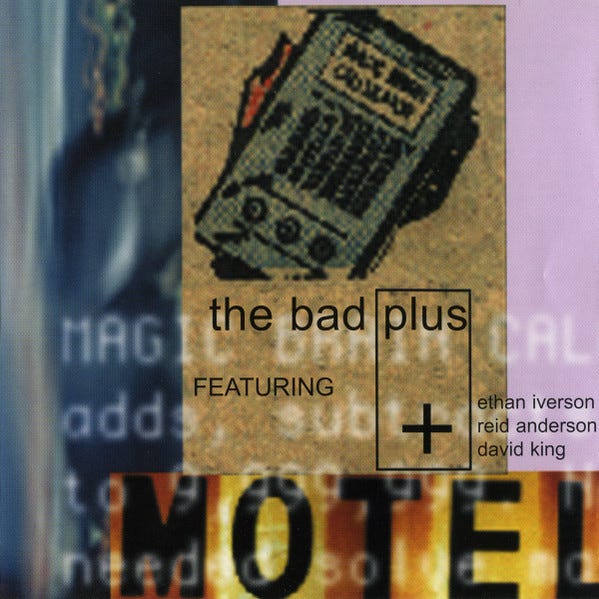
We recorded the first album, The Bad Plus (aka Motel) during a Minnesota snowstorm at the end of 2000, for Fresh Sound New Talent helmed by Jordi Pujol. (Both Reid and I had released a few FSNT CDs at the end of the 20th century.)
“Knowing Me, Knowing You” from ABBA. This one I suggested, because it had been a balm: I had broken up with my first wife and somehow heard this song. Maybe in a movie? Most of the rock songs I have any sort of emotional relationship are from a movie. Anyway, I was getting drunk alone at night and singing this song to myself. (A cliché, I know.)
The intro uses straight triads, and then the melody is never accompanied by jazz chords. At the time this was new. Jazzers like Herbie Hancock and Brad Mehldau who tried their hands at rock songs always used sophisticated close-knit luxurious harmony in the Bill Evans tradition. I knew all that stuff, but I rejected it: my stark intervals were from Thelonious Monk and further decorated with little games from modernist classical music. Playing the opening melody in “Knowing Me, Knowing You” in semi-dissonant seconds is like Bartók Mikrokosmos (and also like Monk on “These Foolish Things”).
For ABBA’s guitar refrain I put a hemiola bass line under the tune. The cross-relations in the harmony are “baby Stravinsky,” I had played through Serenade in A and listened to the Octet, and this was a cheap imitation.
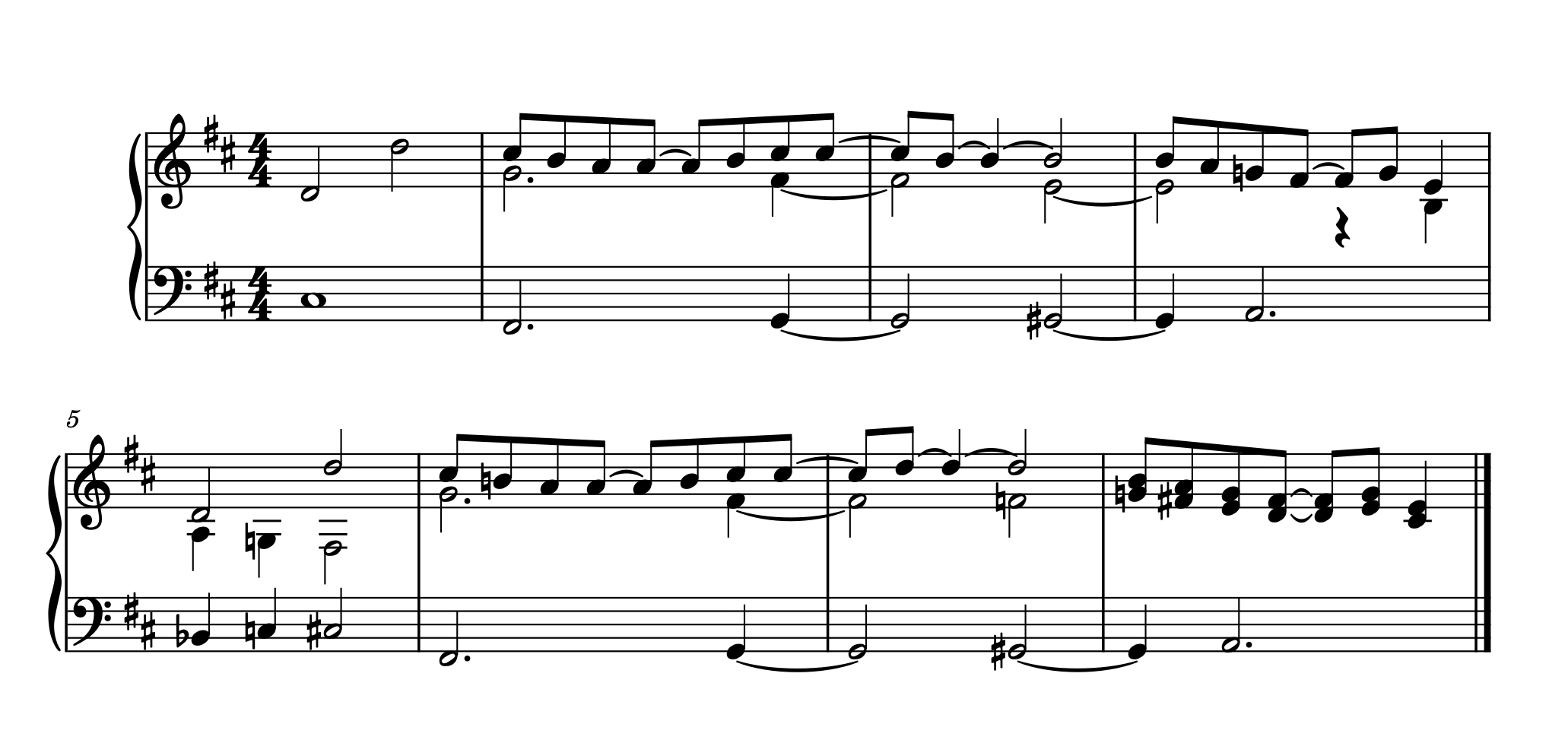
In time I would see Monk and Stravinsky as my essential harmonists. I steal from everybody, but it is the Monk and the Stravinsky that sets me apart from many others of my peer group. There are fewer notes in the middle of the chords.
Dave King’s drumming is out-sized and wonderfully rock ‘n roll. If my triads were unrepentant, Dave’s drumming was also unapologetic. And some of the fills! Oh my god, there’s a drum break on this early “Knowing Me, Knowing You” that is just hilarious.
We were going for a certain emotion: full on, a bit ironic but also dead serious. I’m not saying this perspective didn’t exist in jazz before—Thelonious Monk for starters—but this turn-of-the-century “knowledgeable white boy, rebellious with a tender side” thing we offered was unquestionably fresh. I had seen and loved Tarantino’s Pulp Fiction, so I understood that kind of knowing stance, but I hadn’t seen any David Lynch or Wes Anderson movies when I started gigging with Reid and Dave. My bandmates showed the path. When I walked out of The Royal Tenenbaums it was totally obvious to me that Bad Plus was supposed to be the jazz version of whatever that was—and perhaps we got pretty close, especially on Reid Anderson power ballads like “Lost of Love” and “People Like You.”
At that time, Reid’s bass playing was coming out of Charlie Haden, almost to the exclusion of anyone else. Harmonically, the piano/bass relationship in early Bad Plus was like Paul Bley/Charlie Haden or Keith Jarrett/Charlie Haden. There is no Paul Bley/Gary Peacock or Jarrett/Peacock in this discussion. (Later Reid would play much busier, and in fact, that was one reason I quit the band: The bass was frequently almost blaring over the top of the piano like Richard Davis or Eddie Gomez, although that was more like the personalities were just not getting along at that point, for Reid didn’t stay in that zone after I split.)
Rhythm! Aargh! My time has always been my weakest aspect of my musicianship, and somehow it was only after getting the opportunity to perform on well-let stages did I address this problem with any seriousness. I have to apologize to Reid and Dave, for if our first few albums will never quite attain classic status, it is because the piano player’s rhythm was subpar, at times even barely professional. Probably it was part and parcel of being a nerd (before nerds were cool). I was awkward in my body and unfriendly to society, and didn’t even hear rhythm that accurately…I was only as competent as a first-chair classical musician, which is nowhere near good enough for jazz.
My high school crushes were Mal Waldron and Paul Bley. I suspect I am the only teenager in history that collected Bley and Waldron LPs like baseball cards! It was only after I worked on my rhythm with real seriousness (beginning in the 2000s) that I started hearing how Waldron’s phrasing was a bit inaccurate. Indeed, Waldron is one of the very few legendary African-American jazz pianists who rushes like a European classical musician. Paul Bley is also no swinger, not really, although he had more of it together before he quit practicing in the early 1970s. Bley’s gift was the surreal, Waldron’s gift was the dark and repetitive drone. I drew on both of them nightly in the Bad Plus.
“Smells Like Teen Spirit” from Nirvana. Much of rock music does not fit well on the piano. For some reason this Kurt Cobain melody does! It has kind of pentatonic shape almost reminiscent of Coltrane. One of the Mal Waldron records I liked the most was Breaking New Ground with Reggie Workman and Ed Blackwell, where they play “Beat It” and other pop tunes. In its way, the TBP “Smells Like Teen Spirit” is as if Waldron played Nirvana. The surprise last chord on E minor, after a whole piece being in F minor, is a lift from my NYU composition teacher Justin Dello Joio, whose excellent Piano Sonata starts in C and ends in B. At the end of this first version I suddenly strummed inside the piano, which works well—Kurt Rosenwinkel complimented me on that strong ending.
Yves Beauvais heard us play one night at the Village Vanguard and signed us to Columbia. We had a proper budget, which meant we could go to Peter Gabriel’s Real World in England and record with Dave King’s dream engineer, the great Tchad Blake. This was before file sharing and streaming destroyed the music industry: These Are the Vistas sold 100,000 copies in America alone.
“Flim” from Aphex Twin. I was dubious about learning this one, but Reid insisted. Reid was right, of course. At the time Aphex Twin was the height of insider cool in terms of the electronic music universe, and the diatonic theme of “Flim” was hopeful and innocent: pure catnip for the audience. Unfortunately I did not play the piano part quite right on this studio version, the left hand has a big mistake compared to the Aphex Twin original. (Reid had to correct me later on, and I played it more or less accurately hundreds of times afterwards on tour.) The arrangement wasn’t even really an arrangement, it was a concerto for Dave King, who could express a human version of the rushes and rolls of an advanced electronica beat. When he got extra complicated I would have trouble playing along, even though my part was the simplest stuff imaginable (and I never improvised on it, either). An exact soundalike of our “Flim” was used as the theme music for Stromberg, a German version of the humorous show The Office.
“Heart of Glass” from Blondie. This was my suggestion, because I remembered it playing over the PA the one time I went to a Wisconsin roller rink. The song is in E, but the second chord is C# major, and that kind of harmonic color change is comparatively rare in pop and rock. I think it was Dave who suggested playing it “free.” I bang out the melody on top while everything else is pretty berserk, the overall effect is sort of in the Albert Ayler/Charles Ives tradition. My other reference here is the Ligeti piano etudes, especially during the collective improv in the middle of the track. I’m almost embarrassed to listen to this now, for “baby Ligeti” is even more on the nose than “baby Stravinsky” above. Still, it was new at the time, and that’s why I did it, I knew it was new. To conclude we marshal our forces and depart waving the 7/4 vamp, just like the original Blondie 7/4 (a meter not found in most radio hits). The live version on Blunt Object is pretty good, or at least better than the studio, I had started adding “montuno goes awry” to “baby Ligeti.” In that first rush of success, TBP briefly met Debbie Harry at a NYC music party.
Beauvais warned us about a “sophomore slump” that apparently happens to rock bands after the first album is a success. Not true in our case! In some ways I think Give might be the best TBP album, it is all sort of doing the right thing, the naive and the sophisticated are right up against each other, glaring through mirrored glass, eyeball to eyeball. It is Midwestern, of course, and hard to explain to an outsider. The Coen brothers are perhaps a reference, especially Fargo, and so is Garrison Keillor: Stanley Crouch called me the day after he saw Robert Altman’s A Prairie Home Companion and said, “I think I understand The Bad Plus a little better now.”
Another footnote: Give got us our lone Grammy nomination, a nomination not for the music, but for Tchad Blake’s engineering, and thus actually a worthy nomination (something of a rarity on the Grammy ballot). The record is essentially fried with compression through and through—every needle on the dials go into the red—and, boy, does it sound fucking great. The only thing missing from Give is one of Reid’s towering power ballads, although certainly his “And Now We Test Our Powers of Observation” and “Dirty Blonde” would become two fan favorites.
“Iron Man” from Black Sabbath. I may have suggested this tune, because I remembered the trombone section in high school band playing the riff over and over, and a good riff is a good riff. The opening piano cadenza is more “baby Ligeti,” played on two pianos at once, one being an out-of-tune upright. When the song begins proper we bring out the sledgehammers. The piano part references the European tradition of Chopin, Liszt, and Rachmaninoff, although there is also something manic and absurd. Later I heard Ervin Nyiregyhazi play Wagner transcriptions, and recognized a kindred spirit. Nyiregyhazi is of course a much greater pianist than myself, but the sound world of “Iron Man” is not dissimilar to Nyiregyhazi’s extreme conception. In some ways I’m just banging around like an amateur—but, nonetheless, there is something else happening, some kind of esoteric intelligence is still being communicated. As far as I know, the only time this kind of piano texture was heard on any record anywhere, ever, was certain moments in TBP—and I haven’t done it since, for it required Reid and Dave to make sense. When we put the tune in major the emotion is inarguable, and the “Dies Irae” plainchant beloved by Rachmaninoff and others appears in my left thumb during the minor key coda. We saw Geezer Butler at an LA party: Strange to say, he wanted to meet us! Butler has repeatedly said publicly that our “Iron Man” was the best Black Sabbath cover of all time.
“Velouria” from The Pixies. This must have been Dave’s suggestion, for he loved the Pixies, although Reid loved them too. Listening to this now, I don’t remember a thing about the process, so most (if not all) of the ideas for this long and detailed arrangement surely came from Reid and Dave. The opening melody doesn’t really fit the piano very well—as mentioned above, a common state of affairs when looking at modern rock and pop—but we do our thing nonetheless. Thanks to this track, we opened for the Pixies for a small stadium show. Four or five thousand people crowd-surfed and so forth while the headliner raged; hard to imagine what they made of the opener, although no beer bottles or tomato cans were thrown at the stage. I still don’t know anything about that kind of music, but left under the impression that Kim Deal was a very good bass player.
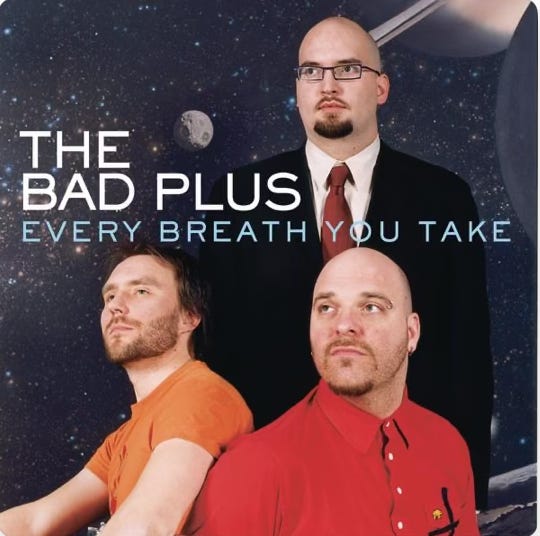
“Every Breath You Take” from The Police. I am actually a bit miffed that this was only a bonus track. It was recorded at the Give sessions and is just as good as “Iron Man,” but has more improvising, with Reid being much more prominent as a player. There must have been a reason we kept it off the album; maybe the record company wanted a cover tune for the Japanese territory release. Anyway, today it is on some of the streaming services. To create the avant-garde bass line, Reid and I drew pitches and rhythms out of a hat, ensuring random chaos beneath the famous melody. The Tchad Blake production is outlandish and compelling, starting with whatever happens during Dave’s superlative backbeat in the intro. The piano solo is pretty good, too, with Paul Bley and Liberace locked in comfortable embrace, and the three big personalities interact smoothly while improvising. Hard to believe we got away with all that! I’m glad this exists.
The Bad Plus gave something back to me that pursuing a career as a musician had taken away, a favorite band. A band whose name I would have written in sharpie on the back of my denim jacket when I was 14… I graduated high school in 1990 and was a New Wave/Post Punk kid who had only discovered Jazz at around 16. I didn’t really dig in until college at which point I just jettisoned everything that I had previously been into in order to try to catch up. I never paid any attention to TBP until I heard Ethan on a Billy Hart record (One Is The Other) and thought “that’s the piano player in the Bad Plus?!…” Anyway, I share your feelings about Reid as a composer. Thank you.
Ethan, I’m heartbroken a second time(1st time when you split). I took my son to his first concert at the Kimmel Center(Philly). TBP warmed up for MMW. I was a huge fan of both. So, nirvana for me. My son was enthralled with you guyz. I was also. But Dave was exceptional that night. I guess because of the great Billy Martin was there. Any how, I’m very sad to see an end of TBP. All the best to the guys and to you also.
PS- we saw you at the Ethical Society in Philly also with Toody Heath. It was phenomenal! Thanks for the music!