
TT 549: Robert Ashley: CELESTIAL EXCURSIONS
2003 "opera" at Roulette last night
Robert Ashley (1930—2014) was a world unto himself, an erudite trickster who eventually reduced his dynamic conception to not much more than a surreal poem over a drone. While initially schooled in conventional formal postwar atonal composition, Ashley soon repudiated such dense sounds and aligned himself with ‘70s and ‘80s minimalism.
Most of Ashley’s operas are for five singers and synthesizer accompaniment. The singers are often doubling each other, like a kind of Greek chorus. The heart of Ashley’s art is an advanced tragicomic text. While there is some singing, much of it is more like a rhythmically energized stage play. The staccato repetitive wordplay might recall the libretti Gertrude Stein created for Virgil Thompson, although unlike Stein, the grouping of topics and events is reasonably linear, with scenes and stories that come in and out of focus.
Celestial Excursions is about the end of the line. The composer explains:
The fear is that we won’t go gently or abruptly into that good night. We will hang on in the endurance trials of old age, forever rehearsing in the early morning twilight, fortified by a few hours of faulty sleep, the plot or why there is no plot, the explanations, the why, the lists, the old grievances never to be settled now, the stories never told or passed on, the interruptions, the terrifying proportions, everything larger than it is known to be, distorted in the mirror, and again and again.
Old people are special because they have no future. The future is what to eat for breakfast or where did I leave my shoes. Everything else is in the past. So, sometimes old people break the rules. Especially the rules of conversation and being together. They laugh a lot. I mean real full laughter. They break the rules, because, for one reason or another (illness, anger, damage, whatever), the rules no longer apply for them. They are alone. Sometimes they are sad. Sometimes they are desperate. Mostly they are brave. Mostly they have given up on the promises of religion, life after death, immortality. Mostly they are concerned with dignity. Living with dignity. And, like all of us, eventually dying with dignity.
But they are still obliged, as human beings, to make sounds. They are obliged to speak – whether or not anyone is listening.
Robert Ashley, 2003
Last night I attended the third and final showing of Celestial Excursions at Roulette in Brooklyn. It was a remarkable entertainment, absolutely unlike anything else. The room was full with Robert Ashley fans who laughed loudly at the jokes. The bare bones stage set was a chair suspended from the ceiling.
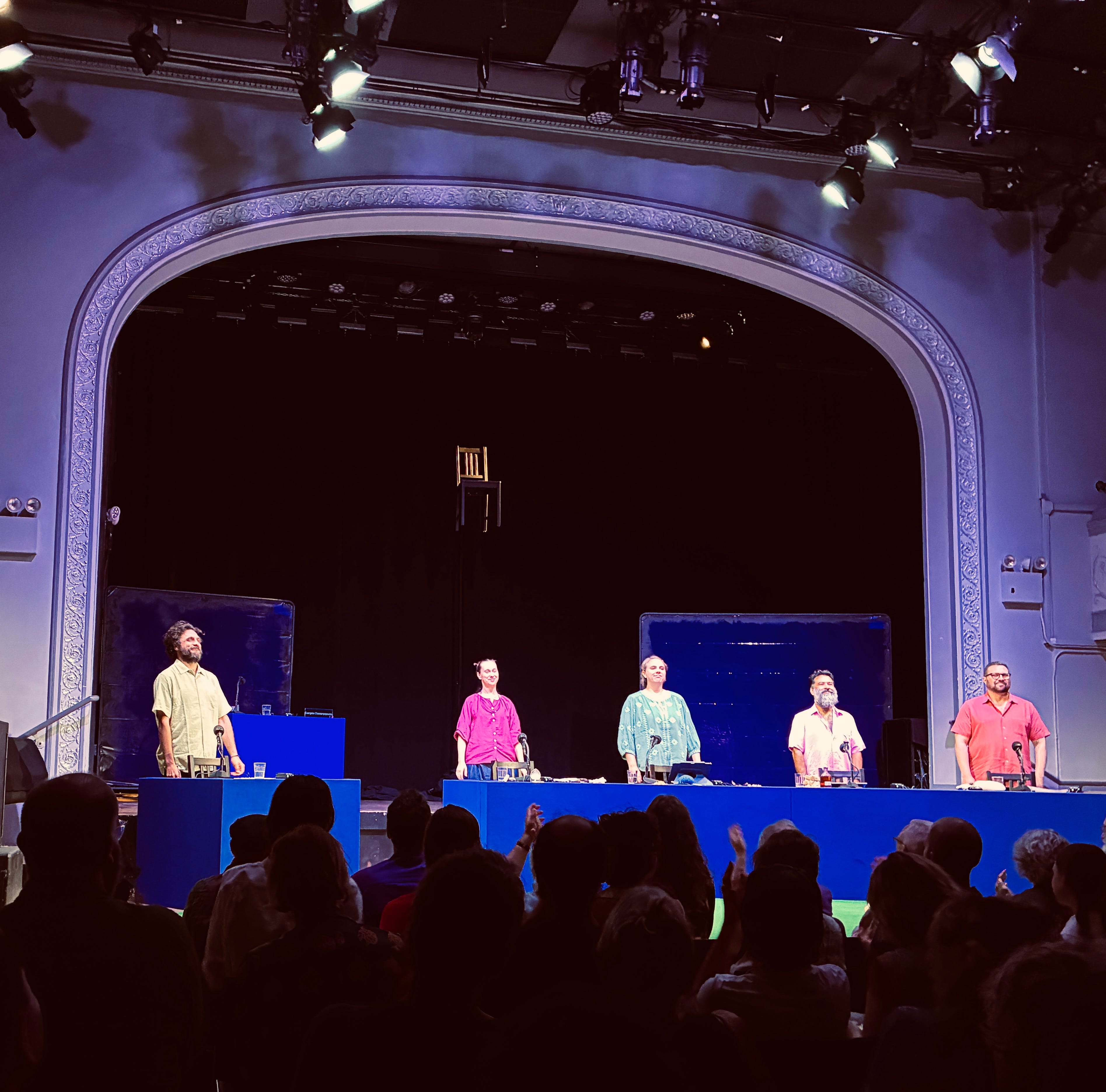
Singers: Gelsey Bell, Kayleigh Butcher, Mario Diaz-Moresco, Brian McCorkle, Paul Pinto
Music Director and Sound Design: Tom Hamilton
Stage Design and Lighting: David Moodey
Producer: Mimi Johnson
The singers were great, but the synthesizer sounds were a bit dated, especially the slap bass in the second section, although it certainly comes off better live than on the recording. The rather Thelonious Monk-ish piano flourishes by “Blue” Gene Tyranny were a highlight. (At some point, maybe there would be room to re-conceive a bit of the orchestration, perhaps with the addition of acoustic instruments.)
One of the people who taught me that certain minimalist composers were as math-oriented as 12-tone composers was Kyle Gann, who published articles about Robert Ashley and others in The Village Voice. Gann eventually wrote a book on Ashley, and a webpage has Gann’s analysis of Celestial Excursions. In a way there’s not that much to see, but then Gann points out, “Notice that the entire piece uses only the C-major scale, with any pitch but C in the bass.” This is a rarefied compositional detail and explains something about the way the harmony successfully suspends over the course of 90 minutes.
I love all Ashley. I am particularly fascinated with this scene in "Improvement." https://youtu.be/dxzgDlKxs6g?si=Noqd3QkULVd6xrD2
The juxtaposition of the voices is unlike anything I've ever heard. It opens up a new world that only Ashley seems to have visited.
Mr Ashley: very well put. If there is something called dignified humour, that’s it.