
TT 542: Mal Waldron Centennial
A drone, a riff, a mood
In the 1950’s Mal Waldron was an important member of the common-practice jazz fraternity. He gigged with Billie Holiday (he’s the pianist on the video of Lady Day singing “Strange Fruit”) and Charles Mingus (he’s on the seminal Pithecanthropus Erectus). Waldron’s original music was workmanlike and riff-based, much like his piano playing, which led to a gig as house composer and arranger for Prestige Records. Waldron even took part in early attempts at Music Minus One, and didn’t mind writing out easy piano scores for publication.
There wasn’t whole lot of virtuoso piano on offer when Waldron sat down at the bench. Rather, Waldron was in the lineage of Thelonious Monk, mysterious and restrained. (Appropriately, Waldron is the pianist on Steve Lacy’s early Reflections, the first album of “all Monk tunes” played by someone other than the composer.) The many ‘50s Waldron LPs are all pretty good, but Waldron wasn’t a mature artist yet. His solos displayed authentic hard-bop language flavored with a taste of surrealism, but lacked the swing or power of Monk, Horace Silver, or Bobby Timmons.
The 1959 trio album Impressions with Addison Farmer and Tootie Heath is one of the smoothest documents of the early years. The originals are detailed and intriguing, while the piano solo on “You Stepped Out of a Dream” is fairly relaxed and fluent.
Around this time Waldron also penned two compositions that have become standards, “Left Alone” and “Soul Eyes,” wonderful melodic ballads championed by Abbey Lincoln, John Coltrane, and many others.
In the early ‘60s, Waldron’s laconic attitude and ease with paper made him a good fit for the emerging avant-garde—not for the completely free or atonal players, but for those like Max Roach and Eric Dolphy who were doing more measured experiments. Several sets of Dolphy and Waldron alongside Booker Little, Richard Davis, and Ed Blackwell at the Five Spot are famous. Waldron’s spare approach is beginning to morph into a non-virtuosic drone distantly connected to McCoy Tyner’s modality. After a token nod at running the changes, most of the piano solo on Waldron’s “Fire Waltz” consists of walking up and down a C minor ninth chord or the pentatonic scale.
“Fire Waltz” prefigures Waldron’s mature music. He was probably encouraged by how well this new style fit with Davis and Blackwell: All three play what they play: no exceptions, no hesitations, no reactions. It’s a kind of informed and intentional ignorance. No one bends or adjusts, and everything remains pretty much at one dynamic level throughout. If the form gets lost sometimes—which it does, like at the top of the piano solo on “Fire Waltz”—you can’t readily tell from the way everything keeps chugging along.
Shortly after the Five Spot gig, Waldron nearly died from a heroin overdose. In a revealing interview with Ted Panken, Waldron says, “I was out for about 6 or 7 months, in East Elmhurst Hospital, and they gave me shock treatments and spinal taps and all kinds of things to relieve the pressure on my mind, to get my memory back, because I couldn’t remember where I was, I couldn’t remember anything about the piano or anything.”
On Waldron’s next easily accessible recording, 1969’s Free at Last (the first ECM record), everything is reduced to the drone and the riff. His touch has gotten more secure and elemental, and after finding this utterly distinctive mood, he stayed right there and simply let the gloom deepen until his death in 2002. The right hand is an incantatory shaman sitting atop the chugging, low-register left, insisting that a short stutter of melody will fit anything: any harmony, any place in the beat, any tune. If the changes are noticed, simple lines are repeated in unvarying sequence.
Both standards and originals have this same basic sound: a droning, vamping stomp. After looking over this essay, French pianist Benoît Delbecq offered an important piece of the puzzle:
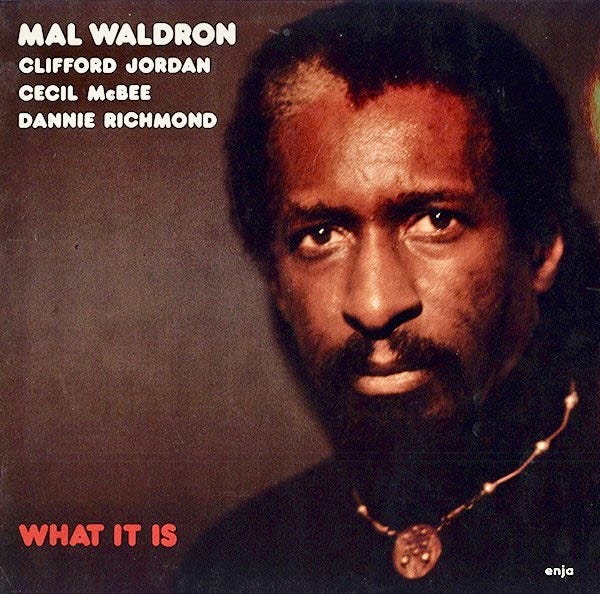
I remember Mal telling me in the late 1980s about his grandmother: she was a Native American (perhaps Sioux?) who had an extremely intense relation to nature—plants and flowers in particular. She would plant a seed anywhere and it’d grow like magic, and her garden was a marvelous and magical space. Waldron told me she always had been a strong source of inspiration for him. Also I now remember Mal wore a talisman necklace that also came from his native relatives. His relation to mystics was very intense, and I tend to believe this is the origin of his stubborn-like pattern repetition concepts. I remember also he warned me not to try to play like “piano-bar jazz”—he was not a mocking person but certainly had a big laugh after saying this. (This is when I was showing him some Bill Evans-like harmonies I was learning.)
Waldron’s best music also has a darker side. H. P. Lovecraft’s horror word unnamable might be appropriate: The piano playing seethes and burbles without coming to a climax.
Not everybody likes it. Some professionals find Mal Waldron’s mature music merely amateurish, probably because it doesn’t play by the rules of sophisticated jazz. It’s certainly not that swinging, in part because Waldron frequently pushes ahead of the beat. Waldron also recorded too much, and occasionally the albums feature lesser lights. The Japanese took a special interest in the Mothra of the piano; there are dozens of Waldron records made for various Japanese labels alone. (Waldron’s first version of “Left Alone” with Jackie McLean has iconic status with Japanese jazz lovers.)
The duo with Steve Lacy was a good showcase for both musicians. It’s amusing to read Lacy’s description of Waldron as a master accompanist. Lacy’s right, of course, but that’s hardly the whole story: Waldron bangs his rocks together full-out behind Lacy’s impassioned and structurally perfect solos, and then, when Lacy’s done, he bangs his rocks alone in the same fashion. A notable exception to this procedure is the Ellington/Strayhorn tribute Sempre Amore; the comparatively gentle result is magnificent. The similarly reserved concept record of jazz classics Hot House is not as good, although “Petite Fleur” and “The Mooche” have an appealing dour edge. Those are the only studio records from this duo; the rest of their discography are live gigs featuring Monk tunes (great) and noisy originals (even better). Lacy and Waldron also occasionally worked with a rhythm section; again, the quality of those bands varied.
Waldron played only one way, so it’s interesting to hear musicians familiar from other contexts adjust. A good example of Waldron’s gravitational pull is What It Is with Clifford Jordan, Cecil McBee, and Dannie Richmond. The cover photo is almost as impressive as the music. Waldron was photogenic, and his great look undoubtedly helped him sustain a viable career playing recondite sounds. Everyone interested in marketing uncompromising jazz should check out a vinyl edition of What it Is. It’s obviously badass avant-garde black music that you must buy immediately.
Clifford Jordan’s blues “Charlie Parker’s Last Supper” is reasonably normal jazz,
while the other two extended tracks “Hymn From the Inferno” and “What it Is” are simple and stark Waldron pieces that go into free-form roils.
Jordan, McBee, and Richmond handle the assignment flawlessly. As you listen to “Hymn From the Inferno,” read Lovecraft’s “The Unnamable.”
We were sitting on a dilapidated seventeenth-century tomb in the late afternoon of an autumn day at the old burying-ground in Arkham, and speculating about the unnamable. Looking toward the giant willow in the centre of the cemetery, whose trunk has nearly engulfed an ancient, illegible slab, I had made a fantastic remark about the spectral and unmentionable nourishment which the colossal roots must be sucking in from that hoary, charnel earth…
Waldron’s most important trio came together in the 1980s with Reggie Workman and Ed Blackwell. What was hinted at twenty years earlier at the Five Spot with Blackwell and Richard Davis is now fully realized. Although Workman was once a fairly straight-ahead player, by the time of the Waldron records he was a loose avant-gardist. As with Waldron and Blackwell, Workman’s later style doesn’t easily fit with decorative or hip modern jazz harmony. Workman just strums away, channeling the mystic.
Waldron, Workman, and Blackwell together are pure evil.
The video of the evil trio backing Charlie Rouse and Woody Shaw at the Village Vanguard is a precious document, but I personally owe more to discs of Waldron, Workman, and Blackwell without horns.
Breaking New Ground is a concept album. Some Japanese producer thought, “Let’s have Mal Waldron play the hits of the day.”
“Beat It” played by the evil trio is wonderful and bizarre.
Breaking New Ground also one of the reasons I immediately felt comfortable playing rock covers in the Bad Plus! Somewhere there’s a video of me at 16 playing this album’s arrangement of “Suicide is Painless” on Menomonie public access TV; in time I could explain, “Our version of ‘Smells Like Teen Spirit’ is as if Mal Waldron played a Kurt Cobain song.”
However, the better CD overall is You and the Night and the Music, a collection of standards and blues.
A bracing salutation by Blackwell leads into “The Way You Look Tonight” with the following evil reharmonization:
F / B7(b5) / Bb6 / E half dim, A7 (b5) /
D min / F# half dim, B7 (b5) / E half dim (!?!) / G min, C7 /
The changes then continue normally.
Waldron probably worked from published sheet music, not from fake books or jazz recordings. When the harmonizations aren’t evil, they are “showtuney,” not “jazzy.”
You and the Night and the Music is the only record of a piano trio playing standards with Ed Blackwell on drums. His African-derived tom-patterns are nice and loud in the mix, as is Workman’s groaning bass.
Many of my peers might find this record rather strange, but I heard it early—the long-defunct ProJazz label somehow got their product into Best Buy in Eau Claire, probably due to a Japanese electronics connection—and I bit that apple hard. To this day I more readily appreciate jazz that is stark, surreal, and bass-and-drums-heavy (like the evil trio) more than jazz that is decorative, sensible, and piano-centric (like most piano trios).
Since Mal Waldron is a mood, he is accessible and perpetually relevant. Unlike many of his more polished peers, Waldron’s legacy continues to resonate, partly because fans can group him with minimalism, jam bands or other non-jazz aesthetics. I first wrote about Mal fifteen years ago, and people have kept me in the loop, sending me fresh articles and asking for interviews. Andrew Cyrille’s current brilliant quartet with Bill Frisell, David Virelles, and Ben Street often starts their sets at the Village Vanguard with Waldron’s “The Git-Go.” Not too long ago I had lunch with a civilian who told me, “I always liked Mal Waldron more than Keith Jarrett—especially solo. Instead of The Köln Concert, I listen to Blues for Lady Day.”
(The above is a lightly edited repost of an essay first published on my old site Do the Math in 2010. I posted about the Oscar Peterson centennial yesterday; it is fairly ironic that Waldron and Peterson were born within 24 hours of each other, for they couldn’t be more different!)
If forced, I would pick Waldron's 'Update' from '85 or '86 on Black Saint/Soul Note as not only my favorite piano jazz album, but maybe my favorite jazz album, period. Solo record, but there's a whole world in there. Every time I dig it out I think maybe it wasn't that good, I just heard it when I was young and impressionable. Nope. It's every bit the album I first thought it was nearly 40 year ago. Thanks for writing about him and his music.
This post evokes a lot for me.
Many of my peers in high school were musicians; we were in orchestra together. Some of them, and many of my other friends, were Eric Dolphy fans (also Bill Evans, FWIW). This is how I first heard Waldron, on the out-of-tune Five Spot piano, although I was mainly listening to Dolphy's unique approach to tonality, melody, rhythm. It was only later, as a jazz DJ, that I started attending to Waldron's (and Horace Tapscott's!) discography in the station's LP collection. What I remember most was Sempre Amore, and the piano solos on the double-LP MOODS. I learned to play "I thought about you" off that.
When my son was looking at colleges, I took him to NYC and Cambridge. I thought that he, as a jazz pianist of already considerable skill, should catch some jazz in clubs. (He played at a Village Gate jam and a saxophonist wait his turn told him that as an Oregonian, he should look up Barbara Donald in Seattle; which didn't happen.) We caught Waldron's first set, with a bassist (Cecil McBee?) and Pete Sims, at the Vanguard. It didn't get to us much; my HS peer, master Catskills alto improviser Eric Rosen, told me shortly after that Waldron often didn't get going until the second set. That seems plausible. My son was left with little respect for Waldron until I got him to hear the solo on "Number Eight" (aka "Potsa Lotsa") from the Five Spot recordings, an astonishing melding of rhythm section artistry. Also that "Fire Waltz" that you highlight.
My son, incidentally, told me that fake books are worthless, you have to go to the sheet music; and as in Tristano pedagogy, listen to a solo, memorize it, and write it out. Two approaches. (As an instance, he told me that if he wanted to learn Morton's solos, he wouldn't use Dapogny's (great!) book, he would listen to the records.)
The aforementioned Eric Rosen put me onto Jeanne Lee, and I later found her recordings w/Waldron. There's a great live set on YouTube of the two of them at the Marciac jazz festival, at https://www.youtube.com/watch?v=MIt563yVxgw, which includes a brief Jeanne Lee interview in pieces. Waldron doesn't appear for the first couple of minutes...
Finally, my own sense of Waldron is that he is a master of piano timbre; and those rumblings in the bass as he plays his semi-ostinatos put me in mind me of that early Miles Davis date where Horace Silver is punctuating his solos with bass rumblings. Waldron found a great and unique way to play jazz piano. Monk, similarly beyond unique, sometimes has a striking use of repetition; Waldron is likewise instantly recognizable. And beautiful.