
THE LAST LIST FOR NOW: “What do you give someone to introduce them to modern jazz?”
checking the boxes
It’s been a festival of lists at TT, kicked off by new content from Mark Stryker
Followed by two reposts of stuff from myself
To conclude: “What do you give someone to introduce them to modern jazz?”
Kind of Blue and A Love Supreme are in a class of two.
The criteria includes:
Peak popularity with a general audience aligned with peak musicianship
Small group instrumental modern jazz with extensive improvised horn solos
A priority on group interplay, where each member of the band makes a personal and undeniable contribution to the overall sound.
Kind of Blue is obviously first. A Love Supreme is obviously second.
After those two there’s nothing else that fits the same profile. Time Out is not peak musicianship (I love it, but it can’t possibly be compared to the other two), and piano trios like Concert by the Sea, Live at the Pershing, and Sunday at the Village Vanguard aren’t quite right either.
In lieu of a third place winner, I’d submit ten Blue Note LPs.
They all deal with essentially the same continuum. Nothing that avant-garde. No piano trios, no organ or guitar dates either. A certain thing, and a thing that has outreach beyond serious jazz fans. These records could be in anyone’s collection; I’ve heard all of them in coffee shops and airports.
David Sanborn told me that classic Blue Note records were like classic Film Noir. That’s a perfect comparison. A baseline, all engineered by Rudy Van Gelder in a humble studio, all more truly alike than truly different.
There’s a lot of great jazz from all sorts of angles, but this is the center of the mosaic. A peak of American music, 1958-1967.
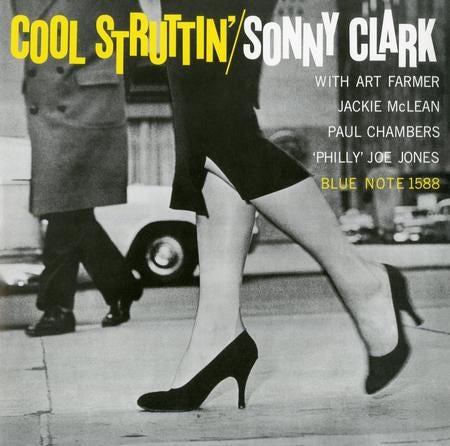
Sonny Clark, Cool Struttin’ (1958)
Cannonball Adderley, Somethin’ Else (1958)
Art Blakey, Moanin’ (1958)
Hank Mobley, Soul Station (1960)
Dexter Gordon, Go (1962)
Lee Morgan, The Sidewinder (1963)
Horace Silver, Song for My Father (1964)
Herbie Hancock, Maiden Voyage (1965)
Wayne Shorter, Speak No Evil (1965)
McCoy Tyner, The Real McCoy (1967)
In half the cases the album is not my personal top selection for the given leader. Many would disagree with me, but I’d choose Empyrean Isles over Maiden Voyage and JuJu over Speak No Evil. Less controversial is the suggestion the Blakey, Silver, and Morgan LPs aren’t automatically their best; it’s more that the opening title tunes have such a hold on the human imagination that they simply must be included. (Of course, they are all still great records from top to bottom.) With Adderley it is a similar case, it is not my ultimate Cannonball but that moody opening “Autumn Leaves” is just too important. (It’s also almost a way of sneaking another Miles Davis date on to this list.) As for Clark, Mobley, Gordon, and Tyner, it is a smooth 1:1 ratio, these albums make the list and are also personal favorites.
Lists are banal and reductive, but they are also interesting thought experiments. The complete list ends up being my proposal for “What do you give someone to introduce them to modern jazz?” A banal and reductive question, but an important question nonetheless. This is the answer: Kind of Blue, A Love Supreme, and these ten Blue Notes.
In the age of streaming playlists, the opening tracks of the dozen are a notably perfect “starter kit.”
“Cool Struttin’”
“Autumn Leaves”
“Moanin’”
“So What”
“Remember”
“Cheesecake”
“The Sidewinder”
“Song for My Father”
“Part 1: Acknowledgement”
“Maiden Voyage”
“Witch Hunt”
“Passion Dance”
Of course, there are plenty of other things to play for a newbie, including Time Out, Getz/Gilberto, the great vocalists, the great piano trio records, the organ records, the guitar records, the big band records. But I like my list. It is all the same yet different, it’s all got charisma, and it’s all absolutely the finest music imaginable. Again, the center of the mosaic.
Footnotes:
The first tune on the earliest date, “Cool Struttin,” and the last tune on the final, “Blues on the Corner,” are both 12-bar blues. They even walk at a similar tempo while referencing street life in the title. More truly alike than truly different—yet under the hood, what a turbo-charged nine years of change, evolving from peak Sonny Clark/Jackie McLean/Art Farmer to peak McCoy Tyner/Joe Henderson.
Joe Henderson doesn’t get a selection—Inner Urge starts with a long bass solo, making it ineligible—but he is a force of nature on three sideman appearances.
It’s hard not to include Sonny Rollins’s A Night at the Village Vanguard but the lack of piano—and, frankly, the raw mistakes of a fearless live performance—renders it a bit too abstract for civilians.
Perhaps the most commonplace modern jazz instrumentation is a quartet of tenor saxophone, piano, bass and drums. A Love Supreme is the fancy version; the meat and potatoes are on Soul Station and Go. The Real McCoy is somewhere between.
Modal jazz is more accessible and popular than bebop, with Kind of Blue and A Love Supreme being the alpha and omega of modal jazz. Several of the Blue Notes are also a bit modal, especially on minor key opening tracks. In a related topic: There’s plenty of hot blowing but there is not an undue emphasis on fast tempos. None of the opening tunes are fast.
Original compositions heavily outweigh songbook standards, although the standards are there. Only a few albums don’t have a literal blues form, but all have a blues ethos.
Drums: Elvin Jones, three. Art Blakey, three. Billy Higgins, two. One apiece to Jimmy Cobb, Philly Joe Jones, and Tony Williams; Roger Humphries and Roy Brooks split Song for My Father.
Bass: Paul Chambers, three. Ron Carter, three. One apiece to Sam Jones, Butch Warren, Bob Cranshaw, Jimmy Garrison, and Jymie Merritt; Teddy Smith and Gene Taylor split Song for My Father.
Piano: Sonny Clark, two. McCoy Tyner, two. Herbie Hancock, two. Wynton Kelly, one (plus one track on Kind of Blue). One apiece to Hank Jones, Bobby Timmons, Bill Evans, Barry Harris, and Horace Silver.
I wouldn't have thought of A Love Supreme as an obvious thing to give someone new to jazz. I would have thought that it reaches levels of intensity that would be a bit too much for a newcomer, and that the last track might be too abstract (not to mention the chanting, which is more than a little atypical). If I were giving a Coltrane album to someone just getting into jazz, I would probably pick Coltrane's Sound: a good introduction to the approach of the classic quartet, but lots of catchy songs. Or, maybe Crescent.
Some Mingus would be a good addition. I think Sunflower by Milt Jackson and Freddie Hubbard is a winner. Personally I’m fond of “ Warm Canto” from Mal Waldron’s The Quest w Dolphy and Booker Ervin, and Archie Shepp’s The Magic of Juju, one side smart arrangements and the other an extended horn outing.