
My First Murder Mystery
"For Agatha"
I have read my fair share of crime fiction but have never felt any interest in trying to write a mystery myself. A new BBC article about the casting of Hercule Poirot gave me an idea! What follows is flash fiction (inspired by the BBC article) and respectfully dedicated to Vince Keenan, Ray Banks, and Lawrence Block.
For Agatha
Ginny Beech was the president of the Serious Agatha Christie Fan Club, based in Bath, with meetings twice a year. The 150+ members had steadfastly voted for Beech to lead the club for two decades not just because she knew the canon better than anybody, but also because she looked quite a bit like Margaret Rutherford, who of course was famous for playing Miss Jane Marple in the rather dated and zany film adaptations from the 1960s. Indeed, Ginny Beech once briefly portrayed Miss Marple onstage for a local production of Murder at the Vicarage at Bath Theatre, where she annoyed the other cast members by attempting to fix what she saw as overreach in the script by Ronald Reginald. (“Flighty” was the word most used by Ginny Beech when discussing the Reginald script in rehearsals.)
In recent years, the Serious Agatha Christie Fan Club had been beset by more and more adaptations. IP was the name of the 21st century game, and the Christie estate seemed to green-light anything and everything through the licensing company Agatha Christie Limited. This was a problem for the Club, for they loved the books, and hated it when Christie’s original text was changed for (in their minds) “no good reason.” You must understand: The Club didn’t even approve of ITV’s well-liked Agatha Christie's Poirot, for every script took “awful” liberties with the original story. A perfect example was the teleplay The Murder of Roger Ackroyd, which in the final act devolves into an action thriller with guns. How dare they trample on the masterful internal chess game of the lauded original and replace it with something out of Jason Bourne?
Admittedly, one could approve of David Suchet. Suchet was good casting. It was perfectly acceptable to “see” Suchet (in the mind’s eye) when reading about Hercule Poirot, just as it was acceptable to “see” Rutherford when reading about Jane Marple.
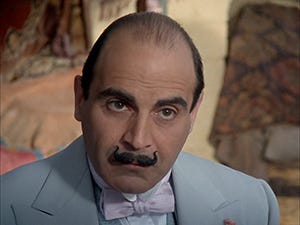
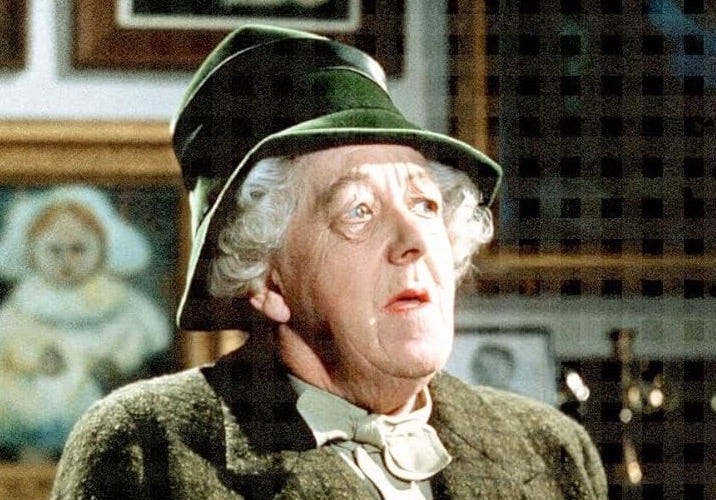
The Club was a united front in terms of deploring all the modern adaptions, but Ginny Beech was the one who took it personally. She authored the letters: A hard copy was sent to the production companies and the text of each letter was also posted to the Serious Agatha Christie Fan Club blog hosted by Wordpress. Some of the younger members of the Club suggested that Ginny Beech move operations from Wordpress to Substack, but Ginny Beech liked Wordpress. It was her first internet platform, and she saw no good reason to change.
The various executives knew all about the Serious Agatha Christie Fan Club. Agatha Christie Limited took no notice, but the executives of each new project spent a few minutes googling their recent forebears, and soon enough found, for example, the rather weighty missive concerning Kenneth Branagh’s A Haunting in Venice, which began with some 1200 words on why Dame Agatha’s original title Hallowe’en Party was better than A Haunting in Venice before proceeding with 37 further numbered examples of major textual distortion.
When tasked with rebooting Hercule Poirot as a young man, the head of Mammoth Screen, Tom Franklin, asked his secretary Gillian Francis what she thought of the Serious Agatha Christie Fan Club. Francis immediately knew what Franklin was talking about, and said, “You could reach out in advance of Hercule. You know, invite them in, show them around the BBC, and try to get ahead of the pushback.”
“Hey, Gillian, that’s a good idea! Ed is really charismatic in person, he will surely warm those old biddies right up. Go ahead and see if they are game for a red-carpet visit.”
As it happened, the email from Gillian Francis to SeriousAgatha@wordpress.net landed the same day as the official announcement.
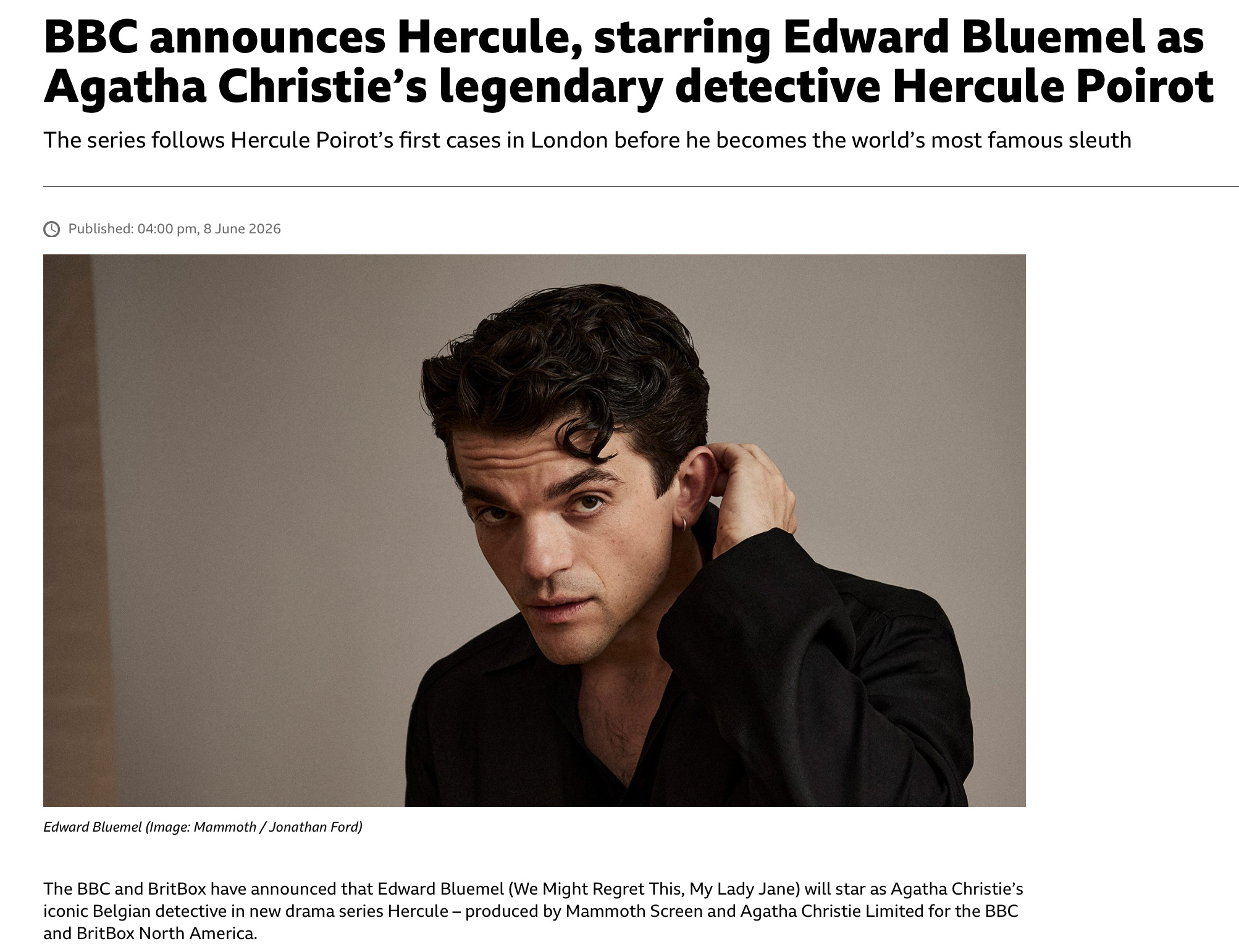
Ginny Beech was thunderstruck by the picture of Edward Bluemel as Poirot. She seethed and simmered. She wrote a vicious reply to Mammoth’s friendly overture — but, at the last moment, did not hit send. Instead, she got up from the computer to look once again at the modest shrine in her living room: pictures of Agatha Christie, several expensive first editions, even a signed letter. Was there anything to be done to stop this madness?
A week later, 40 members of the Serious Agatha Christie Fan Club met Gillian Francis outside BBC security and were ushered into the nicer of two large reception areas. Tom Franklin and the young star Edward Bluemel were on their best behavior, and they immediately charmed everyone, including apparently Ginny Beech, who blushed when Bluemel came close and took her hand. The two even put their arms around each other and posed for a photo taken by Francis. After presentation of press materials and before the planned Q&A, coffee was served in white mugs branded “BBC.”
Nobody observed Ginny Beech spiking her coffee and saying quietly to herself, “For Agatha!” right before taking a long sip of the bitter brew. She had intended to leap up and accuse Franklin and Bluemel of driving herself to the extreme action of martyring herself on BBC premises, but the arsenic acted too fast. Her throat closed up, she lost consciousness, she slipped to the floor and perished. The poisoned coffee fell to the floor and splattered.
Inspector Ghent had actually never overseen a poisoning investigation. Poisoning happened in murder mysteries — Agatha Christie was the inspector’s favorite, of course — but rarely in real life. He was as surprised as everyone else when he was assigned to look into the curious death at the BBC. Among other oddities, a half-used packet of arsenic was discovered in the jacket pocket of handsome Edward Bluemel. Bluemel denied all knowledge of the arsenic, and why in the world would he want to publicly poison some old lady he had never met?
It was a joyous moment for Inspector Ghent when he put two and two together, for it was a convoluted murder plot straight out of his favorite books! The poison was surely intended for secretary Gillian Francis, seated next to Ginny Beech and drinking coffee from an identical white BBC mug. It turned out Francis had spurned Bluemel’s advances, and there was even a record of reasonably steamy texts in both of their iPhones. Francis first egged Bleumel on before deciding that dating a star was too fraught: This potential liaison was possibly even a fireable offense. It was crime passionnel gone awry, with Bluemel simply misjudging the correct coffee mug.
Despite Ghent’s best efforts, the case fell apart, mainly because Francis and Bleumel actually started dating a week after Ginny Beech’s death. As far as Scotland Yard is concerned, the “murder” remains unsolved.
However, Tom Franklin and Mammoth Screen shelved Hercules, as popular sentiment against endless Christie adaptations — and especially Hercules — rose to a fever pitch with Ginny Beech’s death as the flash point. At the beginning of the most recent meeting of the Serious Agatha Christie Fan Club, the new president Eleanor Oaken opened general remarks with the proclamation, “Ginny Beech did not die in vain.”
Goofy and gutsy!! Fun!
Had me going. Well done.