
Miles Davis and John Coltrane through 1960, on America's Birthday
Two Centennials and a Semiquincentennial
The 250th anniversary of the Declaration of Independence this past weekend engendered little celebration in my social circle. The current diseased body politic could almost be described by Hunter S. Thompson in Fear and Loathing In Las Vegas:
My clothes are soaking wet from dawn to dusk. This worried me at first, but when I went to a doctor and described my normal daily intake of booze, drugs and poison, he told me to come back when the sweating stopped. That would be the danger point, he said –- a sign that my body’s desperately overworked flushing mechanism had broken down completely. “I have great faith in the natural processes,” he said. “But in your case…well…I find no precedent. We’ll just have to wait and see, then work with what’s left.”
There is no precedent for Trump v.2 and his cabinet. We’ll just have to wait and see, and — when they finally get out of office — try to work with and salvage whatever is left.
If I’m a patriot, I’m a patriot because of Miles Davis and John Coltrane, who are both celebrating a centennial in 2026.
Burble is moving lines, advanced technique and busy harmonic movement. Everything is stated and resolved.
Sleek is spacious, groovy, and fashionable. The sentences are not completed and tensions are not resolved.
Musicians like burble. Fans like sleek. Of course, both are important, and many of the best jazz musicians blow nice and sleek with plenty of burble.
Until 1954, the Miles Davis discography is a patchwork of burble. Miles played with Charlie Parker, the most sleek of the burbling beboppers. Dizzy Gillespie is the height of burble, but Bird also had the sleek.
If fancy chords move slow enough, they are sleek. The 1947 Gil Evans arrangement of “Robbins’ Nest” written for Claude Thornhill was perfect, and Miles pocketed that concept for the rest of his life.
On some elemental and sensual level nobody understood harmony better than Miles Davis. He could play piano himself, but Miles’s specialty was hearing other people play chords and saying whether they were right or not. There are many good records of burbling “Robbins’ Nest” by other jazz masters — and then there is that mysterious and sleek chart Gil wrote for Thornhill in 1947. That’s just like the Miles Davis discography: There are all those awesome ‘50s and ‘60s jazz LPs from everyone else, and then there’s the luminous Miles collection. Miles told people what to do — not enough to impede their creativity, but enough to ensure there was sleek within the burble.
As much as he understood harmony, Miles does not always play that harmony when he is improvising on trumpet. His solo pitches can often operate at some esoteric remove. Miles is really like Charlie Parker. Yes, Bird played the changes, obviously. But there’s also some kind of private intellect and private folklore that sorts the discourse of his alto solos. No one has ever said what that is, and that goes doubly true of Miles. In terms of melodic and harmonic content (not rhythm) one can basically explain what takes place in Sonny Stitt or Clifford Brown solo. You can’t explain it in the same way for Bird or Miles, for we simply lack the grammar.1
Tadd Dameron was precise and generous, and deserves major credit for codifying the basic language of II/Vs, releasing an all-purpose system that fit any Broadway standard and most other conventional jazz. The whole scene looked up to Dameron, and one of Miles’s earliest compositions, “Half Nelson,” is based on the chord progression of Dameron’s “Lady Bird,” recorded on Miles’s first date in 1947 with Bird on tenor.
What the hell is the first phrase of “Half Nelson?” You certainly can’t harmonize it with Dameron block chords! The rest of the melody is normal bop burble, but only Miles could have thought of that sleek first phrase. That opening phrase reminds me more of Ornette Coleman than anybody else — although some of Bird’s tunes like “Ah-Leu-Cha” (later played by Miles with Coltrane) also feature this kind of diatonic twilight. As it shook out, Miles more or less gave up trying to write it down. He would let other people dream up the charts, and then he would supply in-the-moment mystery as star bandleader and trumpet soloist.
Miles studied Bird up close before roaming the workshops of New York City. The seminal 1949 sessions on 78 now collected as The Birth of the Cool are influenced by Claude Thornhill and Lennie Tristano (Lee Konitz is the ambassador from the Tristano camp), with Gil Evans, Gerry Mulligan, and John Lewis as further important compositional voices.
In the 10-inch era from 1951 through 1954 Miles recorded for Prestige and Blue Note. It’s all a bit bluesier and tougher, which in a way makes it a shade less distinctive than The Birth of the Cool. When there are several horns in the mix there’s a lot of burble, as in a band version of Bud Powell’s “Tempus Fugit” or the truly surprising John Lewis piece “Morpheus.” There a bit small group music with Sonny Rollins and Jackie McLean including “Dig,” a few blues, and lovely Miles melodic statements on standards and ballads such as “It Was Only a Paper Moon” and “My Old Flame.”
Miles’s heroes included Dizzy Gillespie and Billie Holiday, and a burnished synthesis of these two is presented on the version of Gillespie’s theme song “I Waited for You” for Blue Note in 1953. Gil Coggins supplies a gently burbling piano part full of Dameron chords as Miles explains matters of the heart (on open horn, the mute was still to come).
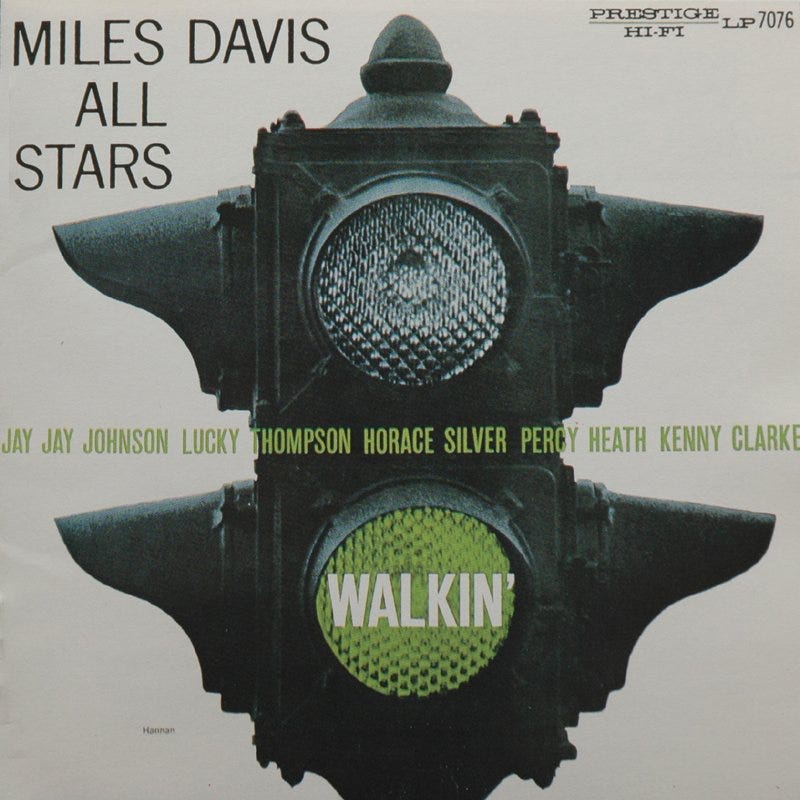
In 1954 it all starts to focus. The piano players are important, especially esoteric Thelonious Monk and bluesy Horace Silver. There are nine tracks of Miles in quartet with Silver, Percy Heath, and Art Blakey in March 1954 spread over Blue Note and Prestige: “Four,” “Old Devil Moon,” “Blue Haze,” “The Leap,” “Lazy Susan,” “Weirdo,” “Take Off,” “Well, You Needn’t,” and “It Never Entered My Mind.” The last is a ballad with the soon-to-be signature sound of harmon mute. Taken as a set, these are the best Miles Davis quartet sides. The rhythm section is more interactive than before, and Miles gleefully rides the wave of Silver’s busy comping, Heath’s firm stroke, and Blakey’s enthusiastic fills. For me, Silver’s best piano playing was early in his timeline: Every circa-1954 Silver piano solo anywhere is gem, with phrases that alternate tight bop burble and sleek blues truth.
A month earlier, in February 1954, Blakey had led the canonical A Night at Birdland with Clifford Brown, Lou Donaldson, Silver, and Curley Russell; at the end of the year Silver and Blakey would establish the major beachhead of hard bop, the Jazz Messengers. Hard bop was a wholesale agreement by that community to make bebop burble a bit more funky and sleek with an infusion of blues and gospel. Miles Davis didn’t stay in that Jazz Messengers/hard bop groove, but he was one of the architects, especially with “Walkin,’” a long blues in F recorded in April 1954. It turned out that letting the rhythm section come to the fore was the answer, and the groove Heath and Kenny Clake set up for “Walkin’” powers the first of many Miles tracks studied by most important bassists and drummers to follow.
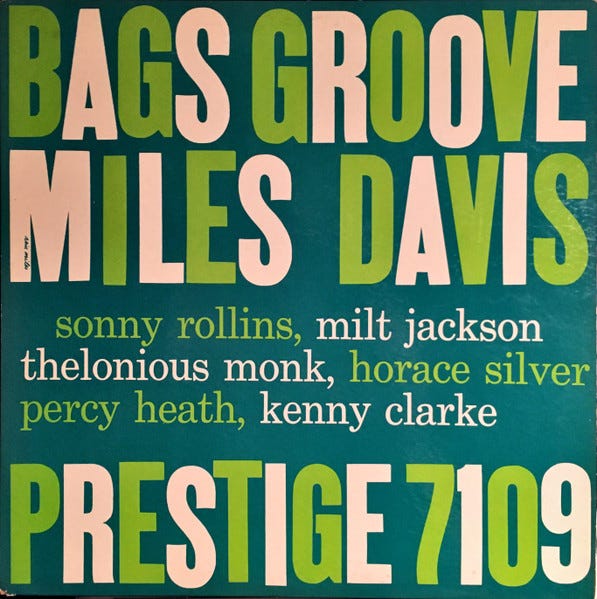
Percy and Klook did it again for another long Miles Davis blues in F, “Bags’ Groove” with Milt Jackson and Thelonious Monk on Christmas Eve 1954.
Charlie Parker and Dizzy Gillespie recorded with Monk, and the result was not a showcase for Monk. Indeed, one is left with the impression that Bird and Diz liked the radical ideas of the pianist but didn’t know what to do with him as a player. Miles knew better, and built the ‘54 Christmas Eve sounds around the unique stylings of Thelonious Sphere Monk. Indeed, this is Monk’s best session as a sideman.
Miles has now evolved into a leader who makes choices based on who he hires, an approach that would not have occurred to Charlie Parker. On topic, and before we leave 1954 and enter the more familiar 12-inch era: In the middle of the year there was a delicious Davis set with Sonny Rollins, Silver, Heath, and Clarke. Three of Rollins’s best and most-played compositions make their debut here, “Oleo,” “Doxy,” and “Airegin.”
While much burble is present, the overall presentation is unfussy and sleek. Part of the way Miles makes that happen is simple enough: He makes the pianist lay out on the heads and in other key places. (For example, Monk didn’t always get to comp behind Miles.)
1955
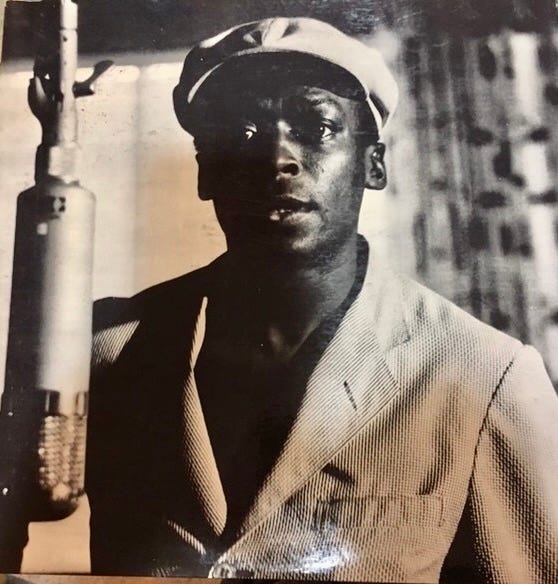
New year, new format: Going forward, everything was a 12-inch release. Miles’s image gets a makeover with the sexy cover photo adorning The Musings of Miles, marking the ascent of Miles as celebrity not just in jazz but the culture at large. Billy Hart told me that as soon at this album came out, he bought a jacket and a cap just like the ones Miles wore in this photo. Billy would put the gear on and pretend to be a trumpet player, fingering an imaginary instrument while looking in the mirror.
Miles has found two of his most important collaborators, Red Garland and Philly Joe Jones. Everyone sounds pretty good but perhaps there is too much burble and not enough sleek. It’s easy enough to blame some of the problem on Oscar Pettiford, who is not quite in sync with the aesthetic.2 There’s a nice moment in “I Didn’t” (based on Monk’s “Well You Needn’t”) where Miles and Philly Joe blast out a particular call that would feature in the rest of Miles’s acoustic bands.
The Musings of Miles was recorded in June 1955, and a month later there was an odd session of fussy ballads on “full burble” setting with Britt Woodman, Teddy Charles, Charles Mingus, and Elvin Jones. (Miles dismissed this mostly Teddy Charles-arranged LP in his autobiography.) At the end of July, Miles played an important gig at Newport with Thelonious Monk, the only time Miles is heard on “‘Round Midnight” with composer’s own changes. This Newport performance was noted triumph and George Avakian signed Miles to a contract with Columbia for an album to be called ‘Round About Midnight.
For the rest of ‘55 and through ‘56 the discography is packed with Miles running through sessions for Prestige to fill out his contract with Bob Weinstock while already recording for Avakian a bit on the side.
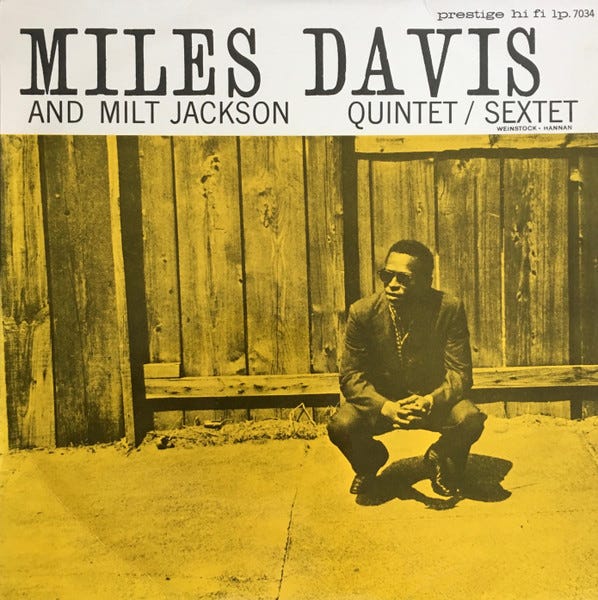
I missed Miles Davis and Milt Jackson Quintet/Sextet entirely until just last month when listening to various things in anticipation of writing this post. Shame on me, for it’s a killer record! Miles plays great and also brings out the best in his collaborators Jackson, Jackie McLean, Ray Bryant, Percy Heath, and Art Taylor. Four long swinging tracks; the two with McLean are McLean’s own melodies. (This was an important record for McLean for he was not yet well-known.) Bryant might not quite be the outrageous stylist of Monk or Horace Silver, but Miles uses Bryant’s Parker-esque blues “Changes” and the pianist delivers throughout the LP. The familiar version of McLean’s “Dr. Jackle” is on Milestones, but this earlier version also has wonderful qualities. It’s almost comic how many blues in F are on Miles Davis records of this era. “Dr. Jackle,” “Changes,” “Bags’ Groove,” “Walkin,’” “Weirdo” — they are all great. Miles also programs “Bitty Ditty” by Thad Jones, which has a burbling form that Miles infuses with sleek.
By fall 1955 Miles has his first great working band with John Coltrane, Red Garland, Paul Chambers, and Philly Joe Jones. They recorded a few tunes for Columbia in October; the only one to eventually go on ‘Round About Midnight a year and a half later is “Ah-leu-cha,” which links Miles directly to his mentor Charlie Parker. The A section is both contrapuntal and rather modal sounding in straight G minor, although the A section blowing is like “Honeysuckle Rose” or “Scrapple From the Apple.” Miles loved Philly Joe Jones, as well he should, and inserted a lot of drum breaks into “Ah-leu-cha” not present in Parker’s original. The rhythm section is swinging, Paul Chambers has a forward lean, the band will settle in as they keep playing together. It’s only been 10 months since Miles used Percy Heath and Kenny Clarke, but they already seem like a distant memory when listening to P.C. and Philly Joe. John Coltrane makes a very strong impression. As busy as Coltrane plays, he is always completely relaxed on a Miles Davis record. This is exactly what Miles wanted: He wanted to play pretty and relatively slow and have the contrasting saxophonist play hard and relatively fast. But Coltrane was also instinctively sleek, although it was a country kind of sleek. Listen to Coltrane talk in his audio interviews: slow, thoughtful, a bit of a drawl — a perfect underpinning for an explosively virtuosic and exploratory musician.
Red Garland was an excellent bebop piano player, but Miles made him study Ahmad Jamal. While Jamal was the height of sleek, Jamal had almost no burble. Garland could play those slick Jamal voicings and arrangements but then cut all that with some burning bebop. In the end, to play with Miles Davis, you absolutely had to be in the lineage of the ultimate authority, Charlie Parker.
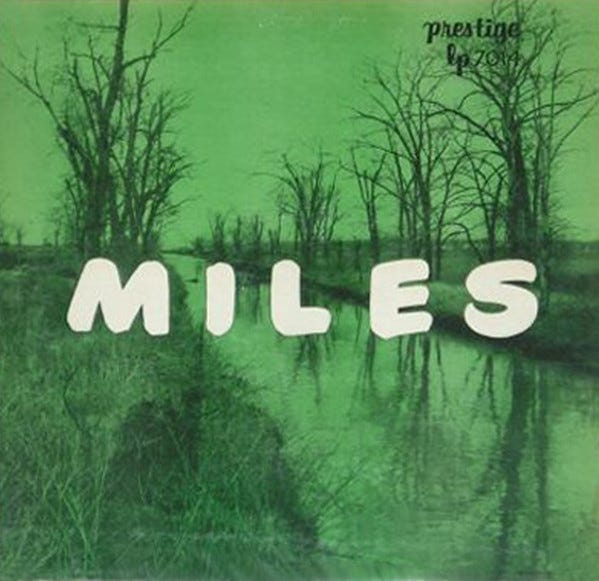
The direct and intense vibe of “Ah-leu-cha” is not apparent when recording for Bob Weinstock and Prestige three weeks later, but Miles may not have had too much to do with the presentation. For some reason the tracklist begins with one of the most unfocused tracks from the first great quintet, “Just Squeeze Me.” It’s basically fine but this is a Duke Ellington tune, after all! (The Ellington original with Ray Nance has a lot more character.) Then the ballad “There Is No Greater Love” is also neither here nor there. Things get more provocative on the second side with clever arrangement ideas in “The Theme” and the first recording of the Benny Golson classic, “Stablemates.” As is standard practice by this point, Miles has Garland lay out on the melody, and the effect is immediately more sleek than most hard bop versions of “Stablemates.” Thanks to Golson’s angular intervals, the melody of “Stablemates” almost sounds like later Miles and Wayne Shorter on something like “Dolores.”
I wouldn’t be surprised if someone buying this album at the time of release would have thought, “Huh, ‘Walkin’’ and ‘Bags’ Groove’ were better than this sleepy new platter. And who is this John Coltrane guy?” As we now know, this ensemble was just getting started. Miles is listening to how everyone sounds and considering what to do.
1956
In March 1956, Miles brought Sonny Rollins, Tommy Flanagan, Paul Chambers, and Art Taylor into the studio for three tunes specifically to fill out Collector’s Items. (The first side were 1953 tracks with Rollins, Bird on tenor, and smoking Philly Joe Jones.) I never listened to March ‘56 much, although Rollins plays a notably awesome solo on the blues “No Line.” Miles and Sonny were great together, but the best meeting of them in the studio remains 1954 with Horace, Percy, and Klook.
The rest of ‘56 was devoted to the first great quintet and their supremely satisfying five-album discography. The Prestige LPs Cookin’, Relaxin’, Steamin’ and Workin’ were recorded either May 11 (twelve substantial tracks) or October 26 (13 substantial tracks). Over at Columbia, one track, “Ah-leu-cha,” was already in the can for ‘Round About Midnight, and the rest of the album was completed on either June 5 or September 10. There is an argument for going in strict chronological order, especially as the band does seem to get a bit better over time. (They were working a lot.) However, I’m swayed by the argument that these five core texts of jazz were appreciated and digested by the community album in order of release. Those that play straight ahead jazz know these records, they are the bible, and that’s been true since 1957 when 'Round About Midnight was released.
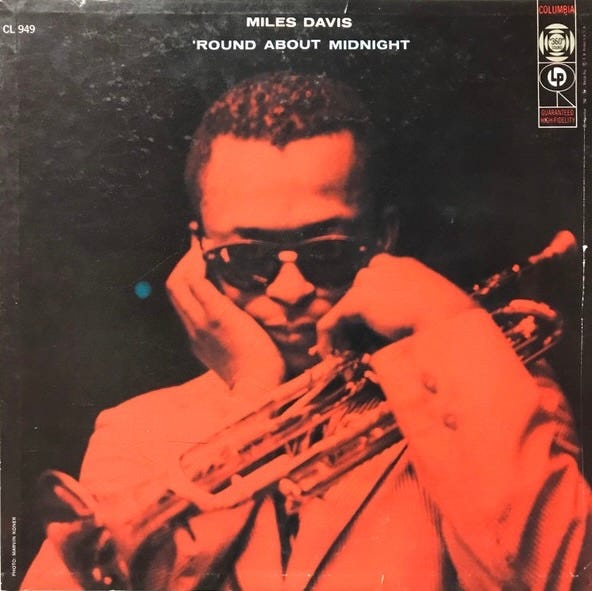
After all these years I am still skeptical about this reharmonization of “‘Round Midnight,” which is apparently by Gil Evans. As is well known, Miles didn’t seem to care too much about the integrity of the source material. He listened to make sure the vibe was right and whether it was swinging. He was a supreme master of sleek harmony but didn’t stop to consider any kind of birds-eye compositional plan, and thus we have the casual and somewhat inconsiderate facelifts of “Well You Needn’t,” “When Lights Are Low,” “In Your Own Sweet Way,” and so forth. The reharmonization of “‘Round Midnight” is in a different category, it is far more deliberate. In the realm of total speculation: Miles knew that people were talking about his “‘Round Midnight” with Monk on piano at Newport, and thus he hired Gil Evans to do something different than the composer. It’s a great track, with perfect statements from both Miles and Trane. But I just don’t know about that reharm with an opening B-flat under E-flat minor and that F7 to E major7 in bar four. Wasn’t Monk’s original already perfect and also perfectly surprising? Well. Who am I to question Miles Davis and Gil Evans…
The rest of the album is miraculous, especially “Bye Bye Blackbird” and “All of You,” boasting two of Red Garland’s finest solos, while the ominous pedal point and minor key of “Dear Old Stockholm” foreshadow modal jazz. These three pieces would become common currency for jazz musicians because of Miles Davis’s quintet. Indeed, most things recorded by the quintet in 1956 would go into the big book of common practice jazz tunes.
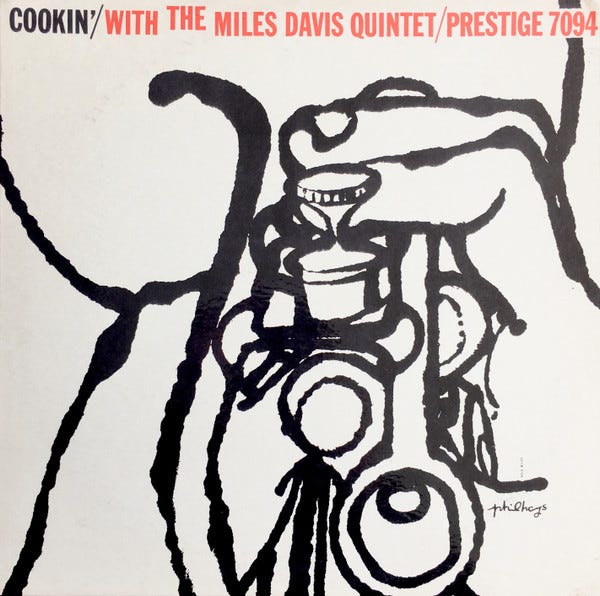
It was a smart move on Bob Weinstock’s part to name the four albums Cookin’, Relaxin’, Workin’, and Steamin’. Perfect.
I know Cookin’ best, I somehow had the vinyl very young. I admit that nostalgia is a factor, but if I had to pick just one, it would still be Cookin’. Perhaps Weinstock agreed, for he put it out first, going neck and neck with ‘Round About Midnight.3 It is all from the final session of the band in October. The first side is particularly amazing: epic “My Funny Valentine” and incredibly swinging “Blues by Five.”
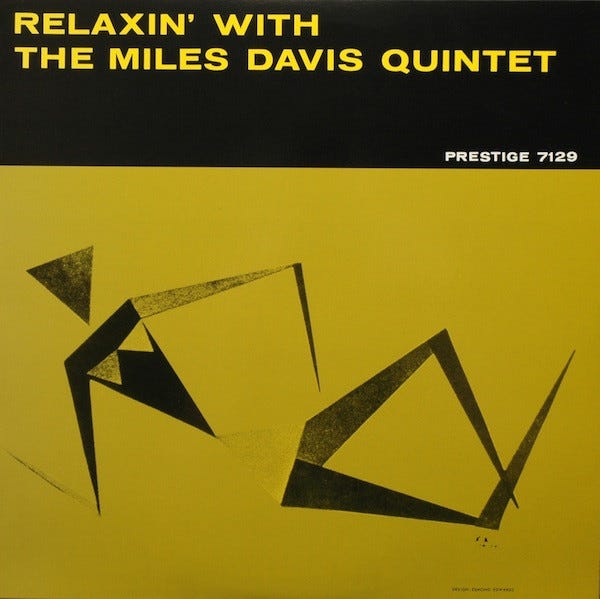
The bulk of Relaxin’ feature October tracks filled out with “It Could Happen to You” and “Woody ‘n’ You” from the earlier session in May. Part of the allure is the studio banter that Weinstock included on first release.
“I’ll play it and tell you what it is later.”
“Block chords, Red.”
“Could I have the beer opener?”
The fan favorite may be “If I Were a Bell,” and this kind of medium-up swing helps define the unique romance of the first great quintet. Red Garland’s style works within as narrowly defined parameters as Thelonious Monk or Horace Silver: the upbeats happen just so, and — on the topic of “If I Were a Bell!” — the overtone series heard in any good bells give Garland’s crunchy bell-like block chords their unique resonance. Even more than “If I Were a Bell” I personally dig “If I Could Write a Book”: pure levitation. (In fact I have never heard another version of this lesser Rodgers and Hart tune that is anywhere near as good.) “Oleo” has a tricky arrangement that would stay in the band book and keep developing for years. Everyone played rhythm changes, but the Miles Davis versions of rhythm changes always had a bit less burble. For his piano solo, Garland brings the sleek by playing low in register a la Tristano. 4
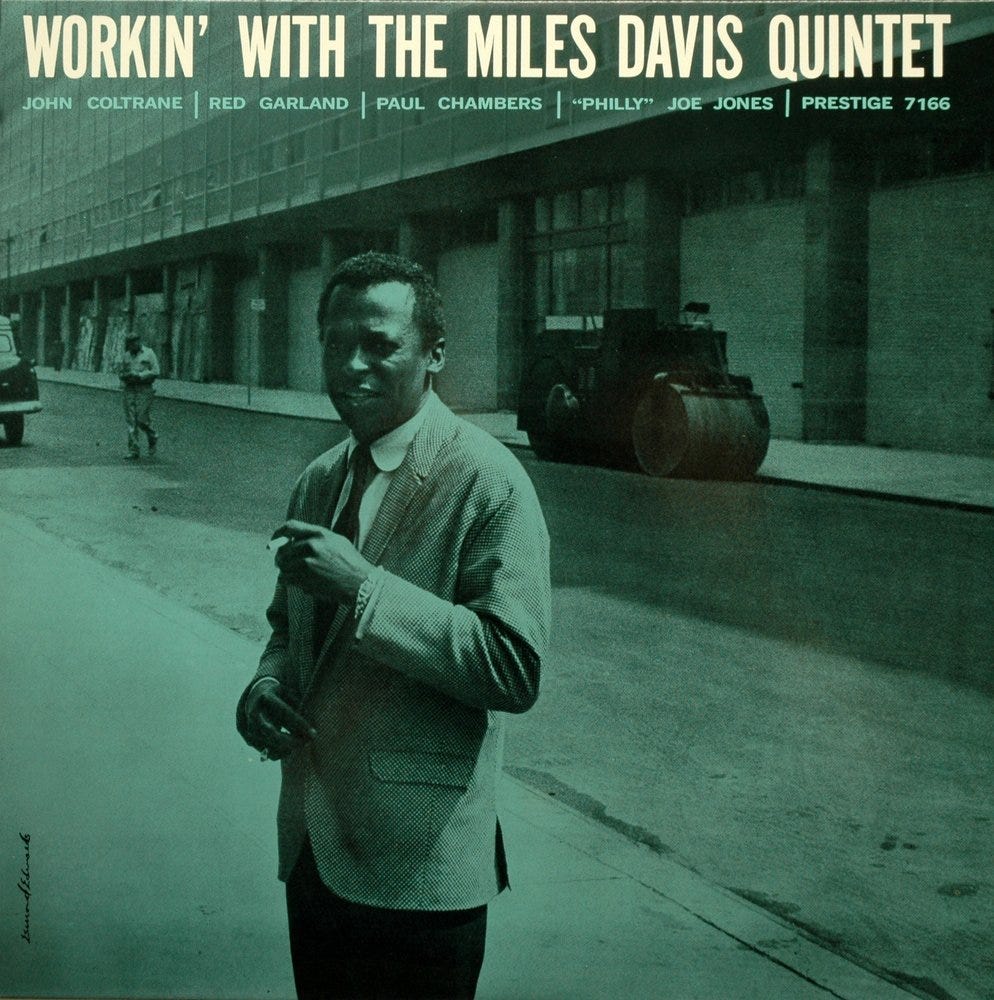
Both Workin’ and Steamin’ are all May with one track from October on each. (“Half Nelson” here, “Well You Needn’t” on Steamin’.) Garland’s broken chord accompaniment on “It Never Entered My Mind” is purely European in affect, almost like Schubert, and Miles plays particularly well on “Four.” There are two short sign-offs of “The Theme” to close each side. Garland’s trio version of "Ahmad's Blues" offers an interesting comparison with the Jamal original, and “Half Nelson” is graced with a new shout chorus before the outstanding trades with Philly Joe.
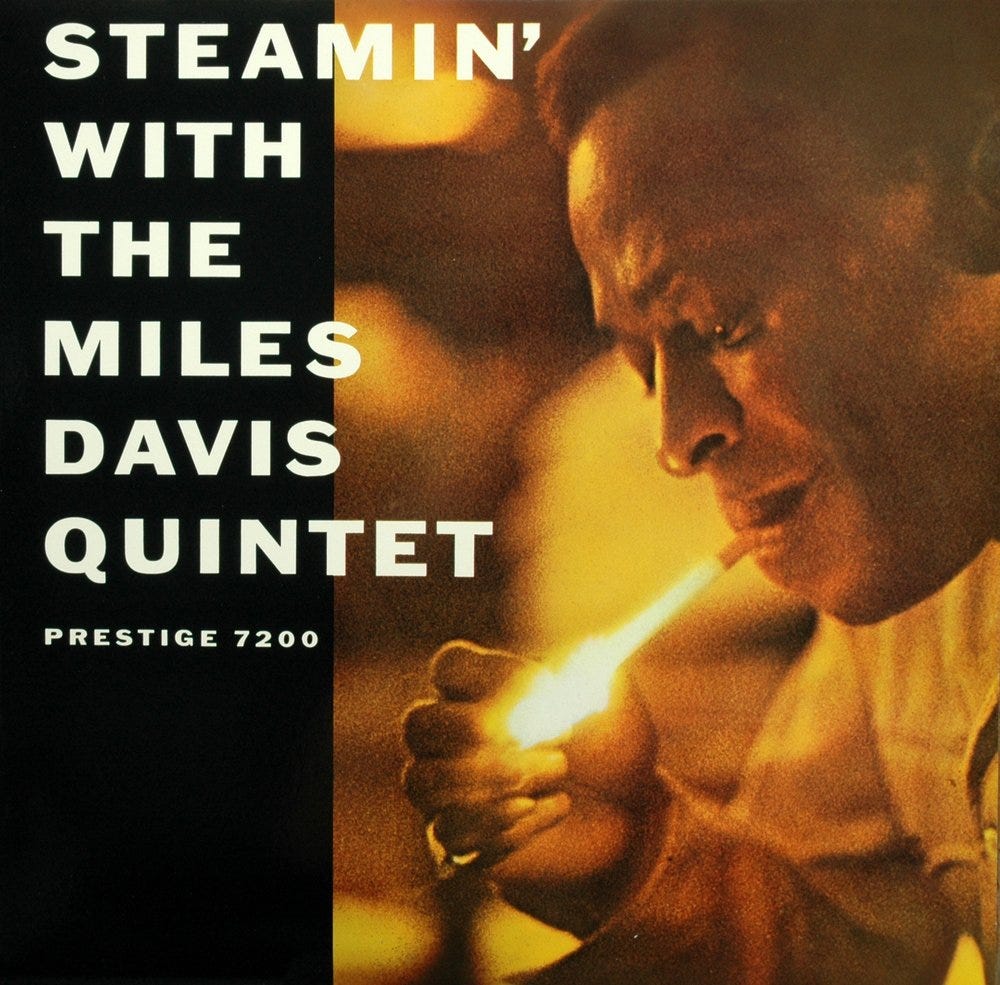
Probably Steamin’ is the least of the four, not that it isn’t very good. The drum solo from Philly Joe on “Salt Peanuts” is a highlight. Bob Weinstock comes in for his share of criticism, especially from the musicians, who thought Weinstock could take advantage. However Weinstock certainly oversaw some of the greatest jazz ever recorded, and in terms of knowing how to listen to the music, one could make a pretty good argument that the four Cookin’, Relaxin’, Workin’ and Steamin’ proceed from best to lesser, with all four albums nonetheless having appropriate balance.
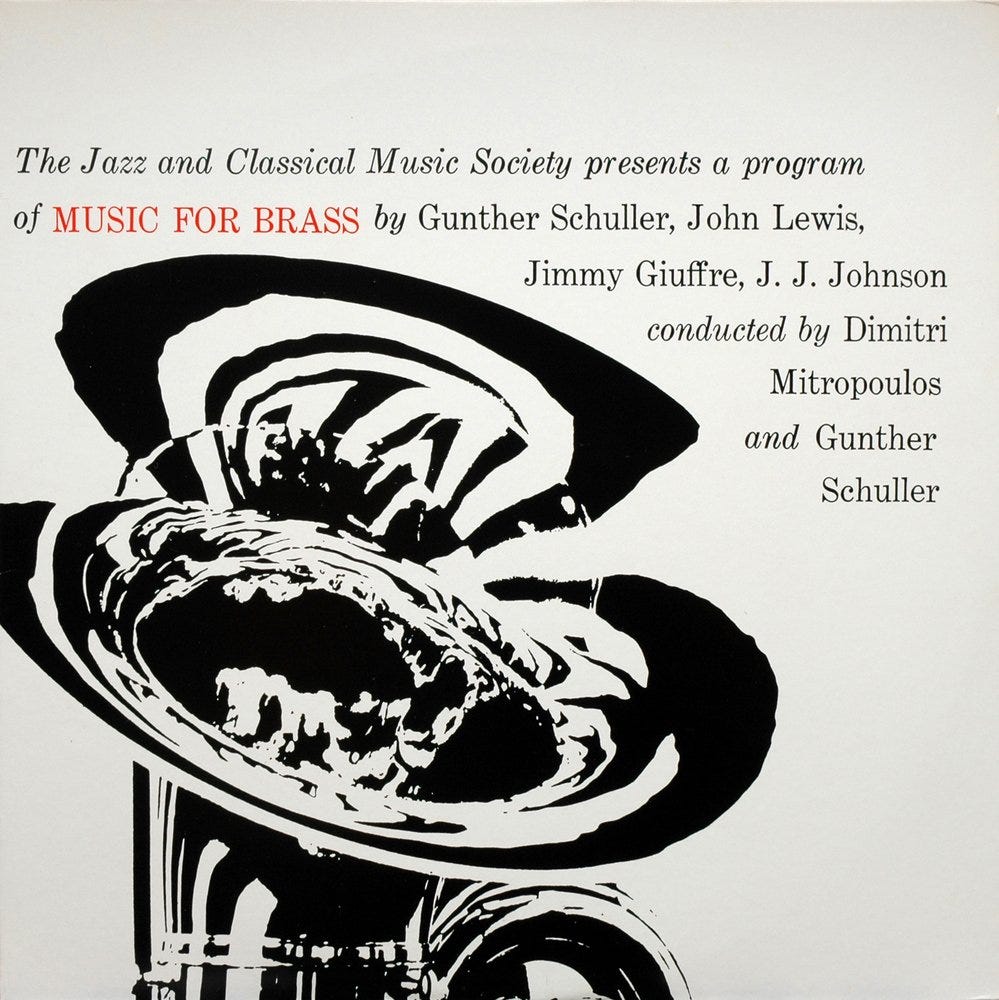
Before we leave 1956, a quick mention of a three movement suite by John Lewis called “Three Little Feelings” for brass ensemble, Milt Hinton, and Osie Johnson. Miles is the featured soloist on the first two movements, and he recorded it just a week before the October quintet session for Weinstock. ( J.J. Johnson is the soloist during the third movement.)
Gunther Schuller named the genre “Third Stream” and, at least in the beginning, there was tremendous energy around this idea of combining jazz and classical music. Schuller produced this record, which includes one of Schuller’s best pieces, Symphony For Brass And Percussion, Op. 16., and Schuller was also almost certainly the commissioner of the pieces by John Lewis, J.J. Johnson, and Jimmy Giuffre. It all comes out of the later experimental side of the late ‘40s ensembles: Claude Thornhill, George Russell’s charts for Dizzy Gillespie, and Miles’s own Birth of the Cool. Miles’s most famous collaborator in this idiom was Gil Evans, and starting next year they will cement their legacy together.
Of the John Lewis formal works I’ve heard, “Three Little Feelings” is one of the best, and overall I rank it with the Miles Davis/Gil Evans collaborations to come.
There’s no weight of thought when Miles Davis plays the trumpet. It exists: it is very strong: it is also just there. Each moment is exactly that moment. Perhaps more than any other soloist in history, Miles is a chemical agent that instantly transforms the surrounding sounds.
1957
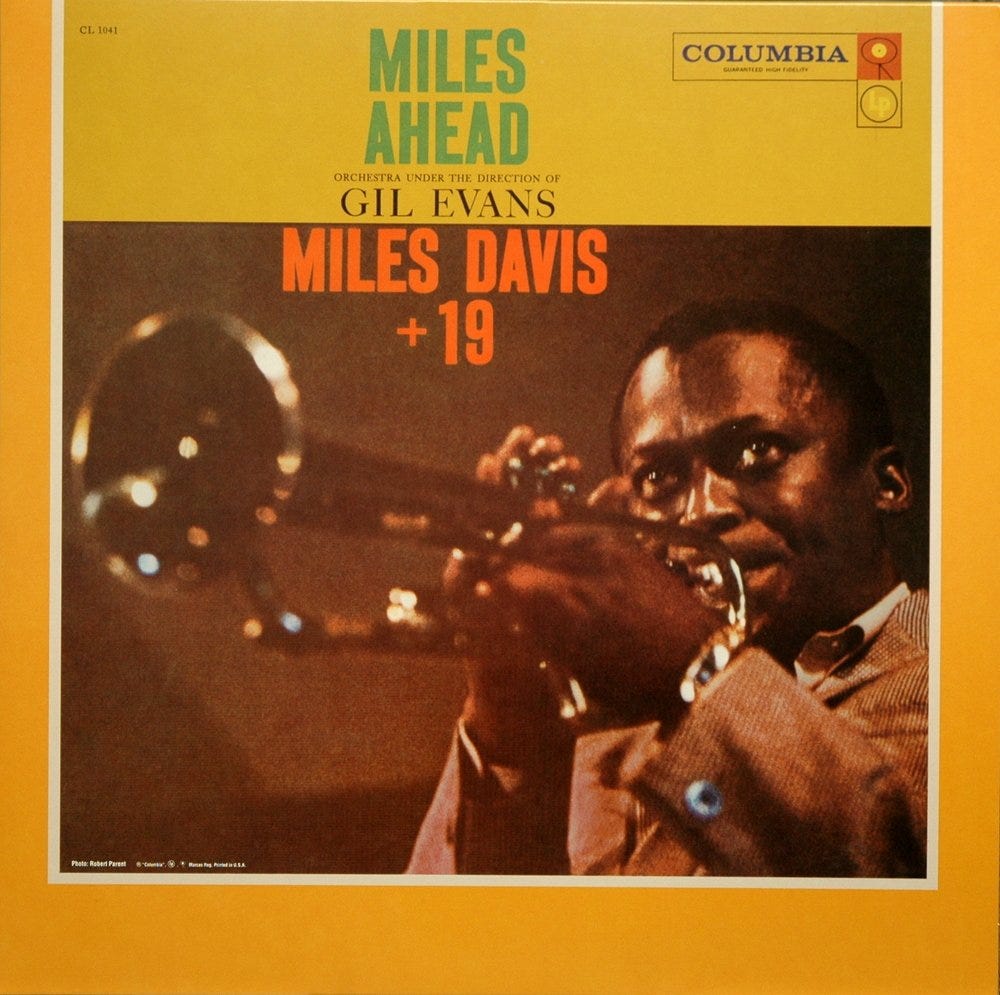
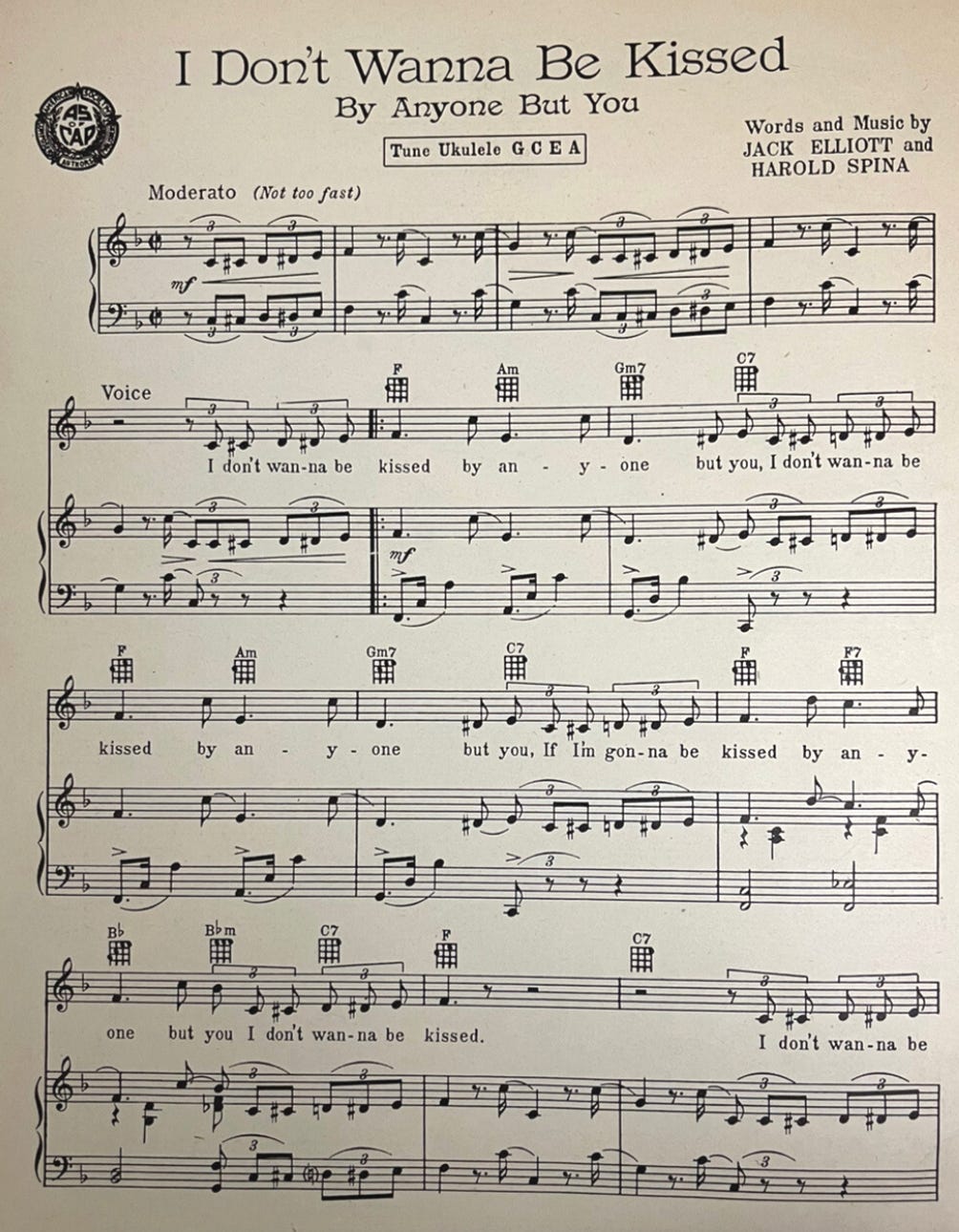
In the liner notes to Miles Ahead: Miles Davis + 19, producer George Avakian credits both 1949’s The Birth of the Cool (just recently issued on LP by Capitol for the first time) and the previous year’s Music for Brass as inspirations for the first of three epochal late-’50s collaborations with Gil Evans. Miles Ahead made profound impression on Herbie Hancock, who modeled his sextet on the flute-heavy sounds of Miles Davis + 19, starting with Speak Like a Child and continuing through the Mwandishi years.
I cede the floor to Vinnie Sperrazza, who investigated the references to Miles Ahead track by track.
Miles fired Coltrane for much of 1957, which gave the saxophonist a chance to not just quit drinking and doing drugs, but also to work under the leadership of Thelonious Monk. One gets the sense that Monk, not Miles, was the person to show Trane how to treat music a bit more systemically.
Working with Monk brought me close to a musical architect of the highest order. I felt I learned from him in every way—through the senses, theoretically, technically. I would talk to Monk about musical problems, and he would sit at the piano and show me the answers just by playing them. I could watch him play and find out the things I wanted to know. Also, I could see a lot of things that I didn’t know about at all. (from “Coltrane on Coltrane” as told to Don DeMicheal, 1960)
Both Miles and Trane were devout students. They looked up to their heroes, played with their heroes, and absorbed every interaction. They also had big music collections, read journals, and went to both movies and the library.
They were almost the same age — again, this is their shared centennial year — but Coltrane was far more casual than Miles until his Monk year of 1957. Though he was not prone to sharing secrets, Miles was pretty organized when working out how to look and sound good while bringing out the best in his colleagues. During all the time Miles was putting that together, Trane just strapped on the tenor and played. He was good for Dizzy Gillespie in 1949-51, Earl Bostic in ‘52, and Johnny Hodges in ‘54, all the while playing in any kind of R ‘n B bar band. After Miles exposed Coltrane to the wider New York jazz community, Trane started appearing on many casual dates as a sideman. His raw virtuosity is exciting and undeniable on ‘56 albums with Elmo Hope, Sonny Rollins, and Tadd Dameron, and his contacts only spread out from there; in ‘57 there were LPs supporting Sonny Clark, Art Blakey, Mal Waldron, and Oscar Pettiford. I suspect he tried his best to learn from any situation, but Coltrane did not automatically shape the discourse of any of that music in the manner that Miles or Monk sought from the beginning.
Coltrane’s first two albums as a leader for Prestige in 1957 are in line with whatever he was doing as a sideman. It’s not tentative, but it is not a grand reveal, either. His third album Blue Train for Blue Note in 1957 is far more ambitious, confirming that the broad outline of his career as a leader is easy enough to sort by label: There’s a whole bunch of casual tracks for Prestige 1957/58, a nerdy one-off for Blue Note in 1957, then a bright new sound for Atlantic 1959-60. From 1961 to the end he was recording imperishable masterpieces for the new arrival Impulse!
It is just a decade’s worth of material, 1957-1967, but nobody made more out a decade than John Coltrane.
The 6-CD box set of the 11 Prestige LPs is called Fearless Leader. While Trane obviously was a fearless leader, his early work for Prestige should actually be called Community Music. Jazz was at a peak, and Coltrane was fitting in with a crowd. He is not bringing hard original compositions to these Prestige record dates, he is treating the occasions mostly as blowing sessions with peers. On many occasions Coltrane is sharing leader credit, and despite the prospect of disagreement, nothing ever seems competitive. Rather, Trane shows up and does his job with a minimum of fuss. Nobody else has to change the way they play when standing next to Coltrane. (Again, that is different than Miles. People played different standing next to Miles.)
Of the 11 Coltrane-led Prestige albums, only the first three were issued in a timely manner, while the rest came out over the years as Trane moved on to other things. This was the Bob Weinstock style: treat sessions like gigs and record a lot. Weinstock tracked so much Gene Ammons that the Ammons output from the label continued unimpeded whenever Ammons went to prison.
It is not clear how much oversight Coltrane had on issues from the ‘57/’58 Prestige sessions. The LP industry was brand new, and the recording artists were hardly auteurs. Sequence was decided by the producer after the session, and Weinstock’s shop was particularly casual, with some of the later Prestige Coltrane records “from the vault” having a decidedly hodgepodge effect. Still, I speculate that Trane did have a general plan in mind for those first three nicely contained albums that came out when Coltrane was under contract: Coltrane, John Coltrane with the Red Garland Trio (AKA Traneing In) and Soultrane. These three are covered in this quick overview, but the rest of the Prestige music is also eminently worthy. Notable Prestige tracks not from those three albums include “I Love You,” trio with Earl May and Art Taylor, where Coltrane’s rhapsodic flurries complete the harmony without piano; one of the first recordings of “Invitation” with a surprisingly interactive bass part from Paul Chambers that foreshadows Jimmy Garrison; scalding “Lover” and “Lover Come Back to Me,” both with Donald Byrd and Louis Hayes; the first McCoy Tyner composition on record, “The Believer”; and the bewildering tenor solo on “Sweet Sapphire Blues,” which surely boasts the most outrageous and extensive conventional double-time jazz that has ever been captured in the studio, a pure wall of sound that goes on and on.
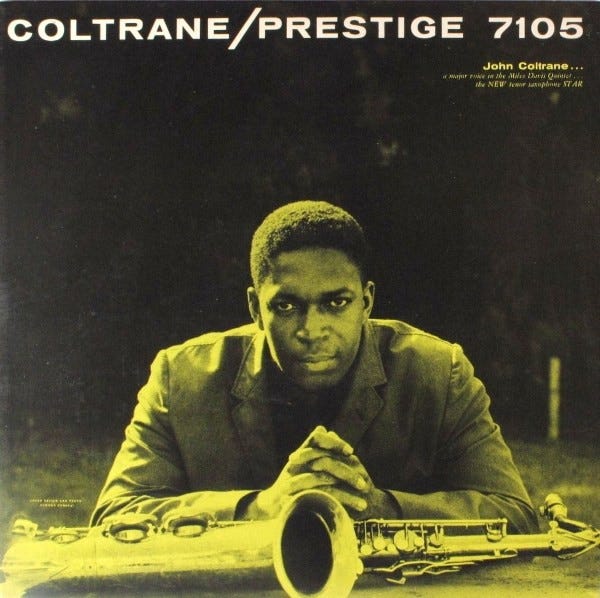
Coltrane was friendly to the scene and liked giving lesser known talents a chance. His debut album Coltrane features Philadelphia representatives composer Cal Massey, trumpeter Johnnie Splawn, and Tootie Heath, who managed the feat of drumming on the first albums of Coltrane and Nina Simone in the same year. Splawn is part of an intriguing bunch that are best-known today as a credit on single Trane album or two — others include Donald Garrett, Dewey Johnson, and Joe Brazil — and bari saxophonist Sahib Shihab is something of a lesser-known as well. Red Garland and Paul Chambers are there, as is house Prestige pianist Mal Waldron on the second side.
Considering both the Miles quintet and the future Trane to come, the first Coltrane LP is reasonably uneventful, although the presence of Massey’s “exotic” and nearly modal “Bakai” and the minor pentatonic line of Trane’s own “Chonic Blues” foreshadow the future. The best track is the ballad “Violets for Your Furs.” For all his technical mastery, Coltrane could really play the hell out of a straight standard ballad.
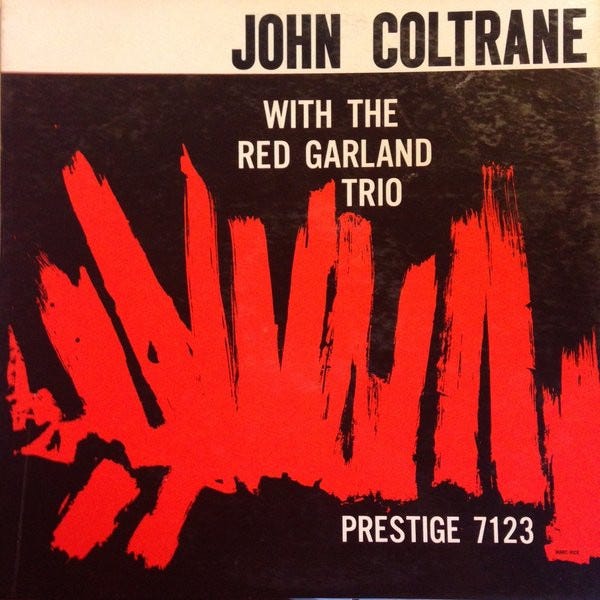
Things settle into more of a groove on With the Red Garland Trio completed by Paul Chambers and Art Taylor, the ace rhythm section most associated with Coltrane and the Prestige years. (Garland also recorded several great trio albums with Chambers and Taylor.) “Traneing In” is a blues with bridge, a form that dates to Lester Young’s “D.B. Blues” twelve years earlier. Trane is quite monstrously awesome on “Traneing In,” and he found this uncommon structure intriguing enough to bring it back on tour in 1962. Chambers comes to the fore, with a mysterious intro to “Slow Dance” and a doubled melody on “Bass Blues.” Brisk tempos are everywhere on the Prestige Trane collection, and the LP concludes with a very fast “Soft Lights and Sweet Music.” These days I can hear how uncomfortable everyone but Trane is all the way upstairs; it would have been interesting to hear the saxist play one of these peak velocity exercises with Max Roach. (Louis Hayes is more born to this particular mission than Art Taylor; Hayes effortlessly powers the uptempo Coltrane Prestige sides “Lover” and “Lover Come Back to Me.”)
While Coltrane understood bebop, he didn’t understand it as well as Bird, Miles, or Sonny Rollins. Trane played the changes too literally, too much like merely arpeggiating the Tadd Dameron chords on the page. Of course, he loved Tadd Dameron, and he understood Tadd Dameron. Dameron is the underpinning. But that mysterious place outside of the changes is the next level. Bird, Miles, and Rollins had their ways with that, as did the white crew of Lennie Tristano, Lee Konitz, and Warne Marsh.
Dameron and Coltrane recorded together in 1955’s Mating Call. Mating Call is burble. Very good burble! But it could use a bit more sleek. Sleek is dissonant Red Garland block chords, sleek is the blues, sleek is Monk avant-garde or even Tristano avant-garde. The one cat really dealing with sleek on Mating Call is wonderful Philly Joe Jones. What would Mating Call have sounded like with Bird, Miles, Rollins, or Konitz in place of Trane? 5
Both Miles and Trane were expert students, but they were also experts at honoring themselves. They knew what the were naturally good at and kept doubling down. Miles was something of a minimalist, while Coltrane was a maximalist. The koan “less is more” has little place in the Coltrane style, although to the master’s credit he never overplays, either. Despite the virtuoso speed, Trane always sounds like a rapturous singer.
Rather than stepping back, Trane forced his virtuosity through to the other side of the equation, using pure speed and flamboyantly esoteric progressions on his way to engendering both bebop mystery and sleek.
It was Miles who made me want to be a much better musician. He gave me some of the most listenable moments I’ve had in music, and he also gave me an appreciation for simplicity. He influenced me quite a bit in music in every way. I used to want to play tenor the way he played trumpet when I used to listen to his records. But when I joined him I realized I could never play like that, and I think that’s what made me go the opposite way. — from “Conversations with Coltrane” by Val Wilmer in Jazz Journal
If there is enough speed on the ball, then bebop “hooks and ladders” can be more safely ignored. I believe Thelonious Monk was a huge influence, for Monk was interested in fast chains of dominants or unrelated chords. On any live “Rhythm-a-ning,” Monk will play a circular chain of dominants, and plenty of Monk tunes have esoteric bass motion foreign to Dameron. Miles himself considered this topic when repeatedly programming Monk’s “Well You Needn’t,” which has disjunct harmonies that can be played in a literal fashion with a certain amount of hipness. There was something there, but what was it?
Coltrane was working on an answer. The most famous set of “Coltrane changes” is “Giant Steps,” which starts with the classic “far reaching” turnaround that ends Dameron’s “Lady Bird.”6 However the extended “unresolved” nature of the tonic is like Monk’s “Bye-Ya” or “Epistrophy,” and the bald half notes in an angular line is also like Monk. Dameron + Monk = “Coltrane changes.” 7
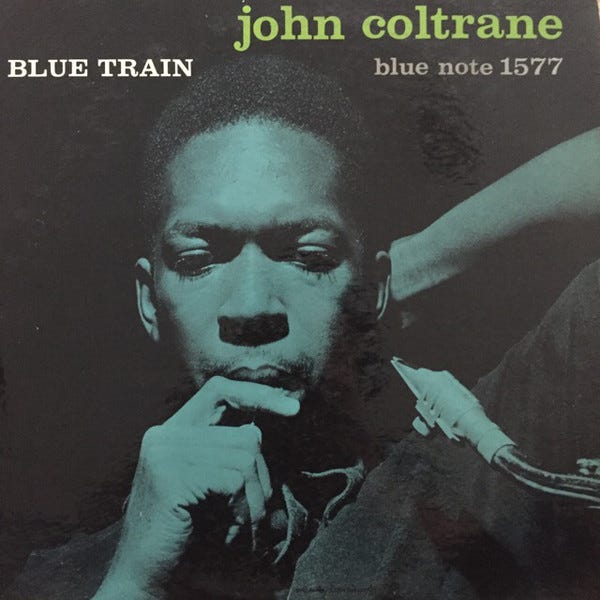
Blue Train does not quite have classic “Coltrane changes” yet, but both “Moment’s Notice” and “Lazy Bird” are undoubtedly hypercomplex. Some believe the titles were mistakenly reversed, for the melody of what we know as “Moment’s Notice” shares a certain profile with Dameron’s “Lady Bird.” It’s fair to say that only Trane has full measure of these two new hard burbling tunes. Another B-flat blues with a bridge, “Locomotion” (it is less than a month after “Traneing In”) is not that easy for the band, either.
The sleek is represented by the title country blues, which in Miles Davis-esque fashion brings out the best in the all-stars Lee Morgan, Curtis Fuller, Kenny Drew, Paul Chambers, and Philly Joe Jones.
Coltrane’s course was clear: How was he going to balance the innovative burble of brand-new “Coltrane changes” with his innate countrified sleek?
At the end of 1957, Miles Davis toured France, playing with René Urtreger and improvising the soundtrack to the Louis Malle film Ascenseur pour l’échafaud with a nice band that included Urtreger, Barney Wilen, Pierre Michelot, and Kenny Clarke. The slower cues for the film with vulnerable trumpet over dry/sad piano chords are perfect Miles Davis noir.
1958
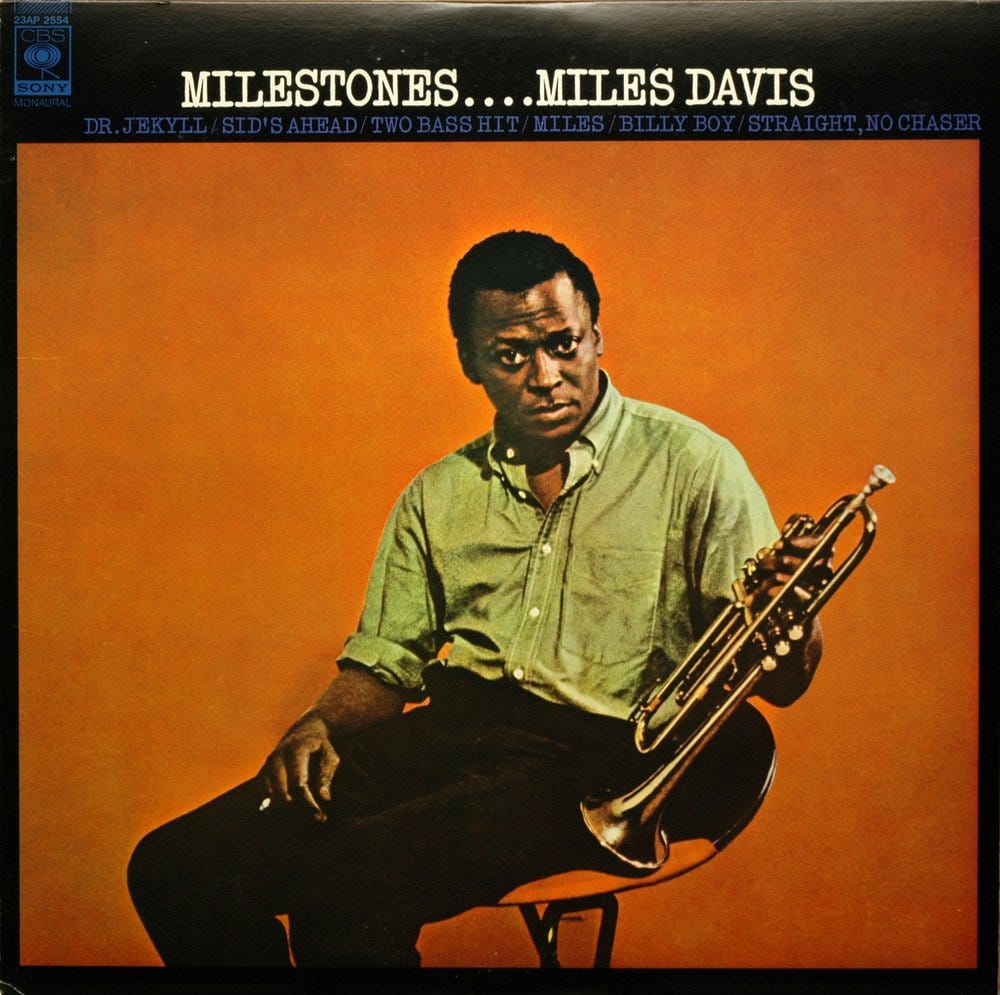
When Coltrane rejoined Miles, there was another saxophonist in the band, alto genius Cannonball Adderley. Adderley had all the chops and the bebop know-how but also a gregarious kind of preach. This cat always sounded like the blues.
Miles accepted his fate and curated a six-tune album with four of the tracks being blues. In a very real sense, Milestones is as good as it gets for the bebop blues. Miles gathers his family together in the compositional credits: Dizzy, John Lewis, Jackie McLean, Monk; the trumpeter is also the one to play crunchy piano chords on “Sid’s Ahead.”
“Straight, No Chaser” is it. Trane’s tenor solo plus Red, P.C., and Philly Joe on “Chaser” is perhaps the most swinging/searching thing in the whole discography. It’s crazy. It’s almost like there will be nothing left to discover…
…Except, of course, there’s an escape clause presented by the title track “Milestones,” where the soloists leave conventional tension and release and blow on scales. Modal jazz had been brewing for a while, but here at last was something truly charismatic and user-friendly. They all play on it comfortably with the exception of Red Garland, who only comps the material of the head and doesn’t solo. (Garland would never do anything with modal music.) There’s a lot of latin music heritage in modal jazz, and Chambers plays a beautiful Afro-Cuban bass part on the bridge.
The piano and drum chairs fluctuate for a year as the three horns and Paul Chambers stay consistent. Milestones with Red Garland and Philly Joe Jones is March ‘58. Bill Evans and Jimmy Cobb come in circa April and play a whole slew of gigs and do a bit of recording. Wynton Kelly replaces Evans late November. Evans returns for Kind of Blue in March ‘59, although Kelly plays on “Freddie Freeloader.”
Miles needed someone who could adapt to the modal concept, and he found that perfect person in Bill Evans. The first recording of Miles and Bill together was on May 1958 alongside Cannonball Adderley, John Coltrane, Paul Chambers, and Jimmy Cobb. In terms showing the way forward with modal/scalar thinking within common-practice jazz, “On Green Dolphin St.” and “Stella By Starlight” were just as important as “So What” from a year later. Both tunes were sourced from Hollywood movies released in the previous decade: Green Dolphin Street (1947) was scored by Bronislau Kaper, The Uninvited (1944, with “Stella” over the main title) by Victor Young. Both also featured notable structural factors that promoted scalar theory. “On Green Dolphin St.” offers a chromatic decent over a pedal point: each station along the way requires a new scale. The long through-composed form of “Stella by Starlight” is hard to follow by ear, and foreshadows future jazz compositions by someone like Wayne Shorter, where complex chords sit next to each other without implying a clear tonic. I suspect the harmonizations of both standards are authored by Bill Evans, although Evans’s “Stella” seems to have been influenced by the version by Chet Baker and Russ Freeman in 1954. (The Ahmad Jamal “On Green Dolphin St.” is probably why Miles played the tune, but Jamal’s harmonization is quite different.) In short order, both standards were embraced by jazzers everywhere, along with a scalar approach to harmony.
This dynamics of this music are quite different than the fierce set on Milestones. In time modal jazz would mean Coltrane intensity, but for these two standards and the upcoming Kind of Blue, the scales were light-footed and impressionistic, mainly thanks to a poet who conjured something non-percussive out of the piano. Once again, Miles changed the sound of his band based on a key sideman.
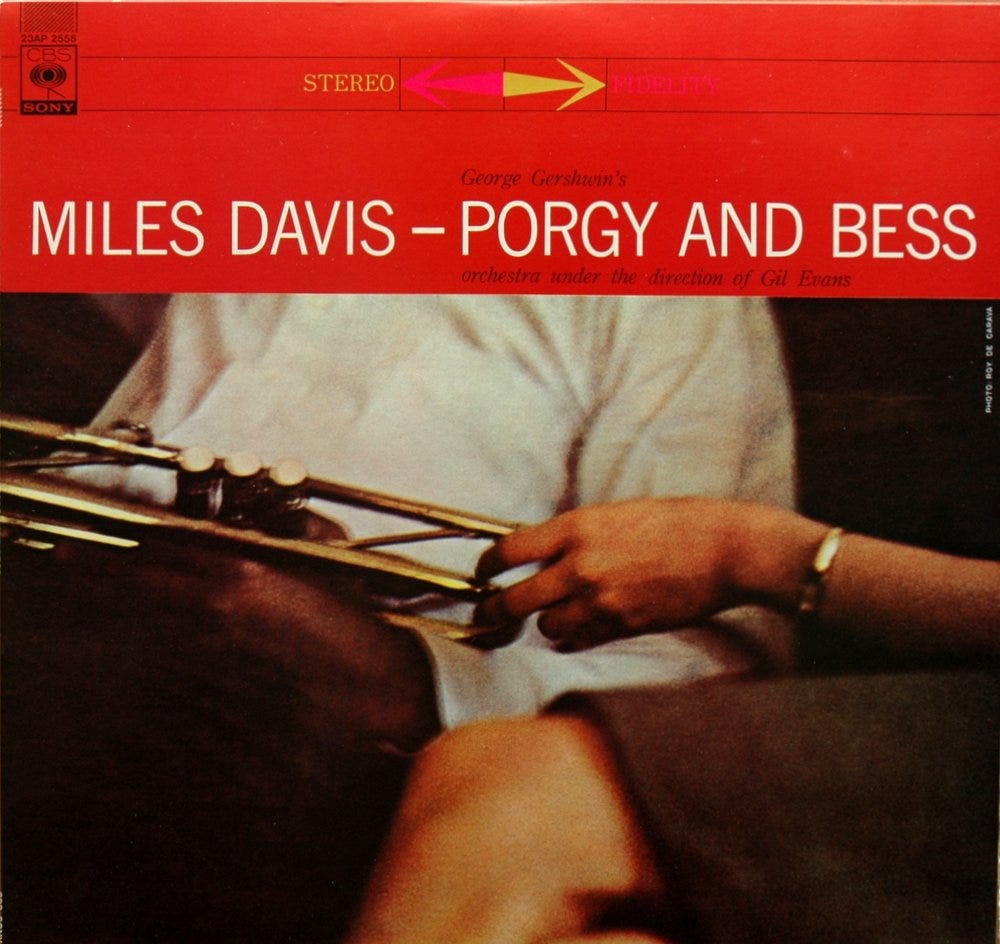
Miles Davis’s rejected the minstrel tradition wholesale. At the time it was a big deal when he didn’t smile. He even turned his back on the audience! His autobiography goes into this topic in some detail. It’s very important.
I’ve seen Porgy and Bess at the Met, and I thought it was pretty damn minstrel. Beautiful music, but bad politics. One can’t really blame George Gershwin, it was what it was. The fact that Gershwin demanded an all-black cast says a great deal of where America was at the time of the work’s premiere in 1935. 8
However, Miles liked the score, and so did Gil Evans. Together they go deep into the music and pull out amazing and unexpected emotions and effects. The Miles and Gil Porgy and Bess is a good one to listen to for the semiquincentennial. Progress is possible.
I’d like to see Porgy and Bess again…Thar’s good black artistic gold in them stereotypes, so instead of being thrown off by the crap it’s best to seek it out, learn from it, and transcend it….Because, like it or not, it is the vitality of Afro-American artistic cultural style which lends such work its interest and endurance. — Ralph Ellison to Romare Bearden in a 1986 letter
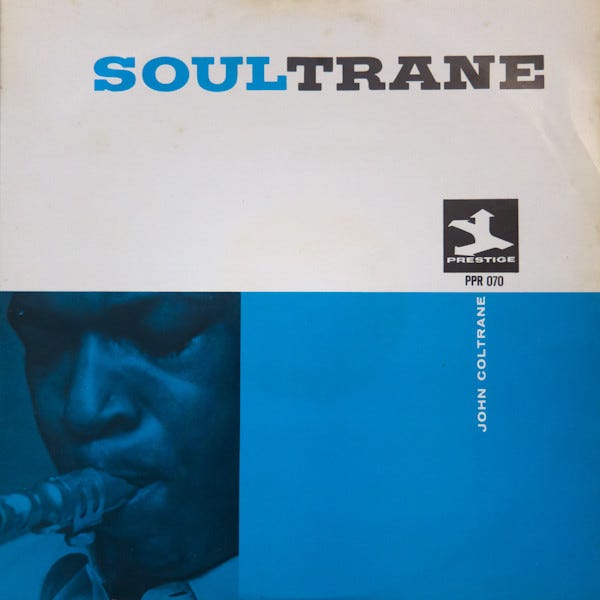
The last of the Prestige Trane albums under consideration here — again, there are many more — is Soultrane, which for my money is the best ‘50’s Trane album as a leader (which means I’m giving it the nod over Giant Steps). Red Garland, Paul Chambers, and Art Taylor were really great, and they evolved into a certain grand accompaniment for the saxophonist. The trio is bright and dark at the same time, an even keel of swing. Tadd Dameron looms large; the first tune is Dameron’s “Good Bait,” and the second is Billy Eckstine’s “I Want to Talk About You,” which was a Dameron arrangement. I speculate that the triplets in Eckstine’s 1944 melody were an influence on Trane’s own everyday convoluted phrasing. Trane would go on to play “I Want to Talk About You” a lot more in the 1960s.
The second side has one of Coltrane’s best medium straight-ahead swinging standards, “You Say You Care,” alongside a ballad sourced from the community, Fred Lacey’s “Theme for Ernie,” and closes with the amusing “Russian Lullaby.” Coltrane joked to Weinstock that the name of this uptempo flag-waver was “Rushin’ Lullaby,” but that’s not the only comedy: Garland’s portentous intro is straight out of a Looney Tunes cartoon.
1959
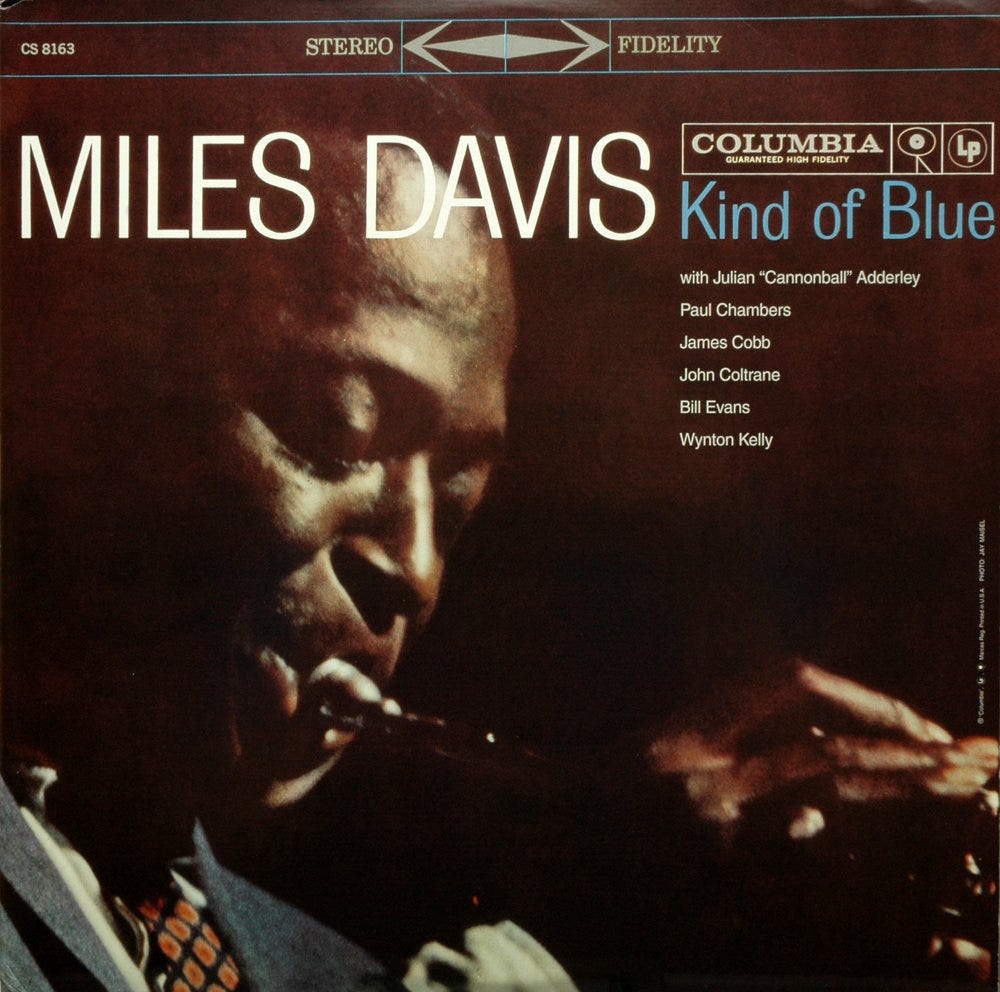
If Milestones was the final chapter on a certain bebop blues tradition, then Kind of Blue begins the modal journey, especially on the opening “So What.” The whole album has some of Miles’s greatest solos, pure melody caught on the wing. It is Bill Evans’s album as much as it is Miles’s, but Wynton Kelly steps in on “Freddie Freeloader” to deliver a flawless sermon. The title named a real person, and according to Billy Hart it is Freddie Freeloader himself who yells very loudly in the middle of a pregnant pause on the 1964 Miles Davis “Stella by Starlight” at Lincoln Center with George Coleman and Herbie Hancock.
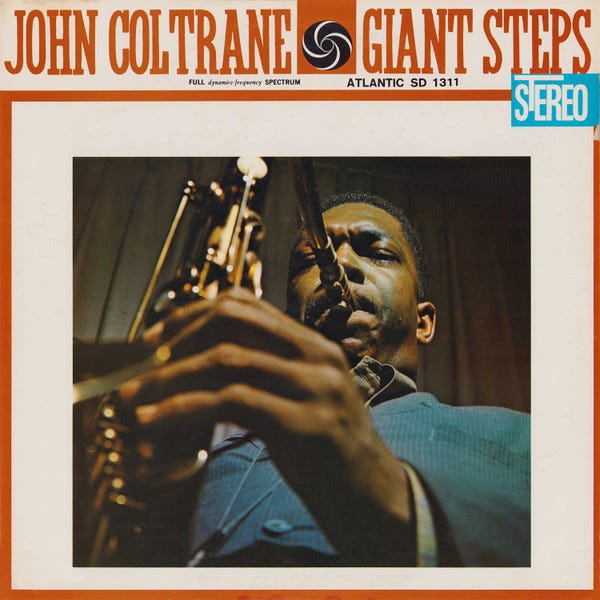
Now signed to Atlantic, Coltrane gave up on adding other horns to his new hypercomplex progressions in the manner of Blue Train and documented “Giant Steps” and “Countdown” with a quartet. Instead of Red Garland, the pianists on Blue Train and Giant Steps are Kenny Drew and Tommy Flanagan; Trane may have felt that Red was not up to the challenge. A first attempt at “Giant Steps” with Cedar Walton on piano occurred a couple months earlier.
This post began with the declaration that “musicians like burble, fans like sleek.” The musicians hungrily fell upon “Giant Steps” as if this was what they always wanted. Hod O’Brien was there at the time, and writes in Have Piano…Will Swing! that “Giant Steps” was suddenly featured in all the New York jam sessions. The great Al Cohn was a bit skeptical, and when people called “Giant Steps,” Cohn would reply, “Sure, but I have my own changes.”
Kind of Blue and Giant Steps, recorded nearly simultaneously: One is the height of sleek, one is the height of burble. However, there is one track on Giant Steps that exhibits a new synthesis, the gorgeous ballad “Naima.” This elegant set of suspended chords would directly inspire a whole generation of ‘60s jazz composers including Wayne Shorter, Herbie Hancock, Joe Henderson, Bobby Hutcherson, and Woody Shaw.
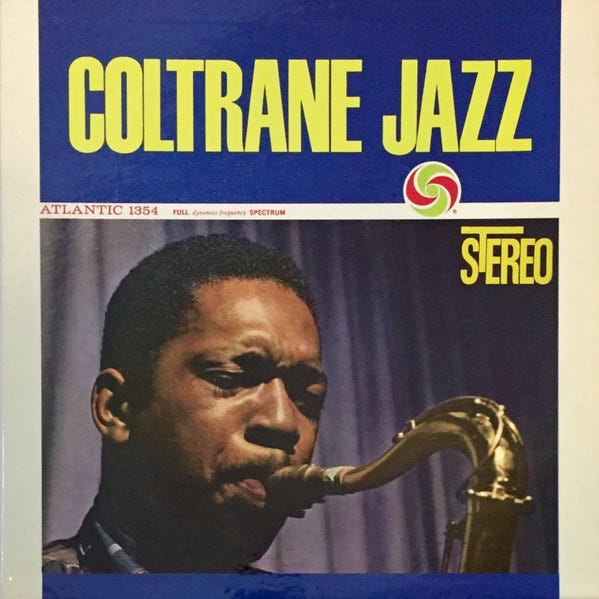
Most of Giant Steps was recorded in May with Flanagan, Chambers, and Taylor, with “Naima” being the lone track from later sessions in November and December with Wynton Kelly, Paul Chambers, and Jimmy Cobb. A parallel situation exists on Coltrane Jazz, which is mostly the November/December Kelly quartet with the exception of one tune, “Village Blues,” being from late 1960 and the new band of McCoy Tyner, Steve Davis, and Elvin Jones.
All of Coltrane Jazz is pretty great, but “Village Blues” is clearly the future. More on that new sound next year. And while Wynton Kelly is typically wonderful throughout the rest of Coltrane Jazz, I also miss Red Garland’s immutable, bell-like comping. Kelly is swinging, tasteful, and interactive. Garland was more rigorous and self-same, foreshadowing the texture that McCoy Tyner would give the Coltrane quartet in the next decade. It helped when the comping was utterly sleek, for Coltrane had so much burble on his own.
1960
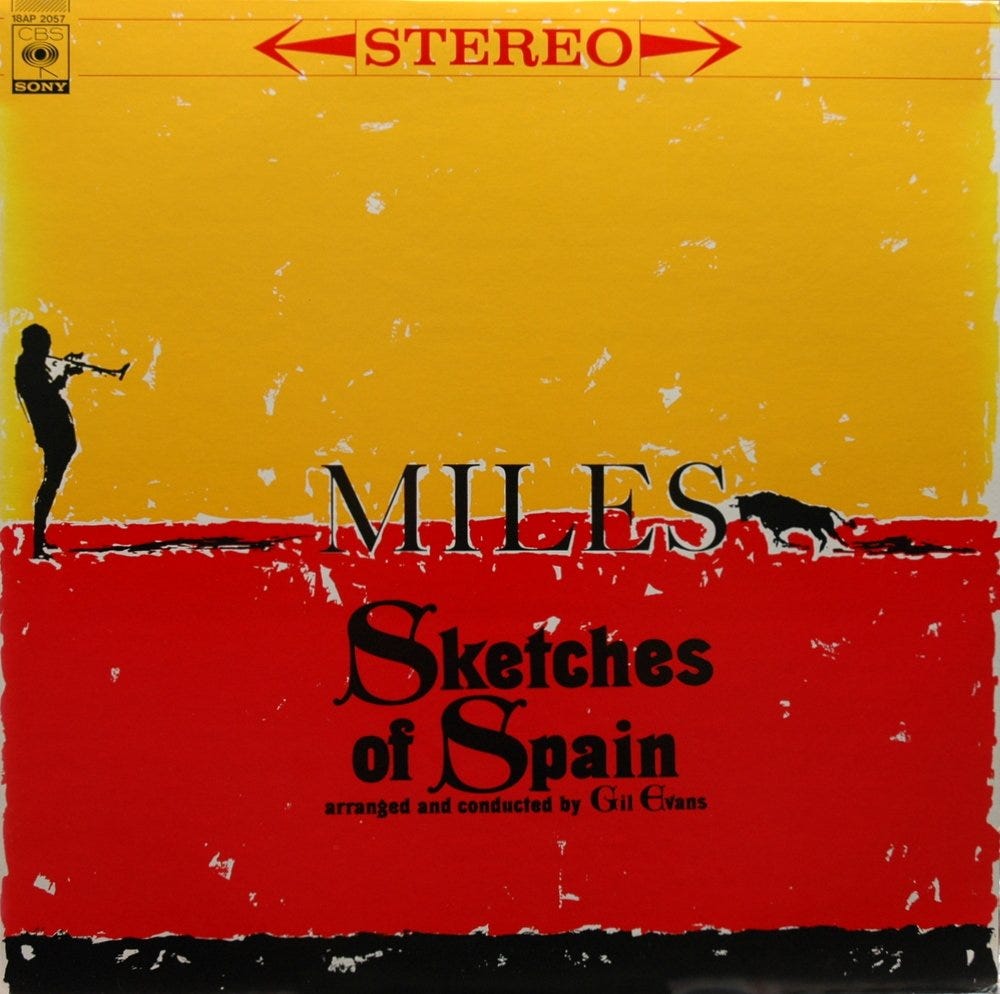
Sketches of Spain was recorded at the end of 1959 and the top of 1960. The essential track is “Saeta,” which has a kind of Charles Ives marching band collage effect, with processional drums, trumpet choir, and Miles himself mourning humanity.
I like the rest of the album also, but my current ruling is that leaving out jazz drums was a mistake. On Miles Ahead and Porgy and Bess, Art Taylor, Philly Joe Jones, and Jimmy Cobb keep some kind of order and frankly smooth out the mistakes made by the band reading challenging Gil Evans orchestrations.
It may also be a bit on the nose to do a whole album of Spanish music. On a related topic, Coltrane’s Olé and Africa/Brass are also a bit on the nose. That said, all these albums needed to be done, they are still wonderful experiments and key documents of the moment when jazz was embracing what would later be called “world music.” 9
Miles and Coltrane toured Europe together in spring of 1960. Almost every gig was recorded, and the outrageous tenor solos show Trane pulling far ahead of the band. This would be more or less the end of the great five-year partnership, although Trane peeked his head into a Miles studio session in 1961 to cut poor Hank Mobley on “Someday My Prince Will Come.” Trane isn’t trying to be competitive, it just is what it is. 10
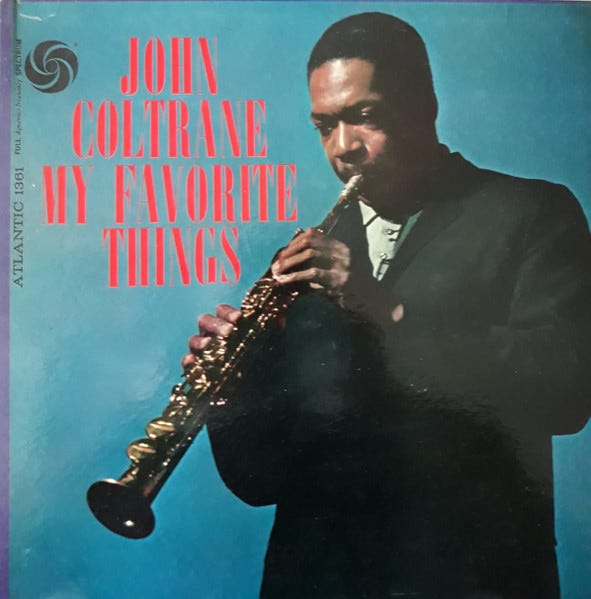
Over the course of three days in October 1960, Coltrane recorded a tremendous amount of material with his new band of McCoy Tyner, Steve Davis, and Elvin Jones. This is a parallel situation to the Miles Davis Prestige Cookin’/Relaxin’/Workin’/Steamin’ sessions, where fresh faces got the bit between their teeth and almost every take in the studio would be first releasable and then influential. In addition to more than three full albums of Coltrane sourced from October 1960, there are also two lovely trio tracks from McCoy Tyner, “Lazy Bird” and “In Your Own Sweet Way,” eventually collected on the trope-namer 1976 anthology of the big four, Chick Corea, Herbie Hancock, Keith Jarrett, McCoy Tyner.
The title track of My Favorite Things was a hit, probably because it was so different and fresh: A modal drone, a waltz, a wailing soprano saxophone. This was an early shot in the “peace and love” genre that would soon become a dominant force in commercial pop and rock. Incredibly, the label even got a hit single out of the long track: the 45 with “My Favorite Things pt. 1” and “My Favorite Things pt. 2” was found in any 1961 jukebox.
As with Kind of Blue, My Favorite Things is utterly sleek and a classic gateway album for the casual fan. The fans like modal jazz. Modal jazz is sleek.
For the first time, the rhythm section is younger than Trane, and they are eagerly bringing their own outstanding innovations to the table. 1960’s Trane is unthinkable without chiming McCoy Tyner and polyrhythmic Elvin Jones; the bassists were great too, with Jimmy Garrison coming in to complete the perfect equation in 1961. In October 1960 it is the estimable and hard-swinging Steve Davis. Davis is also part of Coltrane’s “community music” aesthetic, for the bassist was Tyner’s brother-in-law back in Philadelphia.
In addition to his bandmates, Coltrane was influenced by the new breed of avant horn players: At this time it was Ornette Coleman, later it would be Albert Ayler. In mid-1960 Trane met Don Cherry in Atlantic studios for a Coleman-inspired date, The Avant-Garde — which is perhaps not a great record for Trane, who is still digesting in the material. While neither McCoy or Elvin naturally related to the concepts of so-called “free jazz,” the open-ended, modernist, and sleek feeling of both the pianist and the drummer allowed the saxophonist to access the Ornette-to-Ayler moment within standard forms. This approach would not have worked with Red Garland and Art Taylor. Trane needed McCoy and Elvin.
Miles recorded “Summertime” on Porgy and Bess, Trane includes it on My Favorite Things. Hard to choose! There’s also Duke Ellington’s stunning trio deconstruction of “Summertime” with Aaron Bell and Sam Woodyard a year later in 1961. Duke never said, but this truly avant-garde track might have been in reaction to Civil Rights unrest — or it might have been made in anger, a rejoinder to Gershwin’s continued eclipse of Ellington as the great American composer long after Gershwin was dead. The ending of this Ellington track is truly dire.
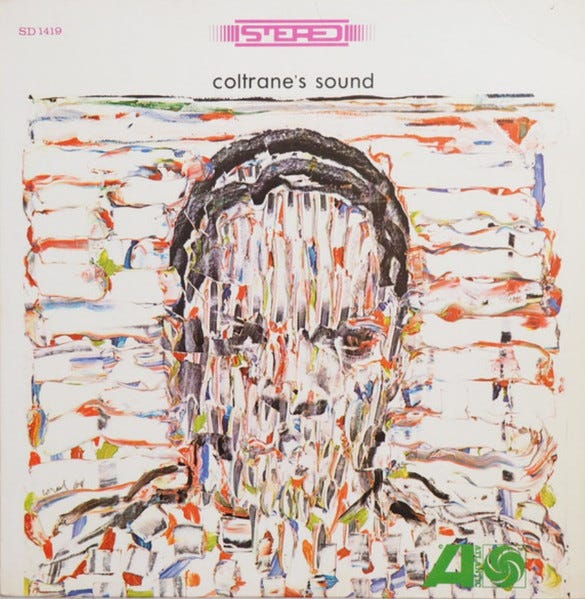
To say John Coltrane influenced future tenor players understates the matter. One of the key albums for all those later saxophonists was Coltrane’s Sound, especially “The Night Has a Thousand Eyes” and “Satellite.” Mark Turner told me that when students wanted to know how Coltrane played “out,” he told them to transcribe Trane on the pedal point sections of “The Night Has a Thousand Eyes.”
Here we have finally arrived at the endpoint of my artificial conceit of “burble and sleek.” Coltrane himself explained:
At the time I left Miles I was trying to add a lot of sequences to my solo work, putting chords to the things I was playing, and using things I could play a little more music on. It was before I formed my own group that I had the rhythm section playing these sequences forward, and I made Giant Steps with some other guys and carried the idea on into my band. But it was hard to make some things swing with the rhythm section playing these chords, and Miles advised me to abandon the idea of the rhythm section playing these sequences, and to do it only myself. — from “Conversations with Coltrane” by Val Wilmer in Jazz Journal
Miles, the king of sleek, told Coltrane, the king of burble, to keep his fast progressions on the horn but straighten out the rhythm section. It took him a minute, but then he got there: On “The Night Has a Thousand Eyes” Coltrane plays an abstract Coltrane changes over a pedal point. That was it. That was the answer. The future was assured. 11
It must be said the 1960 rhythm section is also sounding far more relaxed than their forebears while playing literal Coltrane changes on “Satellite,” “26-2,” “But Not For Me.” But this would essentially conclude that kind of preplanned oblique bass motion within the Coltrane quartet, although Coltrane changes in the bass do appear on the occasional later versions of “Body and Soul.” (The 1965 performance of “Body and Soul” in Seattle is essential.)
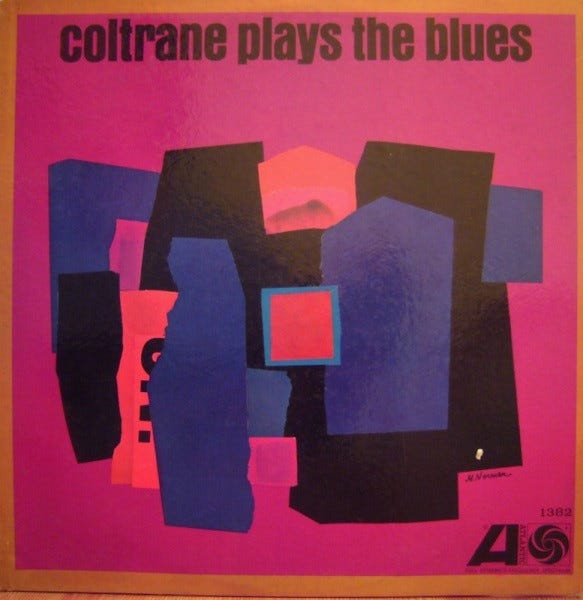
The general fans liked My Favorite Things, while the tenor players liked Coltrane’s Sound. However, my personal favorite from October 1960 is that direct and passionate statement of the truth, Coltrane Plays the Blues.
I proposed Porgy and Bess for a Miles semiquincentennial listen, and for Trane I propose Coltrane Plays the Blues. There’s nothing more American than the blues, and there’s also nothing more American than relentless expansion of a hallowed tradition (such as the blues).
The titles were undoubtedly casual, but they also speak to larger project: “Blues to Bechet” honors a revered forebear, “Blues to Elvin” honors a new creator, and “Blues to You” honors…
…well…
I guess “Blues to You” honors all of us. Ain’t that democratic?
Thanks to Mark Stryker and Lewis Porter for help with this post.
To be clear, Sonny Stitt and Clifford Brown are also great.
Oscar Pettiford is one of the greatest, of course. One of my favorite bass performances is on Thelonious Monk Plays Duke Ellington; another particularly excellent LP for Pettiford is Sonny Rollins Freedom Suite.
‘Round About Midnight was released March 1957, Cookin’ July ‘57.
Almost certainly Garland is following Miles’s direction, for Garland never played a la Tristano this way on his own gigs. This “Red Tristano” character also appears on “Well You Needn’t” on the next record. In time, Herbie Hancock would do the same thing for several solos on Miles Smiles.
The best track on Mating Call is “On a Misty Night,” Trane plays the melody with a perfect soulful cry, and this tune would go on to be the “straight ahead” number in the Pharoah Sanders band book circa ‘70’s and ‘80s.
The "Dameron turnaround” of “Lady Bird” starts C, E-flat, A-flat; “Giant Steps” starts a half-step lower, B, D, G.
Tadd Dameron lived on Central Park West, and I speculate that the later Coltrane composition “Central Park West” is another veiled Coltrane tribute to Dameron. The piece certainly has II/Vs that march along like Dameron!
Apparently bassist Al Hall was the first black musician allowed in the pit of a Broadway show at the late date of 1946. Context: both Miles and Trane were already 20 years old.
The most successful “world music” track is “India” live at the Vanguard in 1961, with minimal Tyner comping, two avant bassists, and Elvin swinging like crazy.
In an intriguing minority opinion, Charlie Haden told me that he preferred Hank Mobley to Trane on “Someday My Prince Will Come.” “Hank Mobley gives you hope!” Charlie exclaimed. However, I have also heard that if you wanted to start Mobley on a bender, all you needed to do was bring up “Someday My Prince Will Come.”
“Fifth House” on Coltrane Jazz with Wynton Kelly also has Coltrane changes over a pedal point, but piano harmonies are either omitted or literal. On “The Night Has a Thousand Eyes” the Coltrane changes just happen or not in the casual welter of improvised horn lines; McCoy stays (or not, it doesn’t matter).
great piece Ethan. Much to think about - sleek and burble, etc.
Also a heartbreakingly apropos Hunter Thompson quote.
(Brought to mind a more widely known HT observation, quite a bit ligher but with a dark truth in it:
“The music business is a cruel and shallow money trench, a long plastic hallway where thieves and pimps run free, and good men die like dogs. There's also a negative side.”)
Thanks for this insightful and thorough piece.