
GUEST POST: The Greatest Ever is Gone: Reflections on Sonny Rollins and a Desert Island List of Recordings
By Mark Stryker
(Few know Sonny Rollins like Mark Stryker does. It is an honor to host Mark’s memorial here. — e.i.)
Almost exactly 10 years ago to the day, I wrote this: “In the last month the world has lost two of the three men I admired most on the planet: Sheldon Stryker (my father) and Muhammad Ali. Whoever is running this fucking circus better be taking damn good care of Sonny Rollins.”
Getting an extra decade of Sonny, who died Monday at 95, has, of course, been a gift for which we should all be eternally grateful. Yet I am still devastated by this news. With due respect to the many masters we have lost in recent years, this one is different. More difficult. More momentous. More foreboding. More depressing. Sonny was not only the last of the line descended directly from Charlie Parker’s rib but also the greatest improviser of them all – the absolute essence of the art form: Truth, Justice, and the Blues.
And he modeled an extraordinary life dedicated to the quest for self-improvement, of digging as deeply as possible to see how much more there was to discover, not only about music but about himself. Every time I spoke with him, I learned something about music and life, and he frequently offered me a peek into a veiled corner of jazz history that he had witnessed firsthand, and which remains hidden from view, certainly not in the history books. On a personal note, he said some touchingly gracious things to me in our final conversation late last year that I will cherish forever.
Even before Sonny stopped performing in public in 2012, he had entered a state of grace. A mythical figure in jazz since 1959, when he famously walked away from the limelight for two years of intense study and marathon practice sessions atop the Williamsburg Bridge, Rollins in recent decades evolved into a sage and symbol. He represented the centrality of jazz within American culture and the creative potential of the individual in any human endeavor. No matter what awfulness you woke up to in the morning news, knowing that Sonny Rollins was on the scene made you feel as if our better angels still had a fighting chance.
Jazz will soldier on -- the music will ALWAYS soldier on; but the universe has irrevocably shifted. Sonny’s death creates a hole that will never be filled, a canyon, in fact, that will only grow ever more gaping, mysterious, and unfathomable in the coming years and decades to come.
Back in 2019, Ethan conducted a long two-part interview with me when my book, Jazz from Detroit, was published. We focused on saxophonists in Part 2, and Ethan’s query about Rollins prompted the following exchange.
MS: Greatest improviser ever and my biggest hero of all. I was hanging out once with the trombonist and new-music improviser Jim Staley in Urbana, and he was talking about two basic kinds of jazz soloists. He said there were “editors” and “improvisers.” The first group are people who essentially play what they practice. They are basically lick and pattern players like, say, a Sonny Stitt or Michael Brecker. They move stuff around, but what comes out of their horns is mostly stuff they’ve played before in some fashion. True improvisers, on the other hand, are people who on a consistent basis conjure things out of the language that they’ve never played before. Of course, the lines are blurry in real life. Many players are somewhere in the middle, and people might fall into one camp or the other at different times. But I’ve always found this a valuable prism through which to think about improvisation. No one can spend 100% of their time in the zone of pure, spontaneous creation. But Sonny has spent more time in that zone than anyone else, and that’s why he’s the greatest. I also think he’s the greatest chord change player ever — not because he’s the best at navigating complex harmonic mazes, but because nobody is better at playing standard song forms. It’s the essence of the art form.
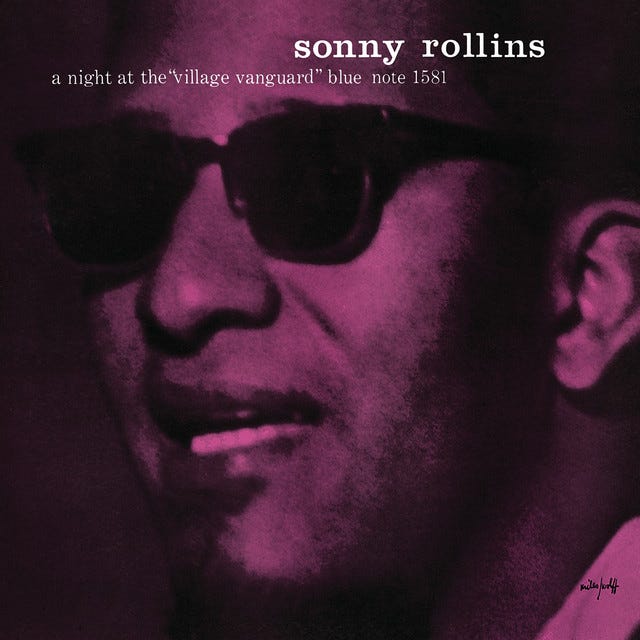
Sonny Rollins and a good trio — that’s as solid a definition of jazz as there is. The authority of A Night at the Village Vanguard or The Standard Sonny Rollins makes a lot of fine jazz musicians sound like relative beginners. When Sonny is on, there’s such a dazzling flow of melodic and rhythmic invention, rhyme, surprise, and so many levels of humor, intellectual acumen and expressive emotion. The organic way his ideas develop creates webs of thematic relationships and even lay listeners can sense how everything hangs together. The rhythmic freedom and sheer variety of phrasing are unmatched. I love how he plays with time, creating feelings of suspension; there are moments when he hovers somewhere between single-time and double-time and seems to defy physics, bending the time-space continuum. His sound has a kind of chiseled muscularity, particularly after The Bridge, and he manipulates his tone in myriad ways. And something that took me a long time to understand was the virtuosity of his articulation and how he’s also improvising with how he attacks each note, really popping some to drive the music forward and create more swing.
EI: Do you have a favorite period?
MS: I often say that if I could do anything, it would be to play like Sonny Rollins on a good night in 1965. That’s the ultimate, plus A Night at the Village Vanguard from 1957 — my all-time favorite jazz record. “Old Devil Moon” and “Striver’s Row!”
EI: To get that music in 1965 you kind of need to go to bootlegs, right? Not the studio records.
MS: Yes, although The Standard Sonny Rollins from 1964 is brilliant, top-tier Sonny. “Three Little Words” and “Love Letters” are jaw-dropping improvisations. His first entrance on “Love Letters” comes at the changes from such an odd rhythmic angle, and the opening phrases are so bewildering that he knocks you off balance. Sonny plays more shit in his first eight or 16 bars on “Love Letters” than some cats do in an entire career.
But, yes, the bootleg tapes and videos from Europe from 1965 are on a rarified plain — especially the Paris concert with Gilbert Rovere and Art Taylor, and the Copenhagen concert with Niels-Henning Orsted Pedersen and Alan Dawson. The last 3-½ minutes that Sonny plays on “Oleo” in Copenhagen is some of the purist jazz improvisation ever recorded.
I think it was easy to overlook Sonny’s genius in this period, and maybe it still is. In the mid ‘60s, Miles’ quintet was turning a corner toward Nefertiti. Trane was recording A Love Supreme and Transition and heading toward Ascension. Wayne, Herbie, Bobby Hutcherson, and Sam Rivers were recording classics on Blue Note. Ornette Coleman, Cecil Taylor, Albert Ayler, and the rest of the avant-garde were making waves. And then there’s Sonny over in the corner still playing “Three Little Words” and “Oleo.” But like Jimmie Lunceford put it: T’ain’t what you do, it’s the way that cha do it – and the way that Sonny did it remains state of the art.
I’ll tell you a quick story. I heard Sonny in Detroit about a decade ago, and I went backstage after the show to say hello. I was waiting by myself outside his dressing room while he did his long cool down. He doesn’t come out for a long time. He continues to play and rest and gradually let his consciousness return to a non-performance state. I’m standing outside his door and at a certain point I hear a piano. It was Sonny playing “Till There Was You.” He also played “Where Are You.” He played through the tunes slowly but basically in time, and he played pretty much exactly like Monk. Minor seconds, spare voicings, whole tone runs, rhythmic displacements, the whole gamut. When Sonny finally came out, the first thing I said to him was: “Is Monk in there?” That put a big grin on his face. But it made me realize something I hadn’t quite thought about before, which is that when players pick up a second instrument, they typically play like their mentors or heroes. Like when you hear Dave Liebman play drums, he plays like Elvin. Chick Corea plays good drums too, but he plays more like Roy Haynes. So, of course Sonny would approach the piano like Monk.
It has long been part-truism and part-cliché that by the early ‘60s, a gulf had opened between his uninhibited live performances and rather staid studio recordings, and that this gap grew evermore pronounced through the 1970s, ‘80s, and ‘90s. This is slippery. On the one hand, yeah, sure, of course. On the other hand, Sonny still made more than his share of great studio records, and, without relitigating the debates over his uneven Milestone discography (1972-2001), I will note that my Desert Island List and Bonus Tracks span 51 years and include studio dates from all periods, official live recordings, concert footage, private tapes, bootlegs, and even a soundcheck in Detroit that remains documented only in the ears of those who were there.
Desert Island Top 10
A Night at the Village Vanguard, Nov. 3, 1957, Blue Note. Wilbur Ware, Elvin Jones.
My all-time favorite record. Dazzling flow of spontaneous and witty melodic and rhythmic rhyme from the greatest chord-change player ever. Given a one-artist one-solo challenge for Sonny, I’m taking “Old Devil Moon,” but “Striver’s Row” (“Confirmation” changes) is right there, and so is “Sonnymoon for Two” (blues). The trio is as flexible as a rubber band. I wish this band would have stayed together. EVERYONE wishes this band had stayed together.
Paris, Nov. 4, 1965. Gilbert Rovere, Art Taylor.
The most consistently inspired of Sonny’s full concerts on film. Olympian authority understates the case as he segues from song to song, and Rovere and Taylor just try to hang on. The opening “Sonnymoon for Two” is a warmup. But then Sonny’s muse shifts into the highest gear imaginable and he soars through “I Can’t Get Started/Three Little Words/St. Thomas/There Will Never Be Another You/When I Grow to Old to Dream” with feints and parries to others. The extensive go-it-alone, unaccompanied statements transcend. Prime ‘60s Sonny – the weightier sound, blunter attack, less rococo than his ‘50s playing, stream-of-consciousness, loose rhythmic gambits at once elliptical and brusque, playing completely free inside the changes. This is how I always wanted to play.
The Standard Sonny Rollins, June 1964, RCA. Jim Hall, Bob Cranshaw, Micky Roker, Herbie Hancock etc.
Sonny’s greatest studio record unfolds not in a series of extended solos but in brief performances, mostly around three minutes, with thrilling improvisations that flash through the music like Roman candles lighting up the sky, before disappearing quickly into the night. Sometimes it’s frustrating – Sonny sounds like he could go forever on “Three Little Words,” before the quick fadeout after just over two minutes. But the content? Holy shit! He distills the entire history of jazz, from Armstrong to the avant-garde, in just three choruses. Pure, crystallized Sonny. “Love Letters” is on the same level. Pro tip: It’s about rhythm.
Newk’s Time, Sept. 9, 1957, Blue Note. Wynton Kelly, Doug Watkins, Philly Joe Jones.
Steve Lacy once told me that after Charlie Parker died, Sonny Rollins was “the champion of the world, the strongest, the most interesting, the most swinging saxophonist in the world.” Lacy could have cited this 1957 LP as proof. The rhythm section is hard bop perfection, the program ideal, and the leader gunning for bear: Sonny’s blazing ride on “Tune-Up,” the insanely inspired duet with Philly Joe’s drums on “Surrey With the Fringe on Top,” and, though the ebullient “Blues For Philly Joe” doesn’t get the ink of “Blue Seven,” Sonny’s thematic development is nearly its equal and a lot more fun.
Alfie, June 26, 1966, Impulse. Five horns and four rhythm, arranged by Oliver Nelson.
Sonny’s original score for the Michael Caine film (which means Bacharach’s title song is not included). Sonny’s long solo on the cocky, strutting “Alfie’s Theme,” one of his most enduring original compositions, tells you everything you need to know about jazz improvisation and the saxophone. Just the gale force of air he’s pushing through the horn to get the sound he does here is from another planet, and, to paraphrase my friend and fellow saxophonist Jim Sangry, nobody had ever thought like this, much less played like this, before or since. Alfie is also one of Sonny’s most fully realized LPs.
The Sound of Sonny, June 11, 1957, Riverside. Sonny Clark, Percy Heath or Paul Chambers, Roy Haynes.
Often overlooked, this sweetheart of a record finds Sonny sounding both relaxed and frisky – and often very funny. Dig his jaunty articulation and stop-time on “The Last Time I Saw Paris,” the curlicue phrasing on “Mangoes,” the sardonic reclamation of the hoary “Toot Toot Tootsie.” The stunning a cappella version of “It Could Happen to You” is the template of a million cadenzas to come. (Forty years ago, I would ape this version of “It Could Happen to You” by playing my own a cappella version on gigs.) Pianist Sonny Clark’s clever comping and liquid phrasing make a strong impression, and Roy Haynes brings the snap-crackle.
Saxophone Colossus, June 22, 1956, Prestige. Tommy Flanagan, Doug Watkins, Max Roach.
Sonny’s most widely known LP and for good reason: It marries the highest level of his spontaneous creation with a storyteller expression that speaks to any listener, from jazz newbies to the hippest of the hip. Five bangers in a row: the debut of the irresistible ur-calypso “St. Thomas,” the emotionally deep “You Don’t Know What Love Is,” the speedy, quintessential minor bebop of “Strode Rode,” the playful and ingenious rhyming phrases on “Moritat” (“Mack the Knife”), and the much-analyzed “Blue 7.” So why not a higher ranking? Well, as great as Roach is, he’s a bit stiff at times and not always the best match for Flanagan and Watkins. (Roach’s solos are aces.) I haven’t picked up my alto in decades, but I could still play chunks of Sonny’s solo on “St. Thomas.”
Now’s The Time, Jan-Feb 1964, RCA. Herbie Hancock, Ron Carter, Roy McCurdy; or Thad Jones, Bob Cranshaw, McCurdy.
This collection of classic jazz originals is about (a) the pleasure of hearing top-shelf Sonny with Hancock and Carter; (b) a one-track glimpse of a tantalizing, what-might-have-been working quartet with Thad Jones, whose spontaneity and bent for thematic improvising would have been a fantastic foil for Sonny; and (c) the sheer expressive strength and power of Sonny’s booming tone, as chiseled as Superman’s muscles. If God ever picked up the tenor, He would sound like this. Favorite track: John Lewis’ immortal “Afternoon in Paris,” where Sonny begins toying with the theme in the second “A” section and morphs slyly into improvising on the last “A.” He doesn’t even play a full solo chorus, but the quartet’s performance is so fulsome, so complete, that it steals the record at just 2 minutes and 43 seconds.
Newport Jazz Festival, July 7, 1963, radio broadcast. Coleman Hawkins, Paul Bley, Henry Grimes, Roy McCurdy.
A 38-minute set, three standards: “Remember,” “All the Things You Are,” “The Way You Look Tonight.” A more rewarding tete-a-tete than the studio record Sonny Meets Hawk made about a week later. On the record, Sonny’s avant-garde contrariness sounds willful and halting, but here he’s in the flow – loose, unfettered, free. Sans Hawkins, Sonny slays “Remember” with stabs of concentrated rhythm and stuttering echoes of Berlin’s melody; the percussive thwack of his articulation ricochets off McCurdy’s invigorating chatter. Hawk, always up for adventure, sounds more confident in this environment than the critical discourse typically suggests. Bley and Grimes are perfect fits for Sonny’s freely conceived and beguiling way of abstracting standard tunes in 1962-63.
Old Flames, July-Aug. 1993, Milestone. Clifton Anderson, Tommy Flanagan, Bob Cranshaw, Jack DeJohnette, brass quartet arranged by Jimmy Heath on two songs.
Has anyone in jazz ever loved playing standards more than Sonny Rollins? Listen to the care, caress, and tasteful ornaments he brings to phrasing the melodies throughout this set of mostly Great American Songbook staples; the romantic tenderness of his tone; and the way his improvisations bloom in heartfelt expression. “Darn that Dream,” one of two tracks with a brass quartet, is as gorgeous as anything in Rollins’ recorded canon. The short cadenza is a beaut, bringing tears to my eyes every time I hear it.
Bonus Tracks
1. “If Ever I Would Leave You” (What’s New), RCA, April 19, 1962. An extended masterpiece of vivacious thematic improvisation and a sui generis take on the bossa nova craze -- Sonny’s articulation pops like he’s sticking a drum set and melodies emerge as naturally as breathing
2. “Oleo,” Copenhagen, Oct. 31, 1965. From one of Sonny’s finest filmed performances, with Niels-Henning Orsted Pedersen and Alan Dawson. An endless flow of ideas and total control over the horn – overtones! The 3-½ minutes of Sonny’s solo starting eight bars after trading with the drums and ending with NHOP’s bass solo might be the most supernatural burst of jazz improvisation I have ever heard.
3. “There’s No Business Like Show Business” (Work Time), Dec. 2, 1955, Prestige. Sonny’s return to the scene after laying low in Chicago and kicking his drug habit opens with this wild romp. The humorous, staccato punch of Sonny’s first entrance and the flexibility with which he toys with the tune at a supersonic tempo served notice: The Boss is back!
4. “The Freedom Suite” (Freedom Suite), March 7, 1958, Riverside. The organic four-movement suite, a reflection of the nascent Civil Rights Movement, is Sonny’s most impressive compositional achievement. The focused concentration and thematic improvising of the unified trio – Oscar Pettiford and Max Roach at their best – shapes a major statement.
5. “Three Little Words,” Copenhagen, Sept. 6, 1968. At 32 minutes, the most epic version of Sonny’s defining anthem of the 1960s. Sonny solos for 17 minutes straight, then trades 4s with drummer Tootie Heath for another nine minutes, without ever running out of steam or ideas.
6. “Best Wishes” (Road Shows Vol. 1), May 25, 1986, Doxy. A stunner. The most exciting track issued in the four Road Show volumes. Sonny’s fetching 12-bar form yields nine minutes of uninterrupted brilliance; he never ditches the melody, spinning endless variations off its basic riffs. The late Al Foster’s splashy, aggressive swing and unique sound show you why he was a Sonny favorite.
7. “Lover,” Village Gate, July 28, 1962, RCA. The three pieces that comprise the celebrated Our Man in Jazz were drawn from 6-½ hours of material, much of it (including this track) either more compelling or more experimental than what made the original record. A tour de force, “Lover” finds Sonny sprinting through the descending chromatic harmony for 18 minutes without ever giving up the baton, balancing form and abstraction. With Don Cherry, Bob Cranshaw, Billy Higgins.
8. “Misterioso” (Sonny Rollins Vol. 2), April 14, 1957. Blue Note. Monk was one of Sonny’s gurus. This classic blues represents the last time they recorded together. Sonny plays a fantasia on the blues and Monk tosses gutbucket shards at him. Both Monk and Horace Silver solo on the same track.
9. “First Moves” (The Cutting Edge), July 6, 1974 (Milestone). Sonny’s most convincing entry in the fusion idiom. The heavy funk groove and simple harmony offer Sonny room to roam, which he does while keeping the main riff of the tune front and center. Bob Cranshaw on electric bass and underrated drummer David Lee lay it down.
10. “I’ll Be Seeing You,” Montreal Jazz Festival, June 1982. A lightning strike of inspiration: The 5+ minutes of trading 4s with Jack DeJohnette in his early prime produces some of the purest bebop lines from Sonny post-1968 that I know. Go, go, go!
11. “Little Girl Blue” (Falling in Love with Jazz), August 5, 1989, Milestone. An alternatingly gruff and vulnerable reading of a Rodgers and Hart ballad from one of Sonny’s most satisfying Milestone recordings.
12. “Confirmation,” Sutherland Lounge, Chicago, July 1959. An amazing tape of Sonny stretching out on Charlie Parker’s “Confirmation” for 26 minutes with a young Freddie Hubbard and Chicagoans Jodie Christian, Victor Sproles, and Wilbur Campbell. They start fast and get faster, and Sonny plays a zillion choruses, before Freddie plays exactly one (!) and they go out. Sonny’s sound, stamina, rhythmic obsessions, and phrasing foreshadow his post-Bridge style – he’s already shedding his skin, prepping for the 1960s.
Encore: “Three Little Words,” Music Hall Center for the Performing Arts, Detroit, Oct. 13, 2007. Sonny played Detroit often, and on this occasion, I slipped into the afternoon soundcheck. Sonny walked on stage playing “Three Little Words” without a mic and, swear to God, time-warped back to 1965. He played two minutes or so of breathtaking, bebop-inspired linear melodies filled with clever rhythm and rhyme and with, more or less, his pre-1972 tone. It was thrilling beyond belief, even surreal. There’s no tape, so you’ll have to take my word for it; but I was there and I’ll never forget it as long as I live.
— Mark Stryker
Mark Stryker is the writer and co-producer of the 2025 documentary film The Best of the Best: Jazz from Detroit (streaming on Prime Video, YouTube, Google Play, and Tubi) and the author of the 2019 book Jazz from Detroit (University of Michigan Press).
Wow. Thank you!
Lovely